






by Or Benson
Copyright © 2021
Jimi Hendrix

Copyright © 2021
James Marshall “Jimi” Hendrix (born Johnny Allen Hendrix; November 27, 1942 – September 18, 1970) was an American musician, singer, and songwriter. Although his mainstream career spanned only four years, he is widely regarded as one of the most influential electric guitarists in the history of popular music, and one of the most celebrated musicians of the 20th century. The Rock and Roll Hall of Fame describes him as “arguably the greatest instrumentalist in the history of rock music”.
Born in Seattle, Washington, Hendrix began playing guitar at the age of 15. In 1961, he enlisted in the US Army but was discharged the following year. Soon afterward, he moved to Clarksville, Tennessee, and began playing gigs on the chitlin’ circuit, earning a place in the Isley Brothers backing band and later with Little Richard, with whom he continued to work through mid-1965. He then played with Curtis Knight and the Squires before moving to England in late 1966 after bassist Chas Chandler of the Animals became his manager. Within months, Hendrix had earned three UK top ten hits with the Jimi Hendrix Experience: “Hey Joe”, “Purple Haze”, and “The Wind Cries Mary”. He achieved fame in the US after his performance at the Monterey Pop Festival in 1967, and in 1968 his third and final studio album, Electric Ladyland, reached number one in the US. The double LP was Hendrix’s most commercially successful release and his first and only number one album. The world’s highest-paid performer, he headlined the Woodstock Festival in 1969 and the Isle of Wight Festival in 1970 before his accidental death in London from barbiturate-related asphyxia on September 18, 1970.
Hendrix was inspired by American rock and roll and electric blues. He favored overdriven amplifiers with high volume and gain and was instrumental in popularizing the previously undesirable sounds caused by guitar amplifier feedback. He was also one of the first guitarists to make extensive use of tone-altering effects units in mainstream rock, such as fuzz distortion, Octavia, wah-wah, and Uni-Vibe. He was the first musician to use stereophonic phasing effects in recordings. Holly George-Warren of Rolling Stone commented: “Hendrix pioneered the use of the instrument as an electronic sound source. Players before him had experimented with feedback and distortion, but Hendrix turned those effects and others into a controlled, fluid vocabulary every bit as personal as the blues with which he began.
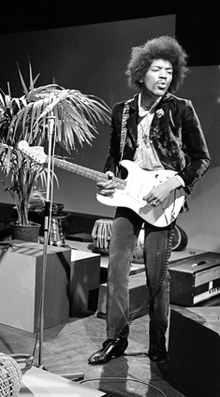
Ancestry and childhood
Jimi Hendrix’s mixed genealogy included African American, Irish, and Cherokee ancestors. His paternal grandmother, Zenora “Nora” Rose Moore, was African American and one-quarter Cherokee.Hendrix’s paternal grandfather, Bertran Philander Ross Hendrix (born 1866), was born out of an extramarital affair between a woman named Fanny and a grain merchant from Urbana, Ohio, or Illinois, one of the wealthiest men in the area at that time. After Hendrix and Moore relocated to Vancouver, they had a son they named James Allen Hendrix on June 10, 1919; the family called him “Al”.
In 1941, after moving to Seattle, Al met Lucille Jeter (1925–1958) at a dance; they married on March 31, 1942. Lucille’s father (Jimi’s maternal grandfather) was Preston Jeter (born 1875), whose mother was born in similar circumstances as Bertran Philander Ross Hendrix.[12] Lucille’s mother, née Clarice Lawson, had African American and Cherokee ancestors. Al, who had been drafted by the US Army to serve in World War II, left to begin his basic training three days after the wedding. Johnny Allen Hendrix was born on November 27, 1942, in Seattle; he was the first of Lucille’s five children. In 1946, Johnny’s parents changed his name to James Marshall Hendrix, in honor of Al and his late brother Leon Marshall.
Stationed in Alabama at the time of Hendrix’s birth, Al was denied the standard military furlough afforded servicemen for childbirth; his commanding officer placed him in the stockade to prevent him from going AWOL to see his infant son in Seattle. He spent two months locked up without trial, and while in the stockade received a telegram announcing his son’s birth. During Al’s three-year absence, Lucille struggled to raise their son. When Al was away, Hendrix was mostly cared for by family members and friends, especially Lucille’s sister Delores Hall and her friend Dorothy Harding. Al received an honorable discharge from the US Army on September 1, 1945. Two months later, unable to find Lucille, Al went to Berkeley, California, home of a family friend named Mrs. Champ, who had taken care of and had attempted to adopt Hendrix; this is where Al saw his son for the first time.
After returning from service, Al reunited with Lucille, but his inability to find steady work left the family impoverished. They both struggled with alcohol, and often fought when intoxicated. The violence sometimes drove Hendrix to withdraw and hide in a closet in their home. His relationship with his brother Leon (born 1948) was close but precarious; with Leon in and out of foster care, they lived with an almost constant threat of fraternal separation. In addition to Leon, Hendrix had three younger siblings: Joseph, born in 1949, Kathy in 1950, and Pamela, 1951, all of whom Al and Lucille gave up to foster care and adoption. The family frequently moved, staying in cheap hotels and apartments around Seattle. On occasion, family members would take Hendrix to Vancouver to stay at his grandmother’s. A shy and sensitive boy, he was deeply affected by his life experiences. In later years, he confided to a girlfriend that he had been the victim of sexual abuse by a man in uniform. On December 17, 1951, when Hendrix was nine years old, his parents divorced; the court granted Al custody of him and Leon.

First recordings
In March 1964, Hendrix recorded the two-part single “Testify” with the Isley Brothers. Released in June, it failed to chart. In May, he provided guitar instrumentation for the Don Covay song, “Mercy Mercy”. Issued in August by Rosemary Records and distributed by Atlantic, the track reached number 35 on the Billboard chart.
Hendrix toured with the Isleys during much of 1964, but near the end of October, after growing tired of playing the same set every night, he left the band. Soon afterward, Hendrix joined Little Richard’s touring band, the Upsetters. During a stop in Los Angeles in February 1965, he recorded his first and only single with Richard, “I Don’t Know What You Got (But It’s Got Me)”, written by Don Covay and released by Vee-Jay Records. Richard’s popularity was waning at the time, and the single peaked at number 92, where it remained for one week before dropping off the chart. Hendrix met singer Rosa Lee Brooks while staying at the Wilcox Hotel in Hollywood, and she invited him to participate in a recording session for her single, which included the Arthur Lee penned “My Diary” as the A-side and “Utee” as the B-side. Hendrix played guitar on both tracks, which also included background vocals by Lee. The single failed to chart, but Hendrix and Lee began a friendship that lasted several years; Hendrix later became an ardent supporter of Lee’s band, Love.
In July 1965, Hendrix made his first television appearance on Nashville’s Channel 5 Night Train. Performing in Little Richard’s ensemble band, he backed up vocalists Buddy and Stacy on “Shotgun”. The video recording of the show marks the earliest known footage of Hendrix performing. Richard and Hendrix often clashed over tardiness, wardrobe, and Hendrix’s stage antics, and in late July, Richard’s brother Robert fired him. On July 27, Hendrix signed his first recording contract with Juggy Murray at Sue Records and Copa Management.[83][84] He then briefly rejoined the Isley Brothers, and recorded a second single with them, “Move Over and Let Me Dance” backed with “Have You Ever Been Disappointed”.[85] Later that year, he joined a New York-based R&B band, Curtis Knight and the Squires, after meeting Knight in the lobby of a hotel where both men were staying. Hendrix performed with them for eight months. In October 1965, he and Knight recorded the single, “How Would You Feel” backed with “Welcome Home”. Despite his two-year contract with Sue, Hendrix signed a three-year recording contract with entrepreneur Ed Chalpin on October 15.While the relationship with Chalpin was short-lived, his contract remained in force, which later caused legal and career problems for Hendrix. During his time with Knight, Hendrix briefly toured with Joey Dee and the Starliters, and worked with King Curtis on several recordings including Ray Sharpe’s two-part single, “Help Me”.Hendrix earned his first composer credits for two instrumentals, “Hornets Nest” and “Knock Yourself Out”, released as a Curtis Knight and the Squires single in 1966.
Feeling restricted by his experiences as an R&B sideman, Hendrix moved in 1966 to New York City’s Greenwich Village, which had a vibrant and diverse music scene. There, he was offered a residency at the Cafe Wha? on MacDougal Street and formed his own band that June, Jimmy James, and the Blue Flames, which included future Spirit guitarist Randy California. The Blue Flames played at several clubs in New York and Hendrix began developing his guitar style and material that he would soon use with the Experience. In September, they gave some of their last concerts at the Cafe au Go-Go, as John Hammond Jr.’s backing group.
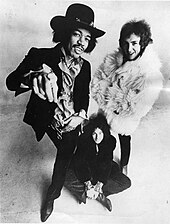
UK success
In mid-October 1966, Chandler arranged an engagement for the Experience as Johnny Hallyday’s supporting act during a brief tour of France. Thus, the Jimi Hendrix Experience performed their first show on October 13, 1966, at the Novelty in Evreux.They enthusiastically received a 15-minute performance at the Olympia theatre in Paris on October 18 marks the earliest known recording of the band. In late October, Kit Lambert and Chris Stamp, managers of the Who, signed the Experience to their newly formed label, Track Records, and the group recorded their first song, “Hey Joe”, on October 23.[“Stone Free”, which was Hendrix’s first songwriting effort after arriving in England, was recorded on November 2.

In mid-November, they performed at the Bag O’Nails nightclub in London, with Clapton, John Lennon, Paul McCartney, Jeff Beck, Pete Townshend, Brian Jones, Mick Jagger, and Kevin Ayers in attendance. Ayers described the crowd’s reaction as stunned disbelief: “All the stars were there, and I heard serious comments, you know ‘shit’, ‘Jesus’, ‘damn’ and other words worse than that.”The performance earned Hendrix his first interview, published in Record Mirror with the headline: “Mr. Phenomenon”. “Now hear this … we predict that [Hendrix] is going to whirl around the business like a tornado”, wrote Bill Harry, who asked the rhetorical question: “Is that full, big, swinging sound really being created by only three people?” Hendrix said: “We don’t want to be classed in any category … If it must have a tag, I’d like it to be called, ‘Free Feeling’. It’s a mixture of rock, freak-out, rave, and blues”. Through a distribution deal with Polydor Records, the Experience’s first single, “Hey Joe”, backed with “Stone Free”, was released on December 16, 1966.After appearances on the UK television shows Ready Steady Go! and the Top of the Pops, “Hey Joe” entered the UK charts on December 29 and peaked at number six. Further success came in March 1967 with the UK number three hit “Purple Haze”, and in May with “The Wind Cries Mary”, which remained on the UK charts for eleven weeks, peaking at number six.On March 12, 1967, he performed at the Troutbeck Hotel, Ilkley, West Yorkshire, where, after about 900 people turned up (the hotel was licensed for 250) the local police stopped the gig due to safety concerns.
On March 31, 1967, while the Experience waited to perform at the London Astoria, Hendrix and Chandler discussed ways in which they could increase the band’s media exposure. When Chandler asked journalist Keith Altham for advice, Altham suggested that they needed to do something more dramatic than the stage show of the Who, which involved the smashing of instruments. Hendrix joked: “Maybe I can smash up an elephant”, to which Altham replied: “Well, it’s a pity you can’t set fire to your guitar”. Chandler then asked road manager Gerry Stickells to procure some lighter fluid. During the show, Hendrix gave an especially dynamic performance before setting his guitar on fire at the end of a 45-minute set. In the wake of the stunt, members of London’s press labeled Hendrix the “Black Elvis” and the “Wild Man of Borneo”.
Hendrix entered a small club in Clarksville, Tennessee, in July 1962, drawn in by live music. He stopped for a drink and ended up spending most of the $400 that he had saved during his time in the Army. “I went in this jazz joint and had a drink,” he explained. “I liked it and I stayed. People tell me I get foolish, good-natured sometimes. Anyway, I guess I felt real benevolent that day. I must have been handing out bills to anyone that asked me. I came out of that place with sixteen dollars left.”Alcohol eventually became “the scourge of his existence, driving him to fits of pique, even rare bursts of atypical, physical violence”.
Roby and Schreiber assert that Hendrix first used LSD when he met Linda Keith in late 1966. Shapiro and Glebbeek, however, assert that Hendrix used it in June 1967 at the earliest while attending the Monterey Pop Festival.[274] According to Hendrix biographer Charles Cross, the subject of drugs came up one evening in 1966 at Keith’s New York apartment. One of Keith’s friends offered Hendrix acid, a street name for LSD, but Hendrix asked for LSD instead, showing what Cross describes as “his naivete and his complete inexperience with psychedelics”.Before that, Hendrix had only sporadically used drugs, experimenting with cannabis, hashish, amphetamines, and occasionally cocaine. After 1967, he regularly used cannabis, hashish, LSD, and amphetamines, particularly while touring. According to Cross, “few stars were as closely associated with the drug culture as Jimi”.
Drug abuse and violence
When Hendrix drank to excess or mixed drugs with alcohol, often he became angry and violent. His friend Herbie Worthington said Hendrix “simply turned into a bastard” when he drank. According to friend Sharon Lawrence, liquor “set off a bottled-up anger, a destructive fury he almost never displayed otherwise”.
In January 1968, the Experience traveled to Sweden to start a one-week tour of Europe. During the early morning hours of the first day, Hendrix got into a drunken brawl in the Hotel Open in Gothenburg, smashing a plate-glass window and injuring his right hand, for which he received medical treatment. The incident culminated in his arrest and release, pending a court appearance that resulted in a large fine.
In 1969, Hendrix rented a house in Benedict Canyon, California, that was burglarized. Later, while under the influence of drugs and alcohol, he accused his friend, Paul Caruso of the theft, threw punches and stones at him and chased him away from his house. A few days later Hendrix hit his girlfriend, Carmen Borrero, above her eye with a vodka bottle during a drunken, jealous rage, and gave her a cut that necessitated stitches.
Canadian drug charges and trial
Hendrix was passing through customs at Toronto International Airport on May 3, 1969, when authorities found a small amount of heroin and hashish in his luggage. Four hours later, he was formally charged with drug possession and released on $10,000 bail. He was required to return on May 5 for an arraignment hearing. The incident proved stressful for Hendrix, and it weighed heavily on his mind during the seven months that he awaited trial, which took place in December 1969. For the Crown to prove possession, they had to show that Hendrix knew that the drugs were there. During the jury trial, he testified that a fan had given him a vial of what he thought was legal medication which he put in his bag. He was acquitted of the charges. Mitchell and Redding later revealed that everyone had been warned about a planned drug bust the day before flying to Toronto; both men also stated that they believed that the drugs had been planted in Hendrix’s bag without his knowledge.
Death, post-mortem, and burial

Details are disputed concerning Hendrix’s last day and death. He spent much of September 17, 1970, with Monika Dannemann in London, the only witness to his final hours. Dannemann said that she prepared a meal for them at her apartment in the Samarkand Hotel around 11 p.m. when they shared a bottle of wine. She drove him to the residence of an acquaintance at approximately 1:45 a.m., where he remained for about an hour before she picked him up and drove them back to her flat at 3 a.m. She said that they talked until around 7 a.m. when they went to sleep. Dannemann awoke around 11 a.m. and found Hendrix breathing but unconscious and unresponsive. She called for an ambulance at 11:18 a.m., and it arrived nine minutes later. Paramedics transported Hendrix to St Mary Abbot’s Hospital where Dr. John Bannister pronounced him dead at 12:45 p.m. on September 18.
Coroner Gavin Thurston ordered a post-mortem examination which was performed on September 21 by Professor Robert Donald Teare, a forensic pathologist.Thurston completed the inquest on September 28 and concluded that Hendrix aspirated his own vomit and died of asphyxia while intoxicated with barbiturates. Citing “insufficient evidence of the circumstances”, he declared an open verdict. Dannemann later revealed that Hendrix had taken nine of her prescribed Vesparax sleeping tablets, 18 times the recommended dosage.
Desmond Henley embalmed Hendrix’s body which was flown to Seattle on September 29.[Hendrix’s family and friends held a service at Dunlap Baptist Church in Seattle’s Rainier Valley on Thursday, October 1; his body was interred at Greenwood Cemetery in nearby Renton, the location of his mother’s grave. Family and friends traveled in 24 limousines, and more than 200 people attended the funeral, including Mitch Mitchell, Noel Redding, Miles Davis, John Hammond, and Johnny Winter.
Jimi Hendrix is often cited as one example of an allegedly disproportionate number of musicians dying at age 27, a phenomenon referred to as the 27 Club.

Published: Apr 25, 2021
Latest Revision: Apr 25, 2021
Ourboox Unique Identifier: OB-1117869
Copyright © 2021

 Skip to content