






by Lola Nickson
Copyright © 2021
The purpose of the Pyramids of Giza

Copyright © 2021
Introduction
The pyramids of Giza are great structures that have stood for centuries until now. They came into existence as the result of several experiments with different degrees of success. They represented a development pinnacle of the imperial mortuary complex. The pyramids of Giza remained unsurpassed in heights for many centuries and continued to enthrall people due to their vast mass and construction perfection. Their correct orientation and architectural design prompted several theories regarding their origin. The builders of the pyramids of Giza integrated advanced architectural skills that could only be applied in contemporary world in the advent of great engineering knowledge. These structures symbolize the sophisticated skills that the ancient people possessed. The pyramids of Giza served various functions for the Egyptians, and their development required a significant amount of resources. The Egyptian rulers were able to provide such necessities due to the government stability and availability of wealth, acquired through trade. The structures have some conspiracies on how they were built, and they served several purposes, including social, political, and religious functions.
Pyramids’ Background
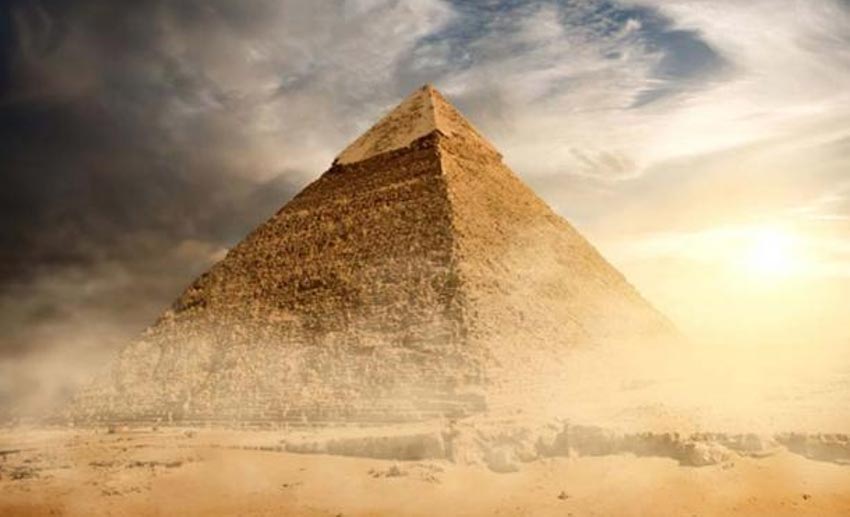
The great pyramids of Giza represent outstanding human-made constructions in the human history. Their large scale symbolizes the pharaohs’ unique role in Ancient Egypt. The construction began during the Old Kingdom to the Ptolemaic period, and the structures were meant for Khufu, or Cheops in Greek. They are located on the outskirts of modern Cairo, on the Giza plateau. The pyramid has a base of 230 meters for its sides; an average of 755.75 feet and the original height was about 481.4 feet. The great pyramids of Giza are believed to have used 2,300,000 limestone blocks. These blocks had an average weight of 2.5 tons, although some of the blocks weighed as much as 16 tons. These dimensions made the structures the world’s largest pyramid. Next to the great pyramid are the three small ones, constructed for Khufu’s queens. Therefore, the pyramids of Giza marked the epitome of human invention as they were large and tall.
Theories and Conspiracies
Several theories and conspiracies have been suggested in an attempt to explain the pyramids’ construction process. The Great Pyramid is the largest of the three and it is a symbol of great engineering works. It is believed that its construction took almost 20 years and most laborers were slaves. However, other schools of thoughts that disapprove this theory hold that many people worked for three months a year to construct the structures, particularly at the times when farming was impossible due to the river Nile floods. It is believed that construction of the Great Pyramid involved a spiral ramp that assisted in moving the heavy stone blocks up. The spiral ramp was located on the interior sides of the outer walls. Another straight external ramp enabled the builders to move materials from the ground to the top for approximately 140 feet. From that point, the workers had to drag the blocks through the rising tunnels of the interior ramp. Therefore, the construction of the Great Pyramid involved many people who worked when farming was impossible, and they used external and internal ramps to get the blocks to the top.
Several conspiracy theories consider that aliens were involved in the construction of the pyramids of Giza. The accurate alignment with compass points and the sides’ angle of the slope are precise, which provokes the reasoning that aliens had assisted the works since during that time, construction and engineering knowledge had not advanced that much. Consequently, only aliens could have achieved that development milestone. Moreover, the blocks used for building the pyramids were substantially heavy. At that time, in 2500 BC, humans lacked the advanced construction tools to construct such structures. The blocks needed a powerful machinery to move them. Therefore, aliens could have helped in building the structures by using advanced construction equipment. Thus, while several theories and conspiracy exist that attempt to explain how the Great Pyramid was built, it is evident that many people worked together under the leadership of the Pharaohs to accomplish the construction. At the same time, even aliens were believed to have contributed to the construction process.
The Purpose of the Great Pyramids of Giza
The Ancient Egyptians used the pyramids of Giza for religious purpose and conducted several functions that were related to their faith. They held several different rituals and worship activities in the pyramids at different times. The Egyptians were among the first societies that believed in the afterlife, and therefore, they started religious practices early. People sought the power from their gods in their funerary monuments such as the pyramids. To them, death did not mark the end of life but it represented another form of existence, especially for the pharaohs. Human beings, according to their beliefs, had several elements that made them up. They included ka and ba that also formed a part of the after-life belief. According to this faith, the human body was inhabited by the living being while ba was equivalent to the idea of the modern soul that represented the essence of every individual. The ka symbolized the transferred energy of life from the creator to the living beings. Consequently, the Egyptians’ belief in the afterlife compelled them, particularly the Pharaohs, to build these pyramids, where they could seek power from their gods since these structures served as worship places as well as tombs.
The great pyramids provided the place where afterlife for the powerful pharaohs begun. Upon death, Egyptians enjoyed the second-self known as ka that they believed lasted to eternity. The individuals, who passed the Osiris test, needed to enjoy a comfortable life beyond the one that they had on earth. The structures served as the grand tombs where they were mummified, and food and other supplies placed there as well. Earliest evidence suggested that Egypt had experienced a socio-religious change in thinking at the time when the construction of Giza was finished. This idea relates well with the shift in the titles given to the Pharaohs. During the completion of the pyramids, the leaders started to attach the “Ra” or “Re” prefix/suffix to their names. These names identified them with the true God, particularly the Sun god. The building brought the pharaohs close to their God due to their sacred nature and place of initiation. Thus, for people, the great pyramids marked the transition from their life on earth to the enjoyment of their second life, ka.
The great pyramids were pharaohs’ tomb after their expiry of physical life on earth, as they believed. The pharaohs were mummified and preserved in the pyramids, according to Sharp and Varavva. Their burial accompanied substantial wealth in the form of jewels and gold, and the Arab conquest later inspired many individuals to hunt for the treasures, buried with the kings. This led to the constant looting of the pyramids. At one time, treasure-hunters discovered gold coins placed and secured in columns. Such information reinforced the belief that the structures were used as tombs for the kings. The Ancient Egyptians devised unique ways of burying their leaders, particularly pharaohs, who had protections from tomb robbers. It is believed that the existence of the pyramids is traced back to the burial activities. The idea to construct superstructures, like the ones at Giza, was born out of the need to conduct burial rituals that befit their leaders. Consequently, the assertion that the pyramids of Giza served as tombs has a sufficient backing; therefore, it points to the notion that indeed, the structures served as tombs among other functions during those days in history.
The Ancient Egyptians used the great pyramids as the initiation center. The structures were considered the temple of initiation. According to the ritual called Theosophical tradition, the departed soul was viewed as following the chambers and passages of the pyramids. Consequently, the building was a symbol and it provided the trials for the future life. According to the Egyptians, their sacred procession of the dead moved mutely to the tribunal of Osiris and entered the hidden places into the secret house of light, which was the pyramid. The Ark of the Covenant. as described in the Bible, depicts the structures of the Egyptian pyramids. The Ark’s dimension in the Bible matches the king’s coffer. Additionally, the molten sea by Solomon had the capacity similar to king’s chamber. As it can be seen, the chambers of the pyramids of Giza were initiation centers.
Further, the Ancient Egyptians utilized the pyramids of Giza as an astronomical observatory. The people, who existed during those days, tended to take a keen interest in the matters related to the study of astronomy. Some architectural elements correlate with the astronomical function of the building. Besides the cardinal alignment, the polar shaft is a definite astronomical characteristic. The construction of this building was completed in phases. One of the stages completed the king’s chamber, and the aim of this phase was to enable the observation of stars. The grand gallery of the great pyramids of Giza, as well as other passages, had particular designs that facilitated the determination of ascension and decline of stars. Other chambers were completed in different phases and meant for other purposes. The true context of the structures was revealed by the proximity of several other funerary topographies. These galleries were the observation points, an assertion reinforced by the presence of strategically positioned holes in the walls. The holes through the walls were particularly used for observing the movement of stars, including the sun. This theory acquired credence from the recent discoveries that the ascending passages were drilled through remaining masonry. Thus, the great pyramids of Giza were also useful centers where the Ancient Egyptians observed the transit of astronomical objects such as stars.
The pyramids of Giza were a passage of the Egyptian giants since it was the hub of a massive intricate of cemeteries, made for the royal court members. Apart from the king’s chambers that were constructed in the pyramid body, the wives of the kings had their pyramids though small in size but with mastaba streets that consisted of bench-shaped tombs. These tombs were made to accommodate the daughters and sons of the king. This also represented the political powers and high social class of the Egyptian pharaohs and kings since their wives, daughters, and sons had reserved burial places in the pyramids. Consequently, the Great Pyramid’s political and social functions were evident. Additionally, the executive officials of the state had a massive cemetery to the west of Khufu’s pyramid. Apparently, all tombs bore similar architectural designs and decorations. The king’s tomb was surrounded by the royal court to symbolize the unity in death just as it was in life. Egyptian society during those ancient periods respected their leaders similar to the modern political leaders and sent them to the afterlife with unknown amounts of treasures in their tombs, hence making the pyramids serve a significant political role where high state officials, king’s wives, and the pharaohs were laid mummified. Obviously, the pyramids of Giza served significant political function since the kings, their families and state officials had reserved tombs that acted as an honor for their status in Egyptian society.
Conclusion
In conclusion, the great pyramids of Giza hold a historical significance to Egyptian society as well as the entire world. These structures had several functions, including religious, social, and political ones. The Great Pyramid of Giza served as the tomb of pharaohs and kings. Due to the kings and pharaohs’ influence and power, the pyramids were designed to hold their graves to symbolize their status in the entire community. The state officials also had their burial places within the pyramids, which implied that a political class was honored after death. In addition to being tombs for kings and pharaohs, the pyramids functioned as the hub of a massive intricate of cemeteries, made for the royal court members. The pyramids’ use as astronomical observatory place was evidenced by the presence of strategic holes in the upper walls that provided the opening for the observation. As initiation centers, the great pyramids of Giza served a particular purpose to the Egyptian community who believed in the after-life. Although different theories exist to explain their origin, the pyramids were constructed by laborers who received motivation from pharaohs in the form of foods and clothing. Major construction works were done during periods when farming was impossible due to floods.
The story on the purpose of the Pyramids of Giza was written by professional editor from papers-land Lola Nickson.
Published: Jun 10, 2021
Latest Revision: Jun 10, 2021
Ourboox Unique Identifier: OB-1172547
Copyright © 2021

 Skip to content