






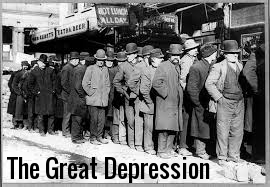
THE GREAT DEPRESSION

Copyright © 2016
In this book I will be explaining The Great Depression, how it started and the events that had happened during that time period. This Time Period called The Great Depression (1929-39) was the deepest and longest-lasting economic downturn in the history causing the Western Industrialized World to suffer severely. This downturn not only affected us, it dropped international trade down by 30 percent and left 30 million people unemployed around the world causing governments to crumble.
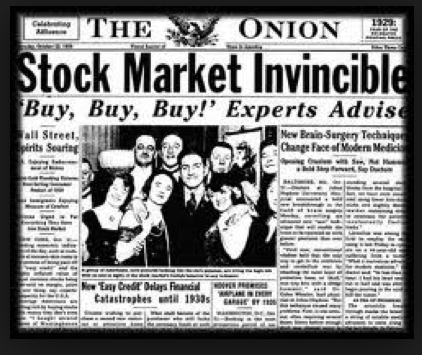
During the 1920’s, the U.S. stock market had went into rapid expansion and reached its peak in August of 1929, after a period of wild speculation. By then, production had declined and unemployment had risen and left stocks in great excess of their real value. Some people believed the stock market would forever climb, but on the day of October 18 they began to fall. Panic set in, and on October 24 “Black Thursday” a record of 12,849,650 shares were traded. Investment companies and leading bankers tried to buy off huge amounts of stock to stabilize the market but on Monday, however, the storm broke out anew and the market went into free fall. Black Monday was followed by black Tuesday (October 29) and the stock market crashed completely and 16,410,030 shares were traded on the New York Stock Exchange in a single day. Billions of dollars were lost and wiped out thousands of investors, along with the stock tickers who ran tremendous hours behind the machinery that couldn’t handle or process the amount of trading.
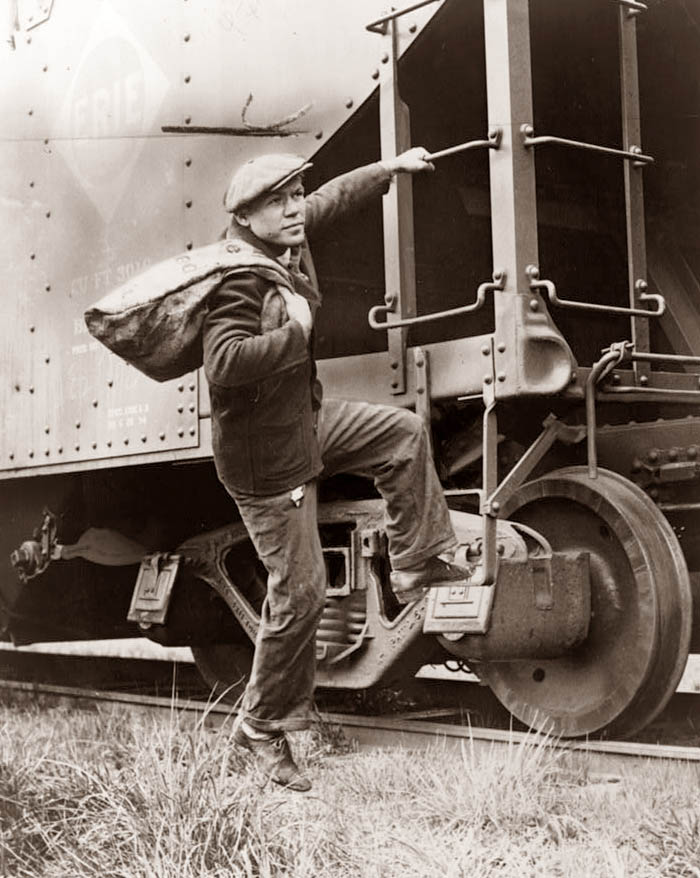
Many were laid off, lost their jobs, or were forced into unemployment to look for jobs on the streets. To survive they would hitch-hike a free ride across the country by hopping on freight trains and travel across the country illegally, these people were called hobos. With Railway Policemen on each side, they would check in between the cars and inside each railway car to make sure these hobo’s weren’t catching a free ride, they usually carried a lantern, club, and sometimes a revolver in case they were armed. When rail yards became heavily armed, hobos began hopping moving trains along the rails.
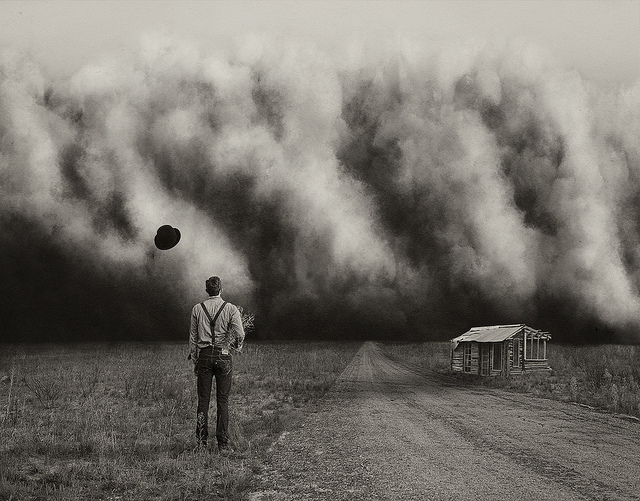
The Dust Bowl was the name given to the Great Plains region that was devastated by drought in 1930’s depression-ridden America. The 150,000-square-mile area, encompassing the Oklahoma and Texas panhandles and neighboring sections of Kansas, Colorado, and New Mexico, has little rainfall, light soil, and high winds, which is a potentially dangerous combination. When drought struck from 1934 to 1937, the soil lacked the stronger root system of grass as an anchor, so the winds easily picked up the loose topsoil and swirled it into dense dust clouds, called “Black Blizzards”. These Black Blizzard’s chocked cattle, plunged dust into homes, and made barely any crops grow forcing 2.5 million people to migrate, mostly to California.
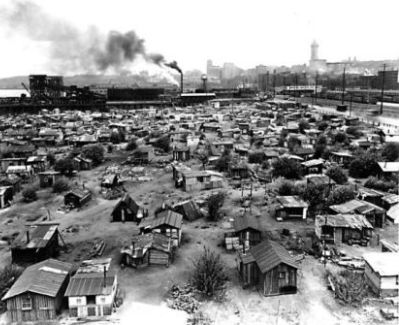
After the stock market crash people lost their jobs along with their houses, moving millions of people to living in the streets or Hoovervilles. These settlements were often formed on empty land and generally consisted of tents and small shacks, and were often built close to free soup kitchens. Some of these men who were forced to live in these conditions possessed construction skills and were able to build their houses out of stone. Most built their homes out of crates, wood, cardboard, scraps of metal or anything they could find.
Published: Apr 17, 2016
Latest Revision: Apr 17, 2016
Ourboox Unique Identifier: OB-125503
Copyright © 2016