






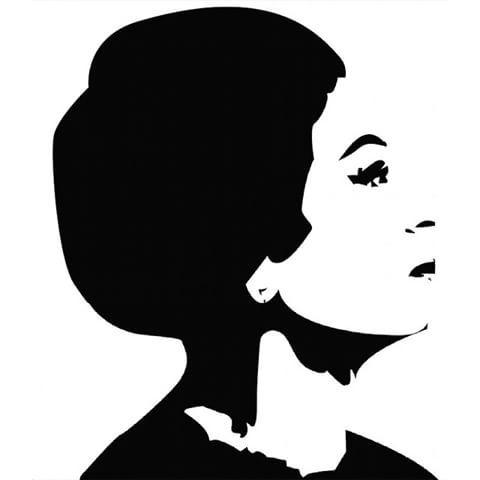
Umm Kulthum

Copyright © 2022
Fatima Ibrahim es-Sayyid el-Beltagi, Kawkab el-charq (Star of the East), The voice of Egypt, Egypt’s fourth pyramid or better known as Umm Kulthum was an Egyptian singer, songwriter, and film actress active from the 1920s to the 1970s.
Umm Kulthum was born in the village of Tamay e-Zahayra, Egypt in 31 December 1898, to a religious family. Her father was the one teaching her to sing and to recite the Qur’an. From a young age she showed how a surprising talent singing thus at 12 years old joining the family ensemble.
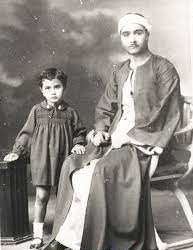
In the family ensemble, at the beginning she was enrolled as a supporting voice. On stage, she wore a boy’s cloak and bedouin head covering in order to alleviate her father’s anxiety about her reputation and public performance, as in that time it was not usual for woman to perform on stage. At the age of 16, she was noticed by Mohamed Abo Al-Ela, a modestly famous singer, who taught her the old classical Arabic repertoire. Later in 1923 moving to cairo to start her professional career.

First thing she did is to struck a contract with Odeon records which by 1926 would pay her more than any other Egyptian musical artist per record. She was introduced to the poet Ahmed Rami, who was to write 137 songs for her and also introduced her to French literature eventually becoming her head mentor in Arabic literature and literary analysis.
In 1926, she left Odeon records for Gramophone records. Furthermore, she was introduced to the renowned oud virtuoso and composer Mohamed El Qasabgi, who introduced her to the Arabic Theatre Palace, where she would experience her first real public success.
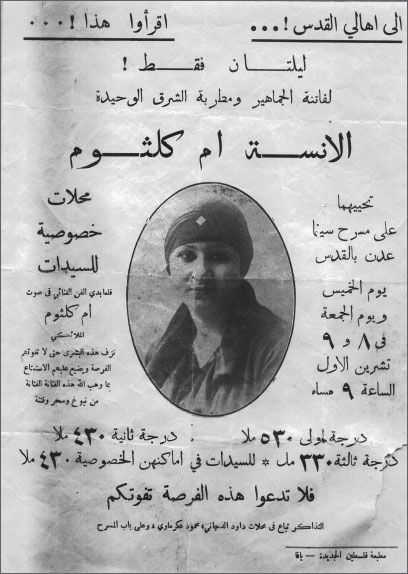
By 1930, she was so well known to the public, that she was the example to follow for several young female singers. In 1932, she embarked upon a major tour of the Middle East and North Africa, performing in prominent Arab capital cities. She even had a concert in Jerusalem, “attached is a poster for her concert in Jerusalem in 1930”.
In 1934, Umm Kulthum sang for the inaugural broadcast of Radio Cairo, the state station. From then on onwards, she performed at a concert on every first Thursday of a month for forty years. Her influence kept growing and expanding beyond the artistic scene: the reigning royal family would request private concerts and even attend her public performances.
In 1944, King Farouk I of Egypt decorated her with the highest level of orders (nishan el kamal), a decoration reserved exclusively to members of the royal family and politicians. Despite this recognition, the royal family rigidly opposed her potential marriage to the King’s uncle, a rejection that deeply wounded her pride and led her to distance herself from the royal family.
The duration of Umm Kulthum’s songs in performance was not fixed as upon the audience request for more repetitions, she would repeat the lines requested at length and her performances usually lasted for up to five hours, during which three songs were sung. For example, the available live performances (about 30) of Ya Zalemni, one of her most popular songs, varied in length from 45 to 90 minutes, depending on both her creative mood for improvisations, illustrating the dynamic relationship between the singer and the audience as they fed off each other’s emotional energy. An improvisatory technique, which was typical of old classical Arabic singing, and which she executed for as long as she could have (both her regressing vocal abilities with age and the increased Westernization of Arabic music became an impediment to this art), was to repeat a single line or stance over and over, subtly altering the emotive emphasis and intensity and exploring one or various musical modal scales (maqām) each time to bring her audiences into a euphoric and ecstatic state known in Arabic as “tarab”. Her concerts used to broadcast from Thursday 9.30 P.M., until the early morning hours on Friday.
Umm Kulthum, was known for her serious stand and present on the stage hardly breaking out of character. And the iconic kerchief she always held. “Here is a rare video of her breaking out of character and interacting with people in her concert”.
At the end Umm Kulthum will always be one of the greatest Arabic female singers of all times. to end the book here is her most famous songs from the 60th.
Published: Apr 16, 2022
Latest Revision: Apr 16, 2022
Ourboox Unique Identifier: OB-1313429
Copyright © 2022