






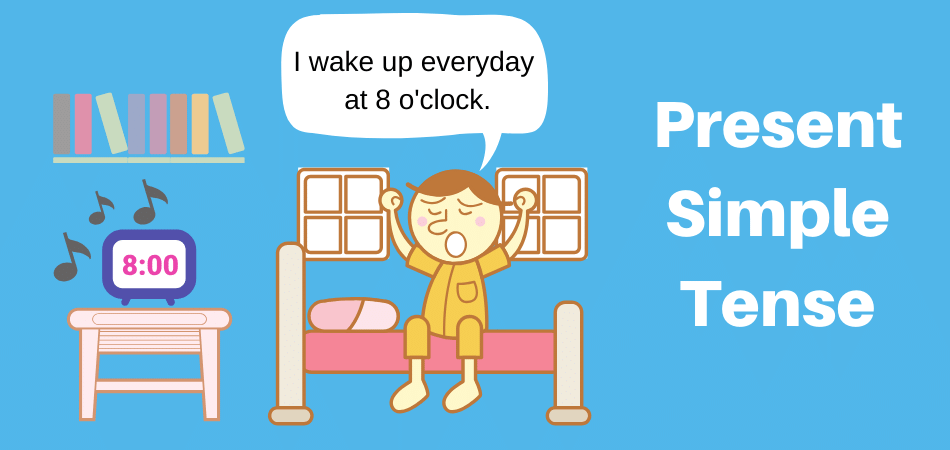
The present tense is the base form of the verb:
I work in London.
But with the third person singular (she/he/it), we add an –s:
She works in London.
Copyright © 2022


Copyright © 2022


1. present simple
2. past simple
3. present simple continuous
4. past simple continuous
5. past perfect
6. present
7. passive voice
8. relative clauses
https://drive.google.com/file/d/1jMypBYH8J3F381Odx77U2i3nZCdwixy0/view
The present tense is the base form of the verb:
I work in London.
But with the third person singular (she/he/it), we add an –s:
She works in London.
Look at these questions:
_____ you ____ the piano?
Where ____ you _____?
____ Jack ____ football?
Where _____ he ____ from ?
____ Rita and Angela ____ in Manchester?
Where ____ they ____ ?
We use do and does to make questions with the present simple. We use does for the third person singular (she/he/it) and do for the others.
We use do and does with question words like where, what and when:
Where do Angela and Rita live?
What does Angela do?
When does Rita usually get up?
But questions with who often don’t use do or does:
Who lives in London?
Who plays football at the weekend?
Who works at Liverpool City Hospital?
Look at these sentences:
I like tennis but I don’t like football. (don’t = do not)
I don’t live in London now.
I don’t play the piano but I play the guitar.
They don’t work at the weekend.
John doesn’t live in Manchester. (doesn’t = does not)
Angela doesn’t drive to work. She goes by bus.
We use do and does to make negatives with the present simple. We use doesn’t for the third person singular (she/he/it) and don’t for the others.( I / You / We / They )

We use the past tense to talk about:
I met my wife in 1983.
We went to Spain for our holidays.
They got home very late last night.
.
When I was a boy, I walked a mile to school every day.
We swam a lot while we were on holiday.
They always enjoyed visiting their friends.
I lived abroad for ten years.
He enjoyed being a student.
She played a lot of tennis when she was younger.
I met my wife a long time ago
1) I ……. pizza last night.
a) wasn’t eating
b) haven’t eaten
c) didn’t eat
2) Sara ……. me yesterday.
a) met
b) meet
c) was meeting
3) They ……. what happened to the police last Monday.
a) reported
b) were reporting
c) had reported
We use didn’t (did not) to make negatives with the past simple:
They didn’t go to Spain this year.
We didn’t get home until very late last night.
I didn’t see you yesterday.
We use the present continuous to talk about:
I‘m just leaving work. I’ll be home in an hour.
Please be quiet. The children are sleeping.
Mary is going to a new school next term.
What are you doingnext week?
We make questions by putting am, is or are in front of the subject:
Are you listening?
Are they coming to your party?
When is she going home?
What am I doing here?
We make negatives by putting not (or n’t) after am, is or are:
I‘m notdoing that.
You aren’t listening. (or You‘re not listening.)
They aren’t coming to the party. (or They‘re not coming to the party.)
1) You ( not use ) my pen
_____________________
2 ) listen ,he (not play ) the guitar
__________________________
3 ) it ( not snow ) this afternoon
__________________________

We can use the past perfect to show the order of two past events.
The past perfect shows the earlier action and the past simple shows the later action.
When the police arrived, the thief had escaped.
It doesn’t matter in which order we say the two events. The following sentence has the same meaning.
The thief had escaped when the police arrived.
We can also use the past perfect followed by before to show that an action was not done or was incomplete when the past simple action happened.
They left before I’d spoken to them.
Sadly, the author died before he’d finished the series.
__________________________________________
__________________________________________
Look at these examples to see how the passive voice is used.
A lot of olive oil is produced in Italy.
This book was written by Angela Davis.
The suspect will be released tomorrow.
This product has not been tested on animals.
We use the passive voice to change the focus of the sentence.
My bike was stolen. (passive – focus on my bike)
Someone stole my bike. (active – focus on someone)
We often use the passive:
We make the passive using the verb be + past participle. We start the sentence with the object.
| Avatar | was | directed by James Cameron. |
| ↓ | ↓ | ↓ |
| Object | + be + | past participle |
It is not always necessary to add who or what did the action.
| My flight | is | cancelled. |
| ↓ | ↓ | ↓ |
| Object | + be + | past participle |
1. Many people begin new projects in January
____________________________________
2. We will have to examine you again.
____________________________________
3. They also speak German at EU meetings.
_____________________________________
4. We have produced skis here since 1964.
_____________________________________
5. The Chinese discovered acupuncture thousands of years ago.
_____________________________________________
Look at these examples to see how defining relative clauses are used.
Are you the one who sent me the email?
The phone which has the most features is also the most expensive.
This is the video that I wanted to show you.
The person they spoke to was really helpful.
Relative clauses give us information about the person or thing mentioned.
Defining relative clauses give us essential information – information that tells us who or what we are talking about.
The woman who lives next door works in a bank.
These are the flights that have been cancelled.
We usually use a relative pronoun or adverb to start a defining relative clause: who, which, that, when, where or whose.
We can use who or that to talk about people. that is more common and a bit more informal.
She’s the woman who cuts my hair.
He’s the man that I met at the conference.
We can use which or that to talk about things. that is more common and a bit more informal.
There was a one-year guarantee which came with the TV.
The laptop that I bought last week has started making a strange noise!
when can refer to a time.
Summer is the season when I’m happiest.
where can refer to a place.
That’s the stadium where Real Madrid play.
whose refers to the person that something belongs to.
He’s a musician whose albums have sold millions.
1. This is the book ……………. Helps me to learn English.
( where – who – that – whose)
_________________________________________________
2. The man …………….. is wearing a white shirt is waiting for you.
( whose – which – that – where)
_________________________________________________
3. My birthday is the day …………. I was born.
( which – when – whose – where )
_________________________________________________
4. I’ve got a friend …………….. exam results are always good.
( whose – who – that – which )
_________________________________________________
5. Cairo is a city ……………… there is the Egyptian Museum.
( when – which – where – who )
Published: Dec 10, 2022
Latest Revision: Dec 11, 2022
Ourboox Unique Identifier: OB-1394860
Copyright © 2022