






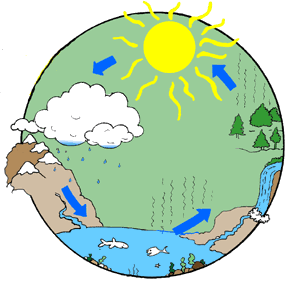
Water cycle

Copyright © 2023
The Natural Water Cycle
The cycle was known as the natural water cycle and was composed of four fundamental stages: first evaporation, condensation, precipitation, and collection.
Evaporation
It all starts with evaporation. Imagine a day when the sun is shining brightly, in all its majestic glory, warming up the earth’s surface. The vaporous heat generated would cause water bodies like rivers, lakes, seas and oceans to slowly transform into invisible vapor and ascend into the depths of the sky. The process doesn’t stop at our massive bodies of water: puddles evaporate, plants release water through transpiration.
Condensation
As the water vapor reaches heights where the air is cooler, it begins a phase transition. The water vapor starts to gather, forming tiny droplets that come together to form clouds. This process of transformation from a gas state to a liquid state is known as condensation.
Just as you might witness when you breathe hot air onto a cold window, the water vapor in the colder atmosphere condenses and forms a cloud. It’s quite amazing to think how every floating cloud we spot in the blue yonder is actually formed through this simple yet poignant part of the water cycle!
Precipitation
But what goes up, must come down. As more and more water droplets join the clouds, they begin to get heavy and dense. Eventually, they can’t hold any more water. So, under the influence of Earth’s gravity, these water droplets descend back down towards the surface of the Earth, a process known as precipitation.
How this precipitation occurs can take several forms. It could be a gentle rain shower that waters the plants and drives the cycle of life. It could be intense snowfall that blankets the open fields in winter. It can also be in the form of sleet or hail, each of these forms representing another aspect of this incredible water cycle.
Runoff
The water that hits the ground doesn’t just lay there. It’s always moving, always flowing, from one place to another, never stagnant. The water seeps through the soil, filling up our underground reservoirs, a process known as infiltration. The water that doesn’t infiltrate into the ground, called runoff, makes its way into rivers and streams, eventually ending up in the oceans and seas, thus completing the cycle.
The water cycle isn’t just a one-time process; it’s a continuous process that repeats indefinitely. The water that’s in your glass today could have been part of an Arctic ice sheet, or a tropical rain cloud, or a deep-sea current years or centuries ago.
Gravity is the force that attracts one object towards another. It is the reason why when we throw a ball up in the air, it falls back to the ground. It’s the unseen force that keeps us on the Earth and the reason why Earth orbits around the Sun.
Whether we realize it or not, this cycle plays an important part in our daily lives. And while it may not be dazzlingly creative in its approach, the sheer magnitude of the process and its ongoing, unstoppable stature makes it one of the most incredible phenomenon nature has ever created. Even though this cycle is a low-creativity natural system, its immense importance and grandeur cannot be overstated.
Published: Sep 7, 2023
Latest Revision: Sep 8, 2023
Ourboox Unique Identifier: OB-1491944
Copyright © 2023

 Skip to content