






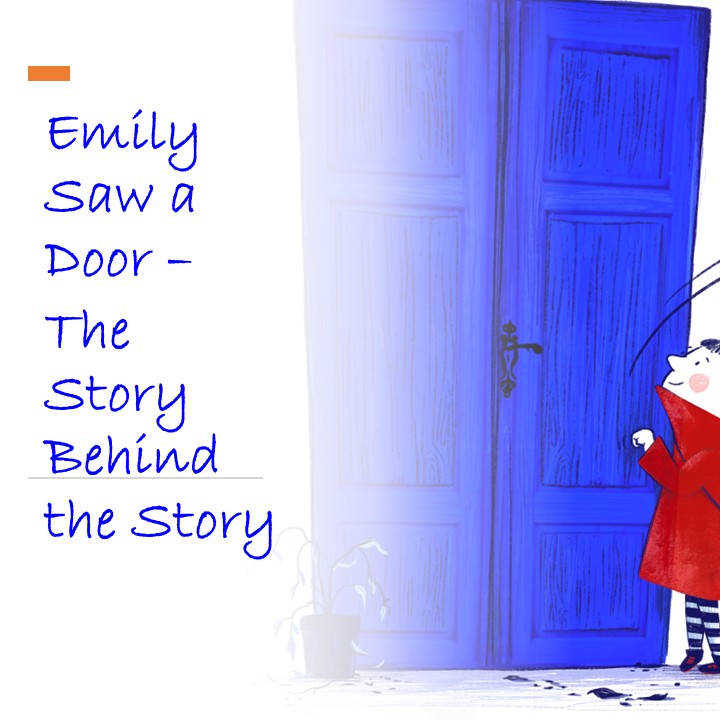

Emily Saw a Door – The Story behind the Story

Copyright © 2025
I started writing “Emily Saw a Door” in December 2018, seven years ago. I wrote my then mentor, author-illustrator Mike Malbrough, that I was working on new story and sent an early draft a few days later.
Dec. 14th, 2018
Hi Mike,
Thanks for our skype lesson. The next day I wrote a new story which I think is my best ever!
Can’t wait to send it to you – should I send it today or work on it till Monday and send then,
I need to know what you think!!!!!!!!!!
have a great weekend
mel
.
The character of Emily was originally a boy, but I quickly decided that there would be too much of ‘me’ (and my own history of rejections), and I needed a girl. This turned out, I think, to be an intuitive choice in the right direction. Emily slowly grew into her spunky, genuine, intuitive, thoughtful, and ingenious self. [I think that the wonderful illustrator, Orit Magia, found it easier to connect with a female MC. You know what? I will ask her.]
Initially her name was Julie, but I changed it to Emily, a stronger name, and one that still has the letters of my name inside (a little author hubris here).
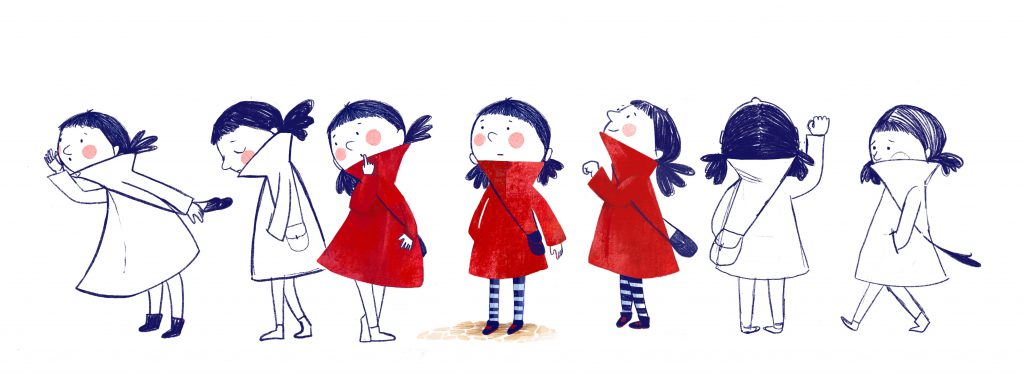
Despite her strong name, in the early drafts, Emily’s character was passive, a kind of ‘punching bag’. She did her utmost to be accepted, even resorting to telling lies at the door for liars (and not being particularly successful). And she was rejected by all the doors. At some stage, I felt that she needed more character, and added doors where she was able to make the choices herself, for example, in the door with the endless stairs. “I really do need a top,” she says before leaving. That spunk greatly added to her persona, and gives us insight into a young girl who will compromise ‘only so much’ in order to gain acceptance. Bravo, Emily!
One of the things that worried me was that children might wonder who she was, where she was from, the location of the doors, etc. In the early drafts, there was an introductory paragraph and text between the episodes, describing her walking from door to door in the inclement weather.
I ended up cutting all this out. In the final draft, we don’t know anything about where Emily is coming from, her family, the physical locale (village? town?). It turned out that my worrying was for nought. Children loved the story jumping in with “Knock, knock, knock.” They immersed themselves immediately in the story, and accept its surreal nature.
Kids are amazing. I could have trusted them from the getgo.
Is Emily patterned after the characters in my favorite picture books? There is undoubtedly some Madeline in Emily and some Alice in Wonderland too. And some of the hutzpa of the princess in Munsch’s classic, “Paperbag Princess.”
And what about Harold of Purple Crayon fame? I wasn’t thinking about that Harold at all, even though he does use his crayon to draw a door. And although I might have seen the book in my youth, I didn’t remember it at all. What I do remember clearly, is the Walt Disney animation based on Benny Goodman’s “All the Cats Join In” in which the animator is visibly involved throughout the plot. I’m quite sure that Crockett was influenced by it as well, since it came out a decade or so before his book.”
Here is the video, please judge for yourselves.
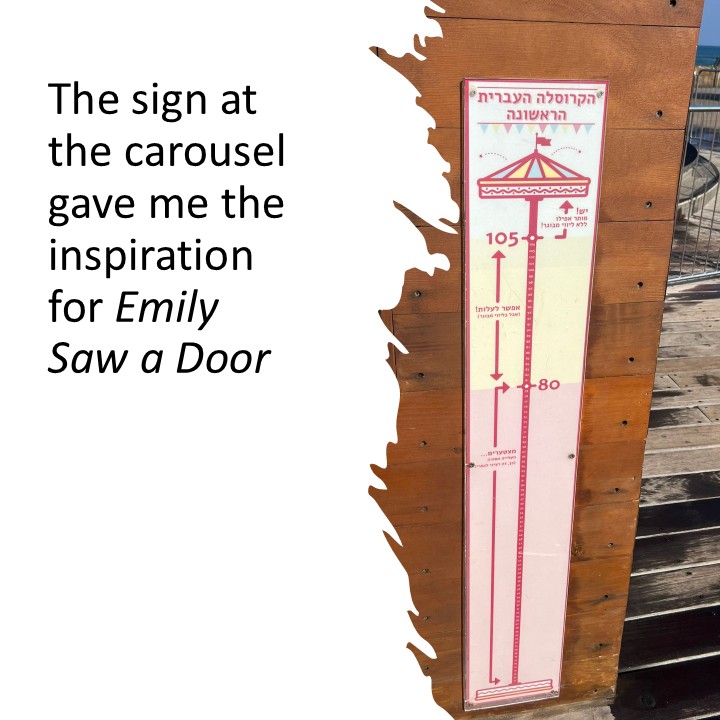
I’m pretty sure that the immediate idea for the book came from a sign that we saw at the old carousel in the Tel Aviv port. It prohibits children less than 80 centimeters tall from traveling the ride. I’m thinking to myself – it’s just a merry-go-round. Parents can hold their children. Why this arbitrary cutoff? How unfair. That got me started on all the times I was unfairly rejected in my own life. I think that prompted me to write a story about rejections. That, and the fact that my own manuscripts were getting rejected, again and again.
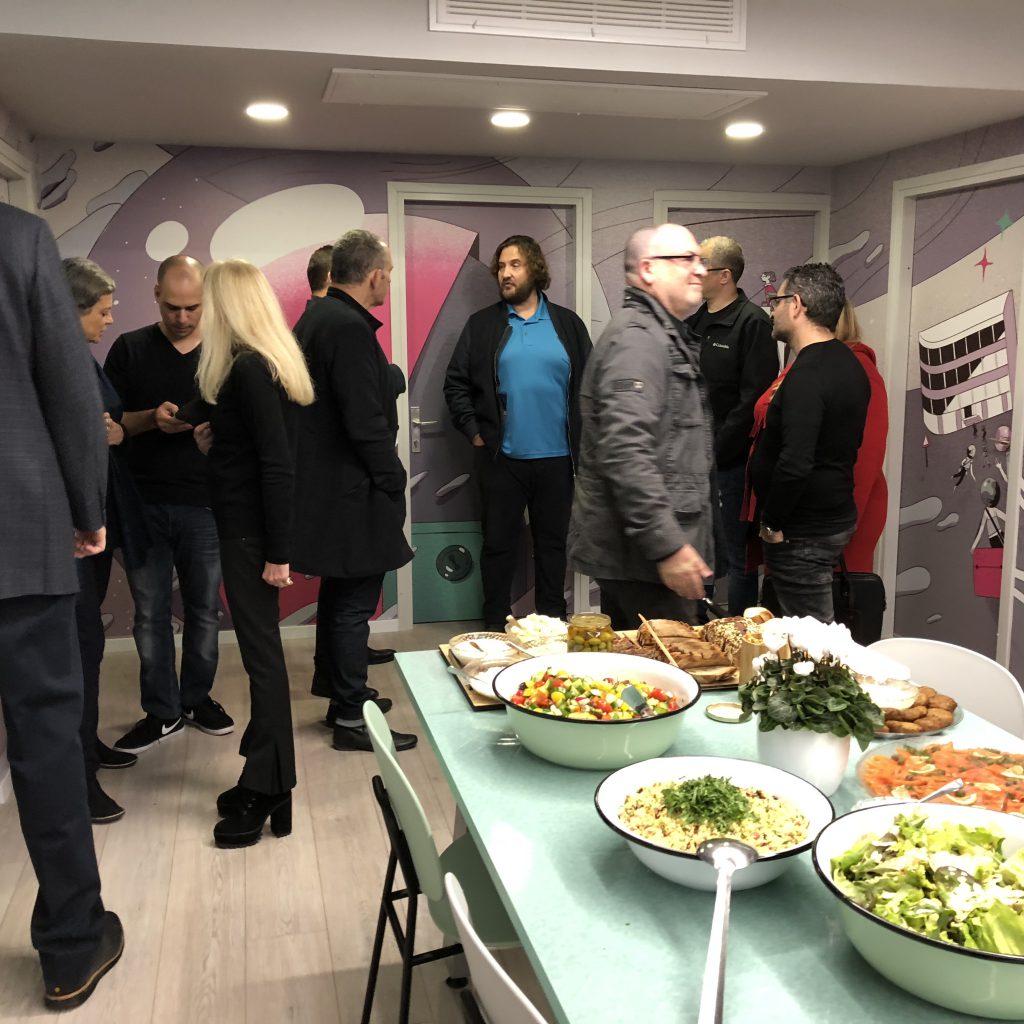
So how and where did the doors come from? I’m not sure. Doors have always been an important metaphor for me. I remember writing a song about doors back in university. I would teach my students the importance of opening doors (sometimes jiggling the lock and kicking a bit) in hunting opportunities. But perhaps the reason was that I wrote the story about doors was more prosaic – I was writing in a long hall with many doors.
The story evolved over dozens of edits and revisions. I had started working (in 2020) with the incredible editor, Harold Underdown (highly recommended, I still work with him weekly, more than five years later!) and we meticulously kept refining and retelling the story. My ability to create multiple dummy books on our digital platform (www.ourboox.com),which was used to create this e-book and see how the text played out over the pages was also critical.
I enlisted my friend, Yaron Haklai, to try to find a small independent publisher who might be interested. He found one. Actually an intern at one who was interested. She asked me to lengthen the story (can you believe?) to about 700 words. But they never got back to me, as did many agents (or rather, didn’t).
The wonderful Israeli editor, Atara Ofek, fell in love with the story and urged me to try to pitch it here in Israel, in Hebrew. There was interest by a serious traditional publisher. At the beginning, they were interested. Their editor, who I will call R.N., identified a critical element. The story at that stage ended when Emily created her own door and walked in. “Somehow I feel that something is missing in the ending. See if you can think of something.” I was initially taken aback. For the first time in my writing career, a serious publisher was interested in my story, and we weren’t there yet – it had to be further improved. Yikes! I smiled and thanked her graciously and headed to my car in dismay. Another ending? What ending? While contemplating the possibility that my story might be turned down yet again, I got into my car and headed home.
It hit me on the way. Of course! Someone has to come knocking on Emily’s door. It was so simple. So perfect. I would never have thought of it without her insight.
Things didn’t work out in the end with that publisher, and I found a magnificent boutique house, Tal-May (that is a story unto itself). Meira Firon, the publisher, loved Emily, and so did the chief editor, Yotam Shwimmer, but alas, he pointed out a defect in the story.
In the original text, a discouraged, rejected Emily comes to a place without a door, pulls crayons from her curly hair and begins drawing her own door. Yotam felt that this showed premeditation on Emily’s part. And on mine too, as author. It felt contrived. It was.
So this was the weak beat of the entire story which I had been trying to ignore. And I had been caught red-crayoned.
How would I find a fix?
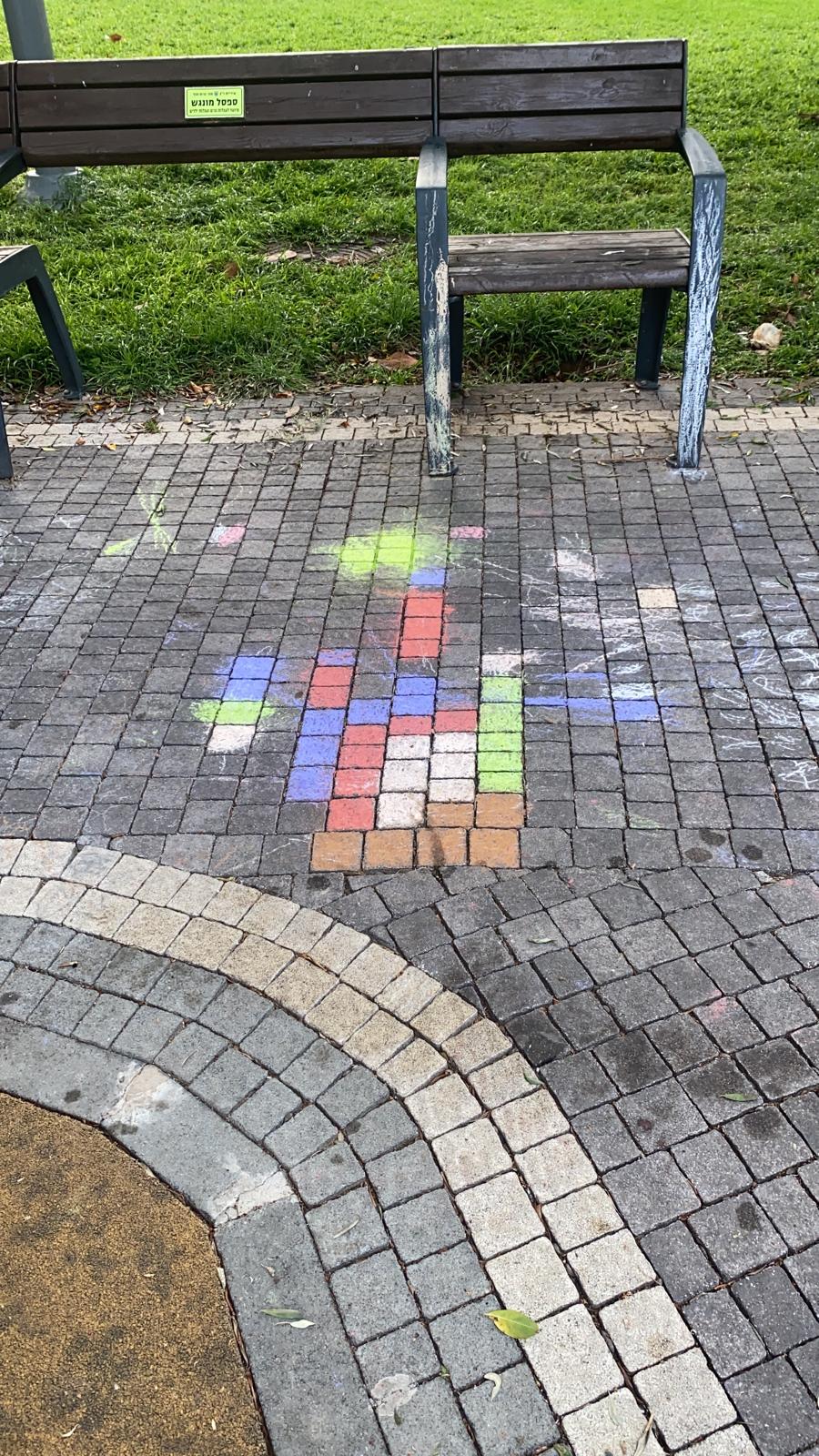
I spent weeks in agony, without coming up with ‘the fix.’ When it came, it was such a relief. In the new beat, Emily sees a chalk game on the ground, and then gets the idea of drawing her own door.
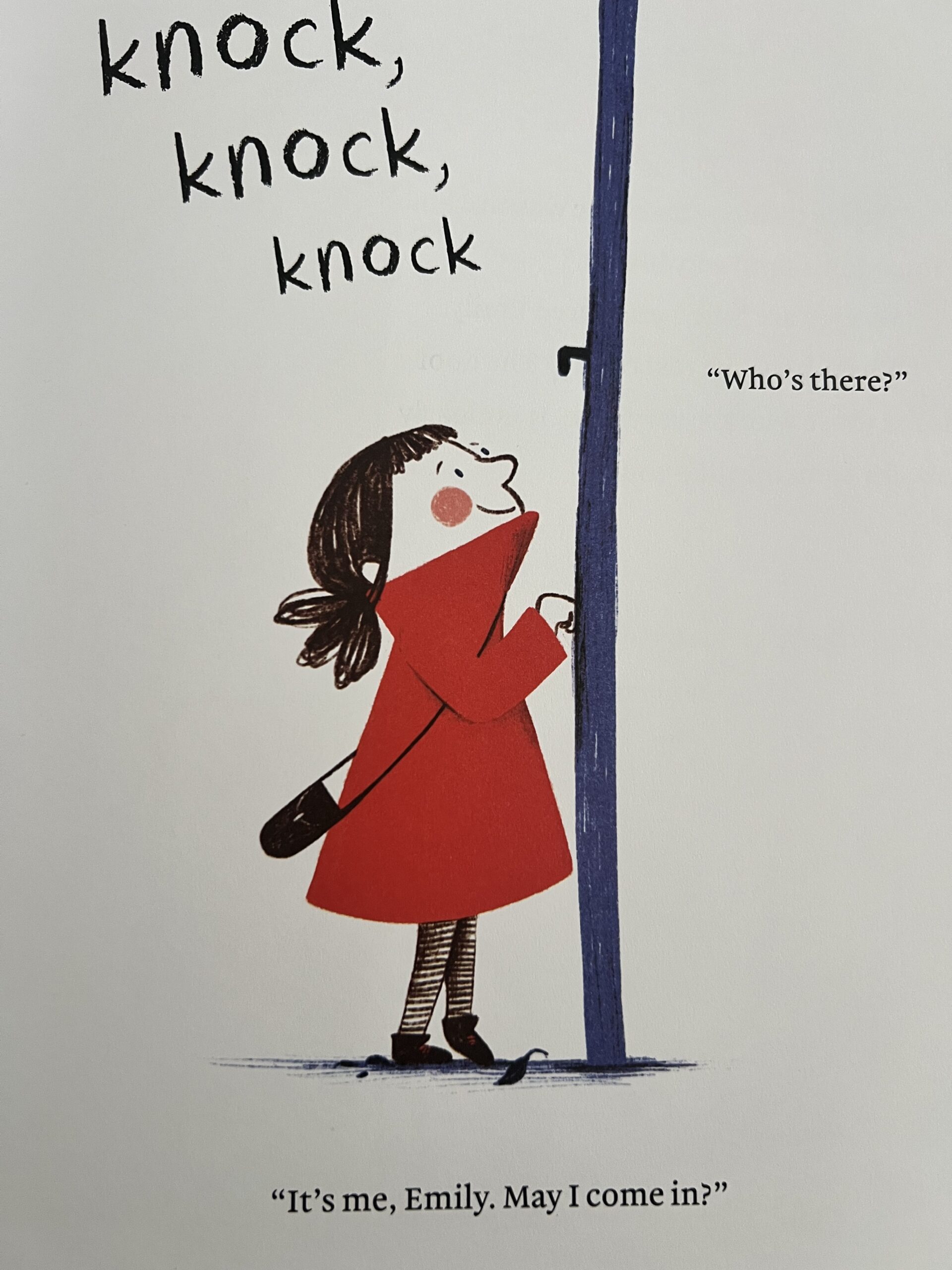
As with US publishers, Yotam selected the illustrator. And it’s a good thing he did!!! Orit Magia turned out to be the PERFECT illustrator for Emily. And as with US publishers, I did not see most of the artwork until it was at a rather advanced stage. But Orit did give me a sneak preview of Emily. Wow! I thought. Emily is an empathy magnet.
One look and you fall in love with her. Complete with red coat and purse accessory.
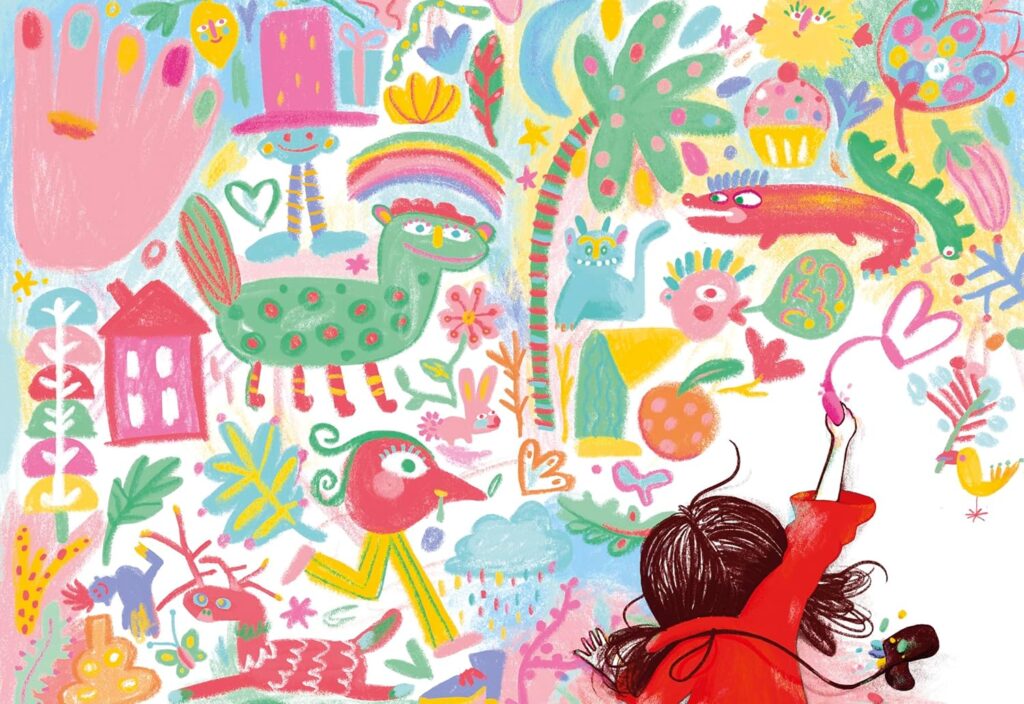
Orit’s work with the doors was incredible. And the double spread in which she draws her own world, was her idea, not mine. I think it’s the best spread in the book. And although it wasn’t my idea, I’m still proud of it. Go figure.
Emily was originally written in English, my native tongue (I left Canada for Israel when I was almost eighteen, but have used it continuously since). The story was to be published in Hebrew, and my Hebrew wasn’t good enough. With the help of top Israeli editor Atara Ofek, and Meira Firon (publisher and owner of Tal-May), we produced a Hebrew version. I like to say that they translated my Hebrew to real Hebrew.
In any event, the story was way too long for Yotam. It was intended to be part of his outstanding series which blends picture book and early reader. He wanted me to cut the text down to 350 words. Yikes!
But as it turns out, he was right again. Stories can usually be pared down, and are sometimes even improved in the process. I was able to cut the story down to 315 words!!
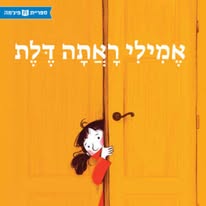
Emily Saw a Door, in its original Hebrew version, אמילי ראתה דלת, was published in the summer of 2023. The reviews were extremely positive. One funny thing about them was that each reviewer had a different ‘take’ on my story. Initially taken aback, I eventually realized that this is a good thing. Different people interpret the story in their own way. It becomes their story. “Reader response!” It might be a good thing, but as an author one has to get used to it. I’m trying!
The book won a prestigious national award. Sifirat Pijama (PJ library here in Israel) recently distributed 50,000 (!) copies to second grade pupils all over the country.
I wanted to create an illustrated version in English to be able to send to potential agents and publishers abroad. The English text had to be fixed according to the shortened format and the illustrations that appeared in the Hebrew version. I think that the story was improved by being translated into Hebrew and then back into English. It also caused me to wonder whether authors who speak several languages have a storytelling advantage. What do you think?
Liza Fleissig and Ginger Harris (LRA) loved Emily. They promptly sold her (and us!) to Annie Kelley at Random House Studio. The text…and the gorgeous illustrations.
Annie and her team also did a great job. The English version is a gorgeous royal blue.
Who says miracles don’t happen? Twice.
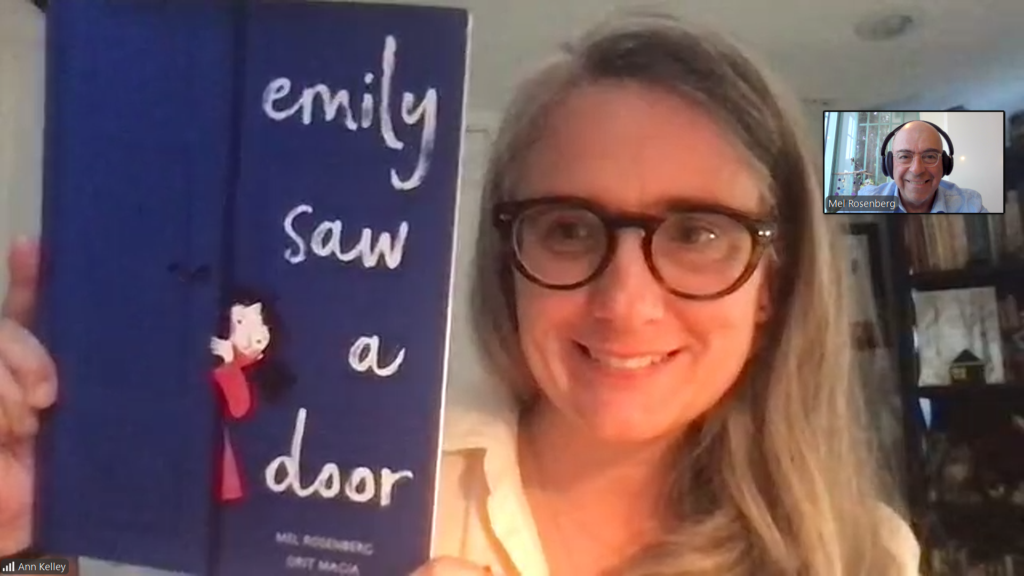
The English version of EMILY SAW a door will officially launch on February 24th, 2026, but it’s already available for preorder here.It has a new gorgeous blue cover, and we hope that it will succeed as well, or better than the original Hebrew version.
If you’re in NYC on Feb. 24th, your invited to come by the Corner Bookstore for some Emily cupcakes (courtesy Liza) and Emily.
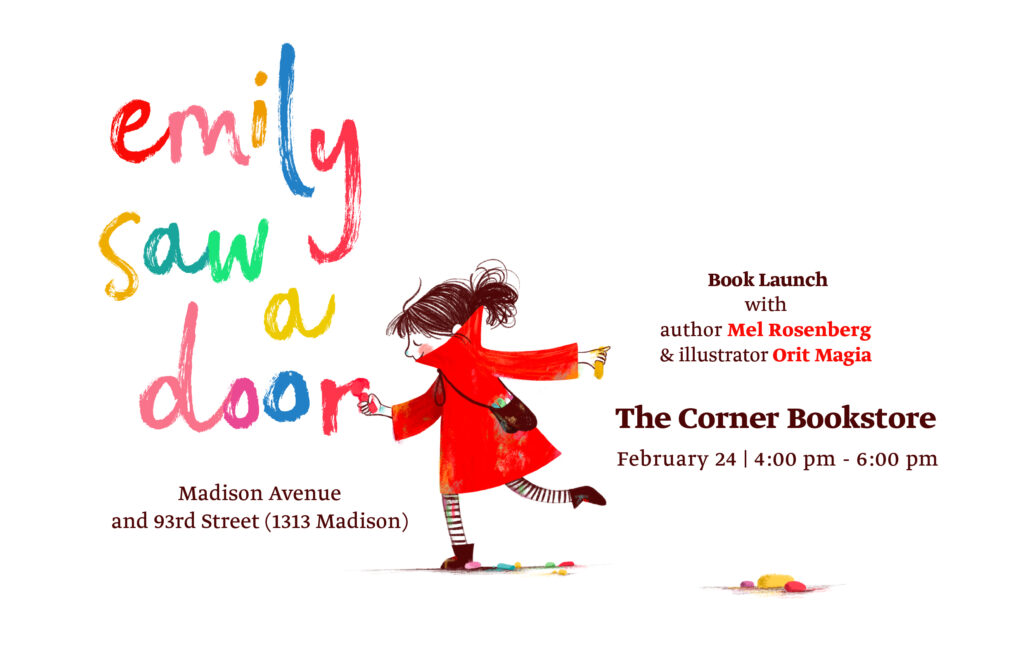
Bonus for reading all the way to the end:
The door that disappeared
There are seven doors in the story (the seventh is the one that Emily creates herself). One door was removed during the revision process. It was a door for ‘those who had already been before.’ I felt that (i) there were already enough doors, and (ii) it might be a bit too advanced. I have included it here as the ‘missing door.’ Who knows? It may someday be the start of something new.
THE SECRET, MISSING DOOR
Knock, knock, knock.
“Hello,” said the voice behind the door. “It’s chilly outside. Perhaps you’d like to come in.”
“I would love to,” said Emily.
“Do you remember the secret password?” asked the voice behind the door.
“The secret password? It’s my very first time here,” said Emily.
“So sorry,” said the voice. “This door is for those who have been here before.”
“Is it parsnip? Bartholemew? Sausage? If you tell me the password, I promise to remember it for next time. Please!”
“Goodbye,” said the voice behind the door.
.
Some recent events, interviews, blogs and write-ups
New Books Network: Podcast: Michelle Knudsen interviews me on Emily
https://newbooksnetwork.com/emily-saw-a-door
New Book Network Newsletter: Meet a Host
https://newbooksnetwork.substack.com/p/25?utm_source=substack&utm_medium=email&utm_content=share
Upcoming NYPL Meet the Author event (Feb. 28th, 3 p.m.) – and attached
https://www.nypl.org/events/programs/2026/02/28/meet-author-mel-rosenberg
Harold Underdown on FB:
https://www.facebook.com/share/p/1HQLuzHzFS/
Storylady blog:
https://storybooklady.net/interview/mel-rosenberg-and-emily-saw-a-door/
Storystorm blog – Tara Lazar – On being silly
https://taralazar.com/2026/01/22/storystorm-2026-day-22/
Picture book builders:
Published: Jul 6, 2025
Latest Revision: Feb 10, 2026
Ourboox Unique Identifier: OB-1679283
Copyright © 2025