






Leonard Bloomfield & American Structuralism

Copyright © 2017
Leonard Bloomfield (April 1, 1887 – April 18, 1949) was an American linguist, whose influence dominated the development of structural linguistics in America between the 1930s and the 1950s.
Bloomfield’s approach to linguistics was characterized by its emphasis on the scientific basis of linguistics, adherence to behaviorism especially in his later work, and emphasis on formal procedures for the analysis of linguistic data. The influence of Bloomfieldian structural linguistics declined in the late 1950s and 1960s as the theory of Generative Grammar developed by Noam Chomsky came to predominate.
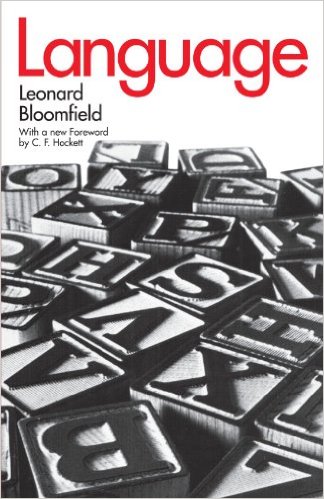
Bloomfield published his Language in 1933, in which he argued that linguistics needs to be more objective if it is to become a real scientific discipline. He believed that the main target of linguistic inquiry should be observable phenomena, rather than abstract cognitive processes. He thus advocated for the establishment of exact descriptive methods through which the use of linguistics could be elevated to the level of a positive discipline.
His Language work attempted to lay down rigorous procedures for the description of any language. It had a profound influence on linguistics, for it was a clear statement of principles that soon became generally accepted, such as:
-> Language study must always be centred on the spoken language, as against written documents.
-> The definitions used in grammar should be based on the forms of the language, not on the meanings of the forms.
-> A given language at a given time is a complete system of sounds and forms that exist independently of the past, so that the history of a form does not explain its actual meaning.
Main premises:
= Linguistics describes what people say, not what people should say.
= The primary form of language is the spoken one; The spoken one comes first than the written one, and not every language has a written form.
= A language should be described on its own terms.
= Meaning should not be part of linguistics analysis.
= Language is observable speech, not knowledge.
Contributions
Concerned at first with the details of Indo-European—particularly Germanic—speech sounds and word formation, Bloomfield turned to larger, more general, and wider ranging considerations of language science in An Introduction to the Study of Language (1914). He then pioneered a work on one of the Malayo-Polynesian (Austronesian) languages, Tagalog. In the early 1920s he began his classic work on North American Indian languages, contributing the first of many descriptive and comparative studies of the Algonquian family.
The Americans developed techniques for phonemic analysis, which they used to identify which sounds in a language were phonemic and which were allophonic. They would then identify which allophones belonged to which phonemes. The methods, which the American Structuralists developed, are still in use today by fieldworkers when they try to record unknown languages. For the American Structuralists, the phoneme was the most basic element.
Bloomfield and his followers were more interested in the forms of linguistic items, and in the way the items were arranged, than in meaning (semantics). Meaning, according to Bloomfield, was not observable using rigid methods of analysis, and it was therefore “the weak point in language study“.
Drawbacks.
Behaviorist linguists start their studies by recording speech, and these samples will become the only basis for the study of language, in the form of sphich corpus. Speech will be divided into sound segments and they will observe these segments in their linguistic context. Finally, they will classify those segments according to their distribution. However, this method made the study of meaning very complex and probably outside the domain of linguistics, and this is the main behaviorist limitation.
The Bloomfieldians laid down a valuable background of linguistic methodology for future generations. But linguistics also became very narrow. Trivial problems of analysis became major controversial issues, and no one who was not a linguist could understand the issues involved. By around 1950, linguistics had lost touch with other disciplines and became an abstract subject of little interest to anyone outside it. A radical change had to take place for linguistics to survive as a “living” science.
How do you see this theory reflected in your language acquisition experience?
Leonard Bloomfield was a well-known linguist who applied the behaviourist theory to the study of language , who argued that “a regular analogy permits a speaker to utter speech-forms which he has not heard”
Though one cannot deny the role of social interaction or of general learning mechanisms in the acquisition of language, one cannot ignore the overwhelming evidence which shows that “language growth”, especially syntactic development, cannot reduce to analogy, connections, abstraction or social interaction. The relation which exists between the primary linguistic data (PLD) to which the child is exposed and the output grammar may rely on principles which are not operative in other kinds of learning and which can account for the huge amount of creativity in language development as well as for the speed with which children acquire language. Language is much more than a mere mapping between cognition/social categories and linguistic patterns.
Published: Feb 21, 2017
Latest Revision: Feb 22, 2017
Ourboox Unique Identifier: OB-252955
Copyright © 2017

 Skip to content