






by Marcos Rodriguez
Copyright © 2018
Dimensions of Depth and Complexity

Copyright © 2018
Resources to implement all elements of Depth and Complexity
Depth Tool- Language of the Discipline
The lips represent specialized language related to a topic or concept.
-key words, phrases, signs/symbols, figures of speech, abbreviations, and the like.
For example, to truly understand a concept in mathematics, one must speak the “language of math”. A student being asked to add and subtract would need to understand not only terms such as “sum” and “difference”, but also be able to understand mathematical sentences which often include symbols: 27 + (16 – 5) =
 Depth Tool- Details
Details contain the information that enhance understanding. They act as supporting information to a big idea or concept (main idea).
Details include:
parts, factors, attributes, traits, and variables.
If we go back to our earlier math example: 27 + (16 – 5) = the details are the numbers themselves (the parts that make up the equation).
Questions
What distinguishes this form from others?
What are its attributes?
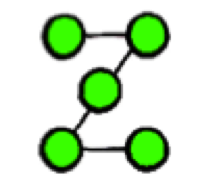 Depth Tool- Patterns
Patterns are recurring elements or factors in ideas, objects, stories, and events. They are predictable, repetitive and ordered.
We see patterns in: number lines, geometry; literature: “Little pigs, little pigs! Let me come in…” ; social studies: patterns in movement and settlement, behavior.
Task Starters
Describe the patterns that are found.
How does one pattern compare to another?
 Depth Tool- Rules
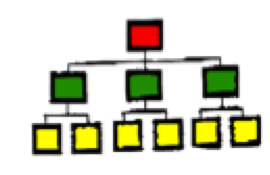
Rules are the organizational elements that create structure. This concept is an easy one for students, as they are surrounded by rules (at home, school, in sports, etc).
Rules provide structure and represent organization and hierarchy. The meaning is reflected in the design of the icon, which itself has a clear structure.
 Depth Tool- Ethical Issues
This element of Depth and Complexity represents moral principles (possible rights or wrongs).
An easy way to remember the meaning: “Black and white/ right and wrong”. It represents conflicting points of view on events, ideas or issues and involves bias, values, or judgments.
Students will most likely encounter this dimension when analyzing literature or studying social studies.
For example, students might be asked to consider ethical issues surrounding Spanish colonization and the establishment of missions along the California coast or to examine ethical issues surrounding a character’s behavior in a story.
 Depth Tool – Trends
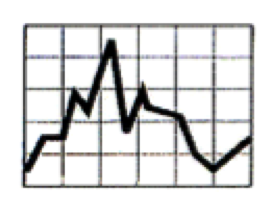
This is the icon I about which get the most questions. Trends represent the general direction of change. CHANGE is the key word here.
Trends can be explained by external factors or influences that contribute to the change.
This icon is represented well by the line graph. Each spike and dip in the graph was caused by something (external factor or influence).
This is different from simple change over time, because for a trend to occur, one thing has to replace, or compete with, another. It’s important to not only examine the “why”, but also the “so now what?” questions. What are the consequences, both intentional and unintentional?
 Depth Tool- Unanswered Questions
These are questions about anything is is unsolved, unclear, or unproven. These can be ideas that have yet to be explored, are unresolved, or that have missing components (incomplete). Unanswered questions are good!
These are questions we need to pursue.
Having said this, many students will be content with simply asking a question and leaving it at that. As educators, we need to push students to pursue the answers to these questions.
These are typically questions that are not answered quickly and sometimes they aren’t answerable (yet), but they do have the potential to generate some good thinking and discussion.
 Complexity Tool- Multiple Perspectives
This icon basically represents different points of view on ideas, events, people, and issues.
It often represents an “expert” viewpoint, and is dependent on time and place. This icon falls under the “complexity” section of the Depth and Complexity framework.
This icon is easy for students to remember because glasses have lenses through which one must look to see something clearly.
For example, one could look at the different perspectives on rules or on details. One really couldn’t get a good understanding of a conflict without first looking through the different perspectives involved.
 Complexity Tool- Change Over Time
This icon prompts students to explore a concept, event, or person as it relates to time (past/present/future).
Change is inevitable.
This powerful tool facilitates a more complex exploration and can easily be applied across disciplines and combined with all the other Depth and Complexity Tools. Consider having students examine how and why rules change over time.
How do changing perspectives impact changes in rules? For a different approach, consider having students explore why things haven’t changed.
 Complexity Tool- Across Disciplines
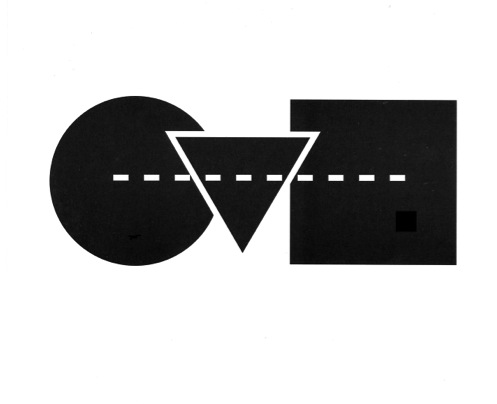
This icon also falls under the complexity section of the framework.
The Across Disciplines icon prompts exploration of connections within, between and across subject areas. Although not used as often as some of the other tools, this icon supports understanding of how something relates to multiple disciplines.
For example, students can examine natural resources across science, economics, history, etc. Questions students might explore – How does the California Gold Rush relate to science, economics, and history? Through what disciplines might we better understand the presidential election?
 Depth Tool- Big Idea
The Big Idea indicates a generalization, principle or theory about the curriculum being studied. It often represents the focus of study or a learning task.
For example, the big idea of a science lesson might be the water cycle. The Big Idea design works well to help students organize the main idea of a story or paragraph (in the roof), which is then supported with evidence (pillars supporting the roof). Students use this with universal themes and
Published: Jul 17, 2018
Latest Revision: Jul 17, 2018
Ourboox Unique Identifier: OB-510024
Copyright © 2018

 Skip to content