






by dina bizzaro
Copyright © 2018

CHEMISTRY – 7TH GRADE

Copyright © 2018
Helping you to understand Chemistry
| The sub-atomic particles
Protons, neutrons and electrons.
|
|||||||||||||
| The behaviour of protons, neutrons and electrons in electric fields
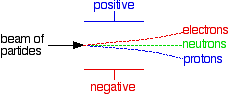
What happens if a beam of each of these particles is passed between two electrically charged plates – one positive and one negative? Opposites will attract. Protons are positively charged and so would be deflected on a curving path towards the negative plate. Electrons are negatively charged and so would be deflected on a curving path towards the positive plate. Neutrons don’t have a charge, and so would continue on in a straight line. Exactly what happens depends on whether the beams of particles enter the electric field with the various particles having the same speeds or the same energies If the particles have the same energy If beams of the three sorts of particles, all with the same energy, are passed between two electrically charged plates:
If the electric field was strong enough, then the electron and proton beams might curve enough to hit their respective plates. If the particles have the same speeds If beams of the three sorts of particles, all with the same speed, are passed between two electrically charged plates:
|
|||||||||||||
Our current model of the atom can be broken down into three constituents parts – protons, neutron, and electrons. Each of these parts has an associated charge, with protons carrying a positive charge, electrons having a negative charge, and neutrons possessing no net charge. In accordance with the Standard Model of particle physics, protons and neutrons make up the nucleus of the atom, while electrons orbit it in a “cloud”.

What is an atom?
Take anything apart and you’ll find something smaller inside. There are engines inside cars, pips inside apples, hearts and lungs inside people, and stuffing inside teddy bears. But what happens if you keep going? If you keep taking things apart, you’ll eventually, find that all matter (all the “stuff” that surrounds us) is made from different types of atoms. Living things, for example, are mostly made from the atoms carbon, hydrogen, and oxygen. These are just three of over 100 chemical elements that scientists have discovered. Other elements include metals such as copper, tin, iron and gold, and gases like hydrogen and helium. You can make virtually anything you can think of by joining atoms of different elements together like tiny LEGO® blocks.

Photo: What does an atom look like? You can see one if you have the right kind of microscope or camera! This photo shows strontium atoms “flying” in a cube while being stimulated with precision laser light. By courtesy of National Institute of Standards and Technology (NIST).
An atom is the smallest possible amount of a chemical element—so an atom of gold is the smallest amount of gold you can possibly have. By small, I really do mean absolutely, nanoscopically tiny: a single atom is hundreds of thousands of times thinner than a human hair, so you have absolutely no chance of ever seeing one unless you have an incredibly powerful electron microscope. In ancient times, people thought atoms were the smallest possible things in the world. In fact, the word atom comes from a Greek word meaning something that cannot be split up any further. Today, we know this isn’t true. In theory, if you had a knife small and sharp enough, you could chop an atom of gold into bits and you’d find smaller things inside. But then you’d no longer have the gold: you’d just have the bits. All atoms are made from the same bits, which are called subatomic particles (“sub” means smaller than and these are particles smaller than atoms). So if you chopped up an atom of iron, and put the bits into a pile, and then chopped up an atom of gold, and put those bits into a second pile
What is the Periodic Table?

Artwork: The Periodic Table of the elements.
Suppose you make a list of the chemical elements in order of their atomic number (how many protons they have), starting with hydrogen (H). You’ll find that elements with similar chemical properties (how they react with things) and physical properties (whether they’re metals or non-metals, how they conduct heat and electricity, and so on) occur at regular intervals—periodically, in other words. If you rearrange your list into a table so similar atoms fall underneath one another, you get a diagram like this, which is called the Periodic Table. The columns are called groups and the rows are called periods.
So what? Atoms in a certain group (column) tend to have similar properties. So, for example, the red column on the right contains the Noble Gases (helium, neon, argon, krypton, and so on), which are relatively unreactive. The pink column on the left contains the alkali metals (lithium, sodium, potassium, and so on), which are relatively reactive metals (you probably know that some of them react violently with water, for example, to produce explosive hydrogen gas). If you know where a certain element sits in the table, and you know a little bit about the properties of the elements above, below, and either side, you can often figure out what the properties of that element will be.
Published: Oct 24, 2018
Latest Revision: Oct 24, 2018
Ourboox Unique Identifier: OB-524723
Copyright © 2018