







The Way We Aren’t
Copyright © 2015
People I meet have trouble understanding why, at the age of fifty-something, my attention shifted from being a scientist to being a writer. Of stories for children.
It’s not that difficult to explain.
Scientists are writers, of course. They write grant proposals, they write scientific papers. They record their observations. Some would even venture to say that they are storytellers.
But the stories they tell are stories about “The Way We Are”.
Scientists, after all, are interested in the way the universe is, and what makes it tick. For every question about the universe there is an answer. The answer. During the course of an individual career, a scientist will try find the answer to a couple of questions.
Scientists think. They observe. They wonder. They ponder. They do experiments. Then they tell the story of what they discovered about the way we are. They hope that they get the answers right.
Sometimes different scientists get different answers to the same question. When I was a scientist studying bad breath there was a question as to whether only gases containing sulfur atoms contribute to halitosis. Some scientists said yes. Others said no, gases with nitrogen atoms could also contribute. Each of the scientists believed that their story was the right one. But since this is a dichotomous question with one answer, some of the scientists must be wrong.
But perhaps that’s beside the point. Scientists do try to get the right answers.
But, you will agree with me, that there are many more WRONG answers than right answers. There might be a gadzilion wrong answers to any question. And maybe even more.
And that is why I like to write children’s books. Whereas there is only one way to get a right answer, there are so many ways to invent a wrong one. To conjure up another reality. To tell an original tale. The Way We Aren’t.
As a child, I was sure that the stories my Dad read to me were true. I loved Madeline, by Ludwig Bemelmans. That house in Paris that was all covered in vines was as real to me as my own. And his vivid artwork was as real or realer than any black-and-white photo.
I had two versions of Peter Pan, illustrated by two different artists. I would ask my Father time and again “Which is the REAL Peter Pan?”

My sister Rena was particularly fond of the poem “A Frog Went A Walking on a Summer’s Day”. But when Dad would sing “What do you think they had on the shelf? If you want to know go look for yourself” this would really drive her bananas. I think she still wonders about it. I know I do.

As you might expect, the answer is right here in this classic poem. In the real world, there is ‘something on the shelf’ and the scientist will spend his or her career looking for it. For a storyteller, whatever you imagine can be on that shelf.
But it had better be something special! Not a pencil, or a book. More like an elf or an uncomfortable giraffe. Or how about the parking spot for an interstellar orange kazoo?
Illustration: Rotem Omri, From “Where the Teeth Go“

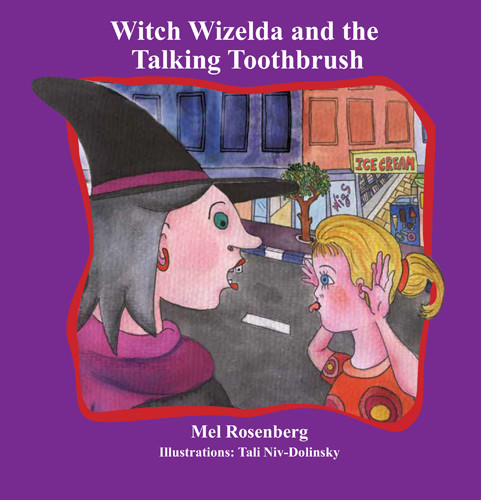
Scientists might deny that witches exist. And of course, flying on a kitchen broom defies the laws of gravity.
Storytellers have no problems with either. But they might ask whether witches get decent dental care.
Illustrations: Tali Niv-Dolinsky, from “Witch Wizelda and the Talking Toothbrush“
Scientists might argue that there is no planet at the end of the universe.
But for a storyteller, it makes perfect sense that the planet at the end of the universe is where the tooth fairies hang children’s teeth to shine and glow bright.
Illustration: Rotem Omri, From “Where the Teeth Go“

As an academic I was sensitive to the possibility of peer ridicule in my storytelling career. My first published book for children was an objective account of what bacteria are. It was published by an arm of Tel Aviv University. I was forty-five years old.
Illustrations: Tali Niv-Dolinsky, from “Bacteria Galore by Sunday at Four”
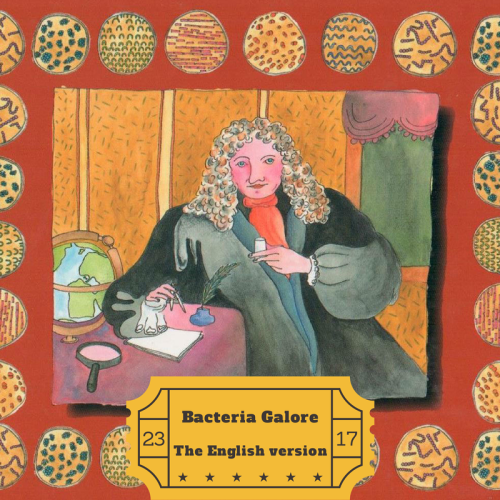
And when I subsequently began to write whimsical stories about witches and fairies, they were tooth witches and tooth fairies. The books thus had some connection with my scientific career at the Dental Faculty. Was I a chicken? You bet.
Illustration: Tali Niv-Dolinsky, from “Witch Wizelda and the Talking Toothbrush“
Nowadays, I write about whatever I feel like. I write about performing mice and zebras, hungry lions, clever skunks, tiny singing whales, dragons and ice cream, kangaroos, porcupines, hyenas and their upside-down rooster doctor…
Illustration: Harriett Goitein, from “Why I Love Yogurt“

…fish with glasses and goggles, fraidy bears, mean businessmen, strict principals and frustrated kings, kind elevator men, and bananas with an attitude.
Heck, it only took me 64 years.
Illustration by Rotem Omri, from “Jeff the Mis-fish Meets Jimmy the Whale“.

Finally, I should add that it’s much harder to be a children’s book writer than a scientist. The chance of having a story published by a bona fide publisher is about one in 1000 or less, much less than the possibility of publishing a scientific article.
You are completely dependent on the skills of your illustrator partner.
And you are at the mercy of several difficult audiences: kids (who demand a good story), parents (who demand a story with a moral) and the child within you (who is always critical of the adult you’ve grown to be).
On the other hand, you get to invent as many wrong answers to any question as you dare. You can create a new animal in minutes (takes evolution forever), make up a new planet or even an entire universe. Or, like Lewis Carroll, concoct a new word that never existed before. A nevereverinventedbeforeweirdwerd. Or gnot.
So, after being a scientist for so many years, trying to figure out the way we are, and worrying about being wrong, I’d rather be a storyteller, worried about not getting things ‘wrong’ enough.
Published: Dec 19, 2015
Latest Revision: Jul 21, 2025
Ourboox Unique Identifier: OB-87574
Copyright © 2015