






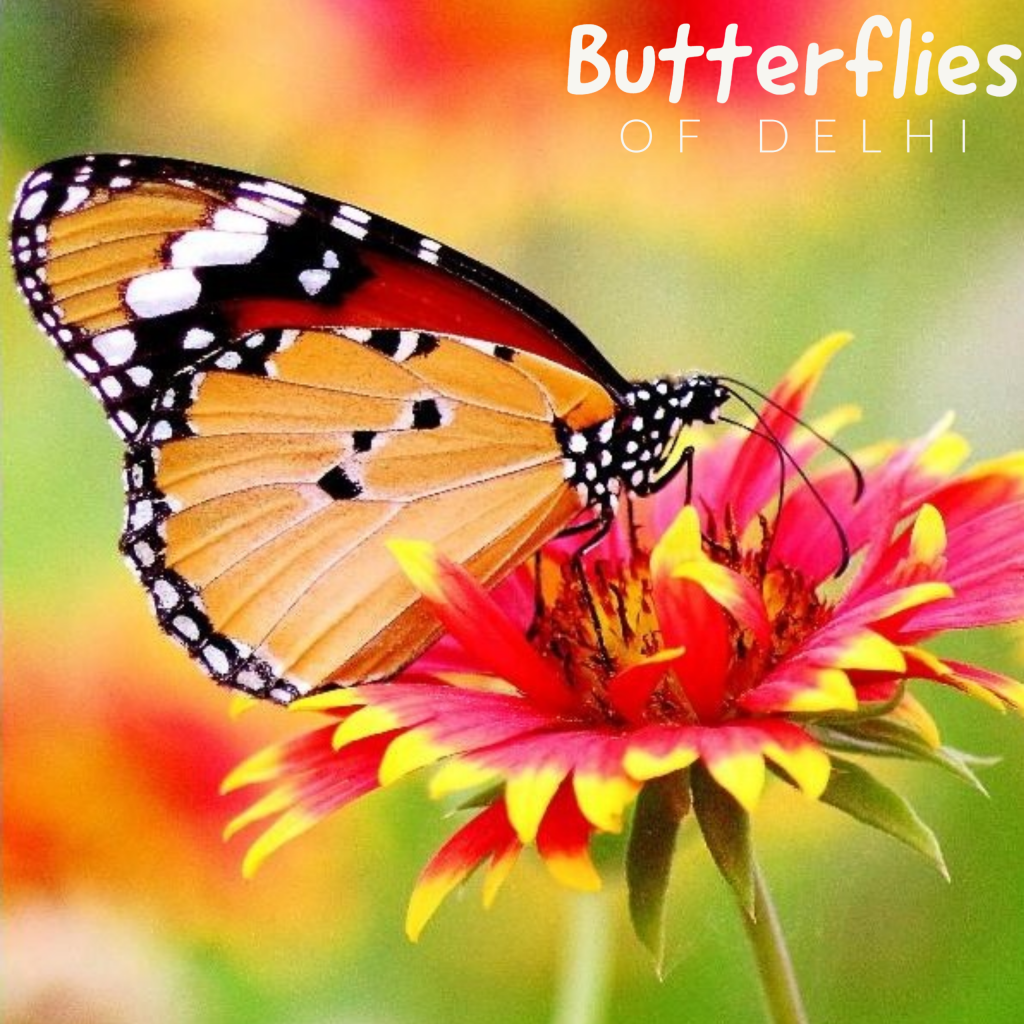
Butterflies Of Delhi

Copyright © 2021
Butterflies Of Delhi
Delhi forever has been a city of parks and gardens. These along with the ridge forest make Delhi one of the greenest of all metropolitan cities in our country. More often than not, these areas are teeming with one of the most beautiful creations of nature-The Butterflies
Our city is home to more than 100 species of butterflies. There are many suitable areas within our environs that attract large numbers of these charismatic insects. This provides us amazing opportunities to watch butterflies all year round in Delhi.
This book showcases 60 different species of butterflies, that are found in Delhi. It contains the common and scientific names and basic descriptions along with photographs, which would readily help in identifying these species. It also gives information on the very interesting life cycle of these wonderful creatures.
No single group of animals has been such a great inspiration to mankind, more than the butterflies. The intriguing life cycle of butterflies echoes the words of the Greek philosopher Heraclitus of Ephesus,
-There is nothing permanents except change.
However, the change, which we are facing in today’s world, is very alarming. We are seeing habitats being lost, the climate being changed and biodiversity being destroyed. The adverse impact of these changes is extremely severe on many species and butterflies are getting no special treatment for being so beautiful.
I hence urge one and all to become more proactive in protecting these species and their habitats. I hope that this book helps in promoting these pristine jewels of our mother nature and ultimately results in providing them a secure future.
Happy Butterflying!
Life Cycle of Butterflies
The life span of a butterfly varies from a few weeks to a few months depending on the factors like species, food availability, latitude, local weather conditions, predation, etc.
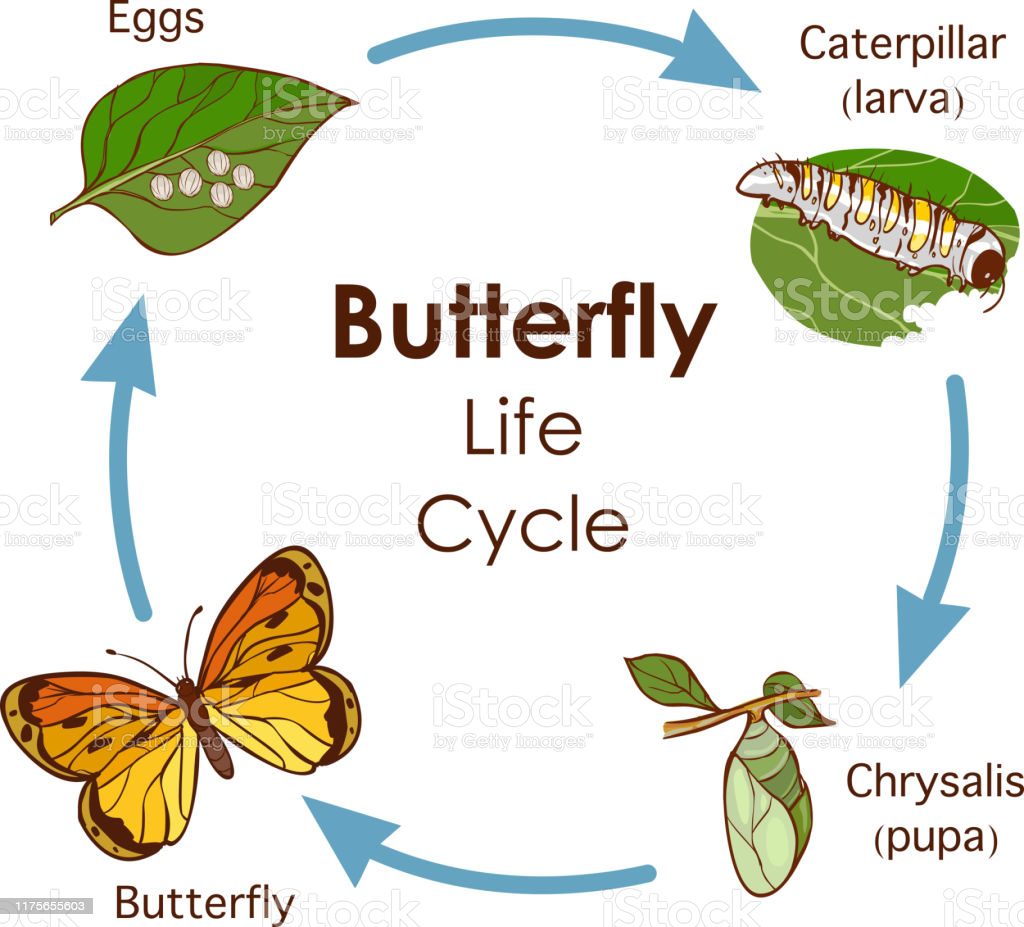
The life cycle of butterflies however is a more intriguing phenomenon. Every butterfly goes through four distinct stages in its life viz., Egg, Larva (Caterpillar), Pupa, and Adult. The time spent in each stage again may vary depending on many factors.
The complete metamorphosis of a butterfly from egg to an adult is one of the most captivating events which nature has offered us to cherish.
(1)
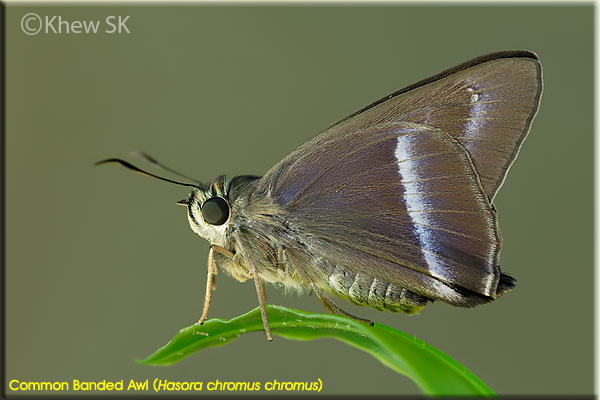
Common Banded Awl Hasora Chromus
45-50mm Wingspan
This common skipper is seen mostly near wet patches, which have its food plants. Male is dark chocolate colored on the upper portion with the distinctive white transverse band on the purplish underside of the wings. The female has two yellowish-white spots in the disc area of the wing. Larva feed primarily on Pongaria pinnata and Ricinus communis.
(2)
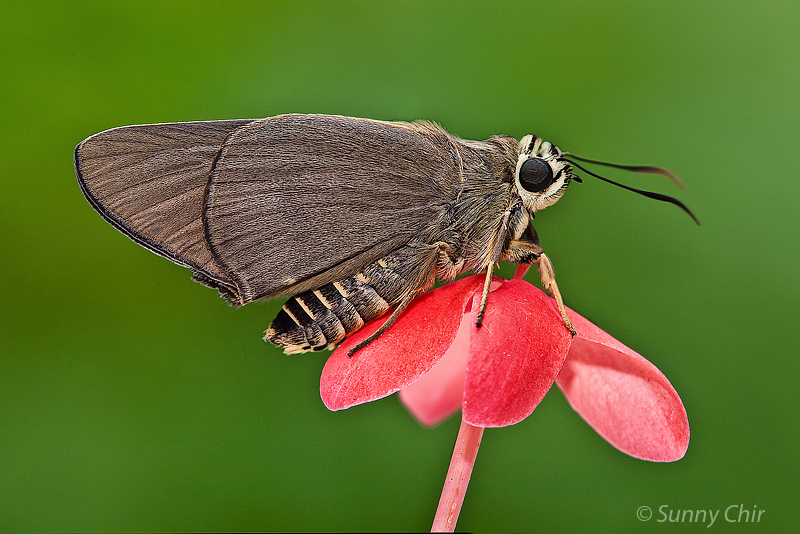
Brown Awl Hasora chromus
50-55mm Wingspan
This species can be identified by the pointed brownish wings and eyes. It can be found mostly in forested areas skipping energetically during the early morning hours. It can be spotted easily in damp patches and bird droppings. The butterfly is dark brown and pale yellow. Combretum, Terminalia, and Ficus are the major larval food plants.
(3)
Indian Skipper Badamia Exclamationis
20-27mm Wingspan
A small skipper has distinctive white spots on its black wings with a chequered hairy fringe. The sexes are a bit alike but the female is larger than the male and has darker and smaller spots on the upper side. Mostly found in grasslands and forests resting on tips of grass blades and branches. Larvae can be seen feeding on Hibiscus spp.
(4)
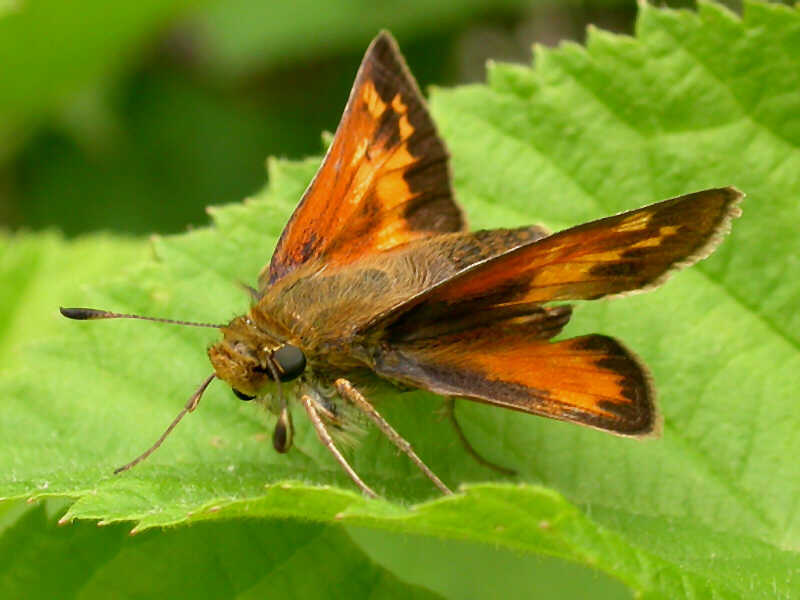
Small Branded Swift Pelopidas mathias
32-38mm Wingspan
It is the commonest of the skippers in Delhi and is found in almost all habitat types here. They can be seen in large numbers during and after the monsoons. Mostly active during early morning and late evenings when it can be seen flying very swiftly. The butterfly is predominantly brown with a golden sheen. Larvae feed mainly on different grass species.
(5)
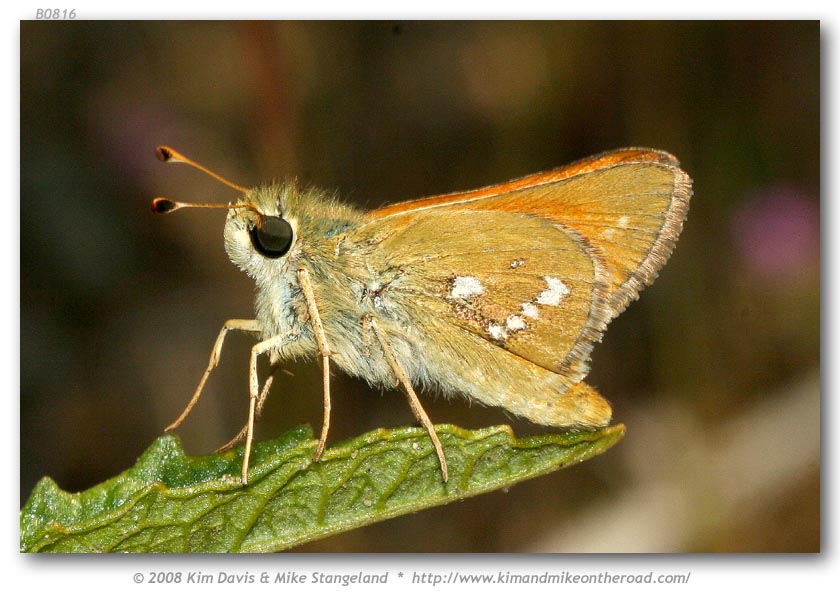
Indian Palm Bob Suastus gremius
32-45mm Wingspan
This is a sun-loving skipper easily found on flowers, damp areas, and bird droppings. It gets its name from the fast dipping flight shared by other bobs. It is easily identified with the help of the distinctive black spots on the underside of the wings. The larvae feed mostly on different species of palm trees, thereby lending it the name.
(6)
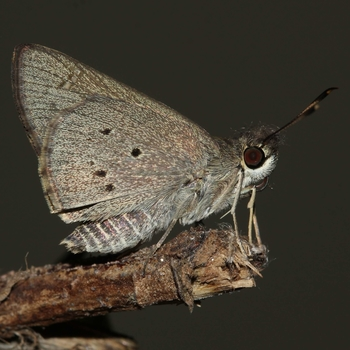
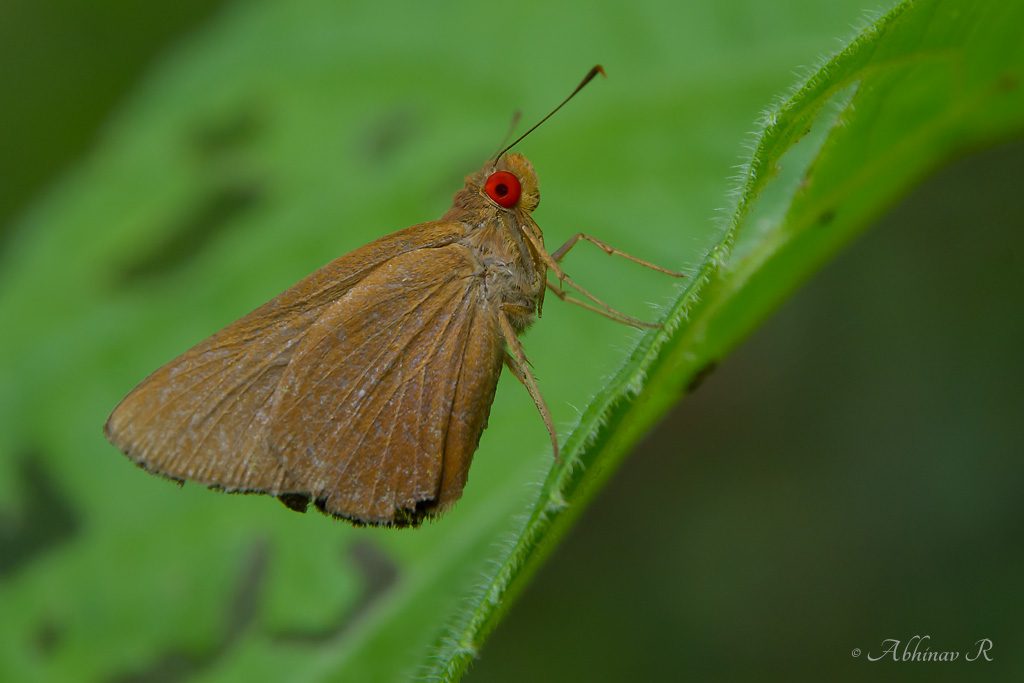
Common Redeye Matapa aria
40-55mm Wingspan
The species are found mostly near bamboo thickets and edges of forests. The flight is very rapid and it visits flowers occasionally. The dark redeye and the earthy brown wings without any patterns are the distinguishing features of this skipper. Bamboos form the exclusive food for the caterpillars of this species.
(7)
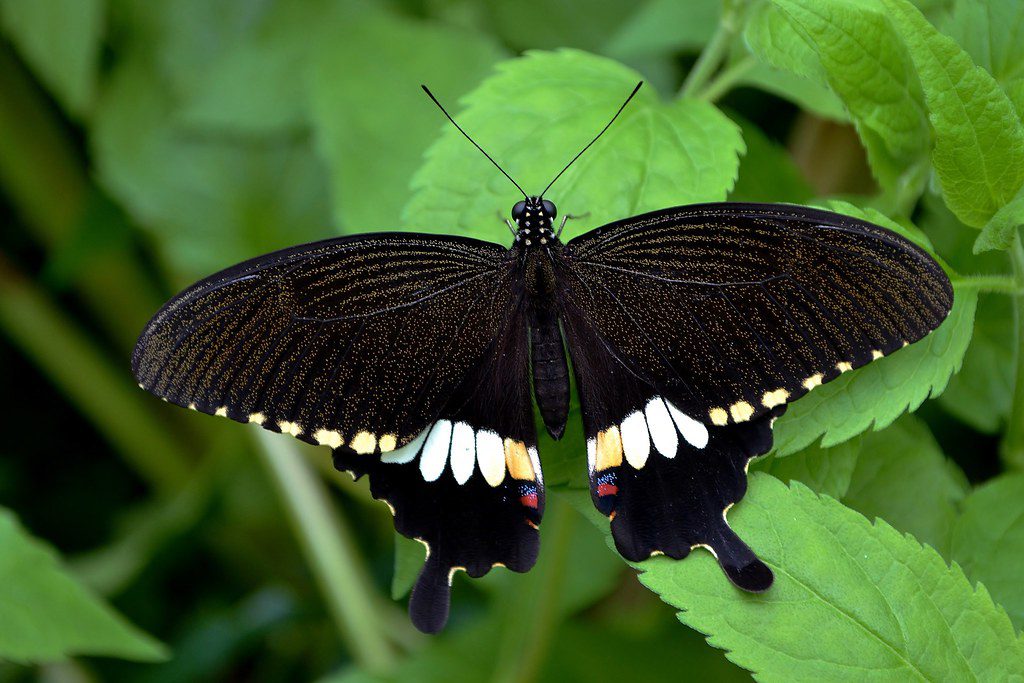
Common Mormon Papilio polytes
90-100mm Wingspan
It is one of the most commonly seen butterflies. The male is glossy black on the upper side with white spots in the hind wing. The females of the different forms mimic other species of butterflies for protection from predators. The larvae feed mostly on lime and curry leaf plants.
(8)
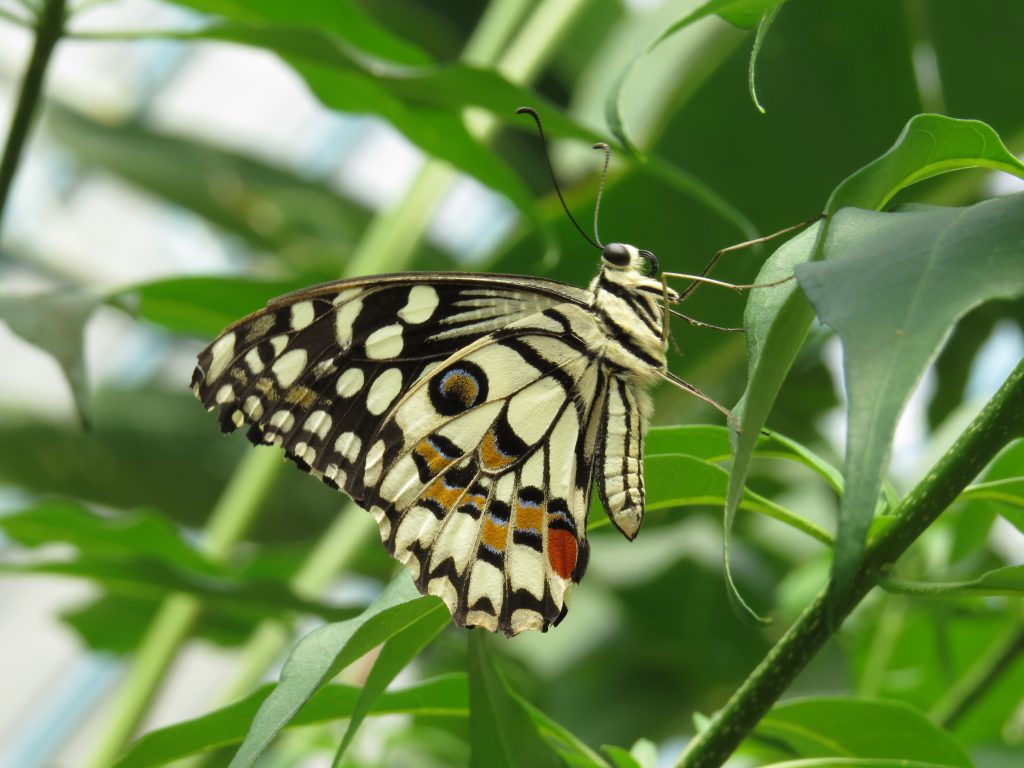
Lime Butterfly Papilio demoleus
80-100mm Wingspan
This is the commonest of all swallowtails. It is a large, tailless butterfly with numerous yellow spots on black wings. It prefers open areas and can be seen mudpuddling in groups in many gardens and grassy patches. As the name indicates, the caterpillars feed on many lime plants and also on curry leaves.
(9)
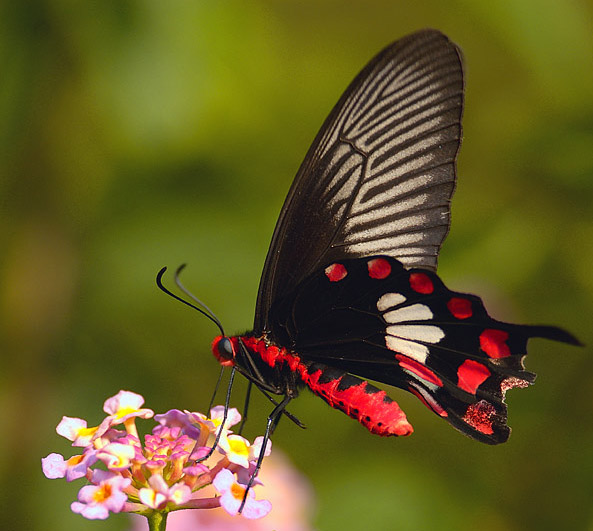
Common Rose Atrophaneura aristolochiae
80-110mm Wingspan
It is easily identified by a reddish body and large black forewings with white markings. The hind wings have white and red spots with a black tail. The butterfly is poisonous to many predators and is not easily attacked. It is mimicked by one female form of the Common Mormon. Larval food is mainly from the species of genus Aristolochia.
(10)
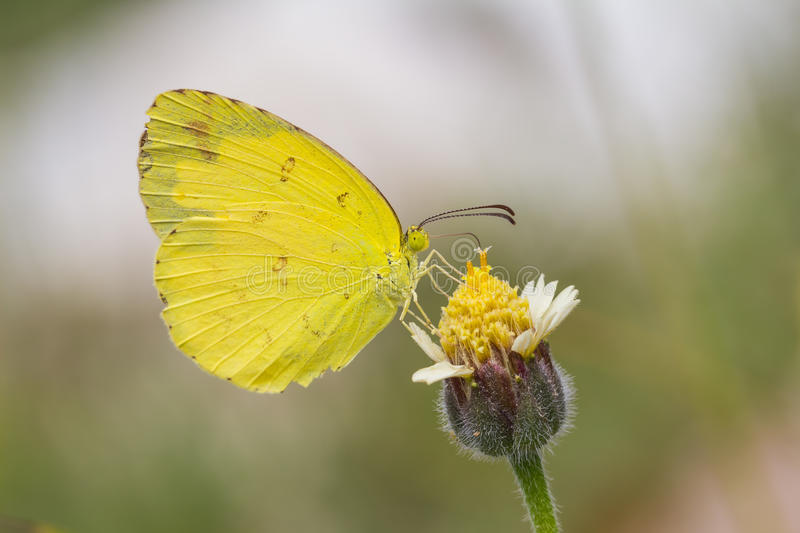
Small Grass Yellow Eurema brigitta
30-40mm Wingspan
A small bright yellow-colored butterfly found commonly on flowers in degraded habitats near forest areas. The wings are more rounded and are rusty spotted on the underside. Both the sexes are similar, however, the female has slightly broad marginal patches in the upper side of the wing. They are found to migrate to different regions. The larval food plants are the species of the legume family.
(11)
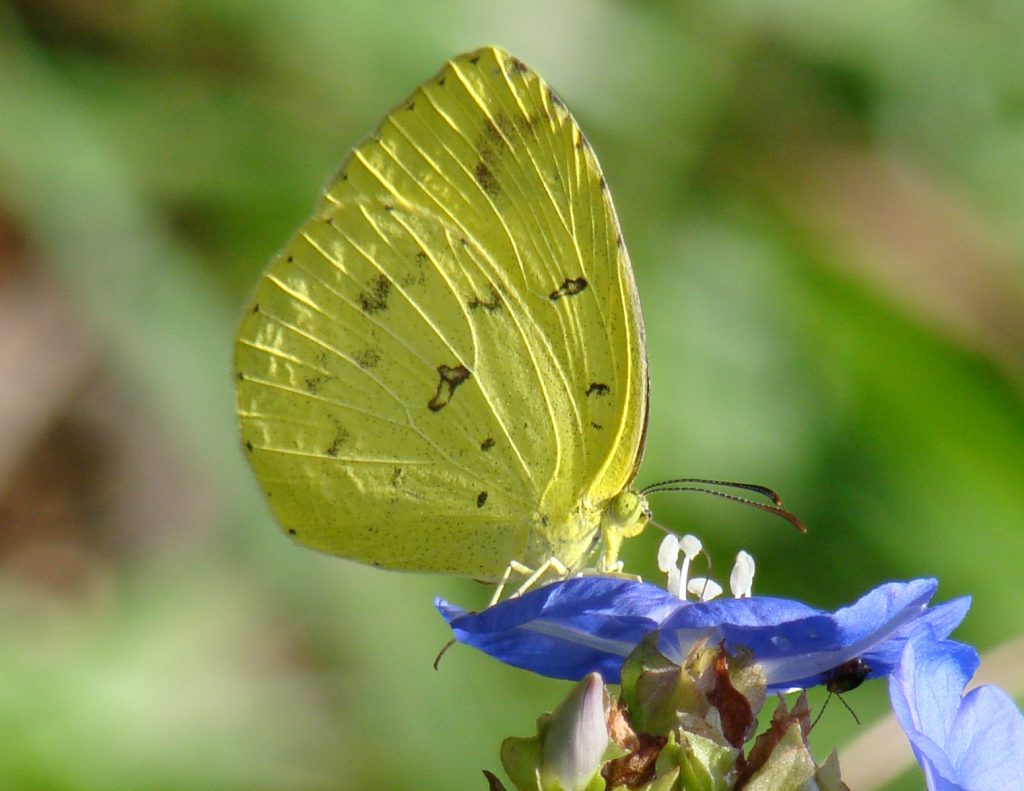
Common Grass Yellow Eurema hecabe
40-50mm Wingspan
Fairly common butterfly seen in many gardens and parks of Delhi. The underside of the wings is yellow with prominent rust-colored spots. The prominent Black Margin of the upper side is slightly visible even when the butterfly is alighted with the wings in the folded position. Larvae feed on leguminous plants.
(12)
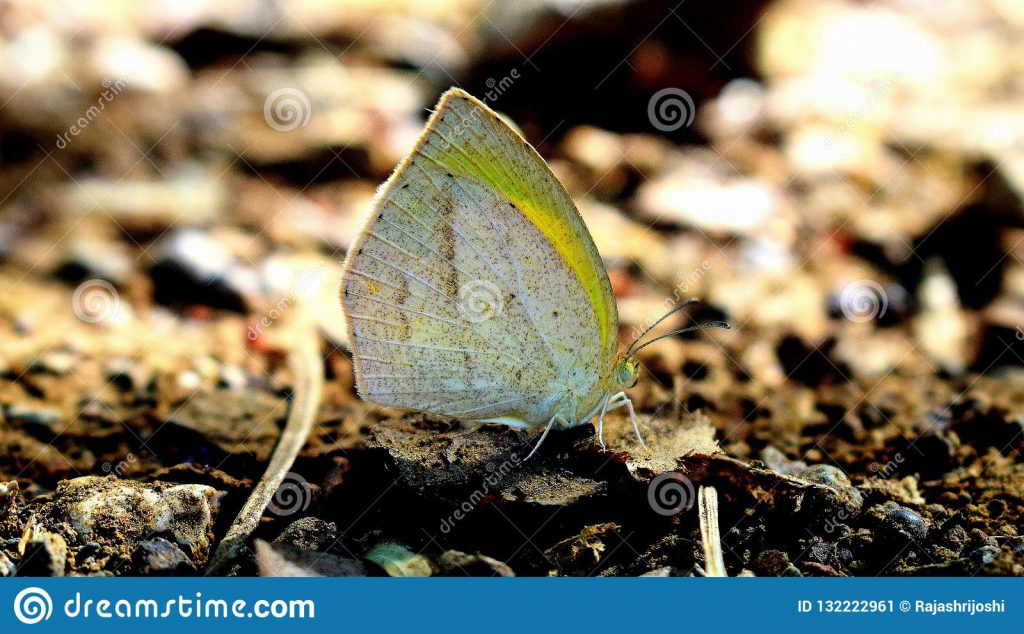
Spotless Grass Yellow Eurema laeta
30-45mm Wingspan
As the name indicates, this species does not have easily recognizable spots on the wings. There are distinct wet and dry season forms and the former is brightly yellow-colored and the latter is camouflaged. Like other yellows, the larvae of this species also prefer leguminous plants for food.
(13)
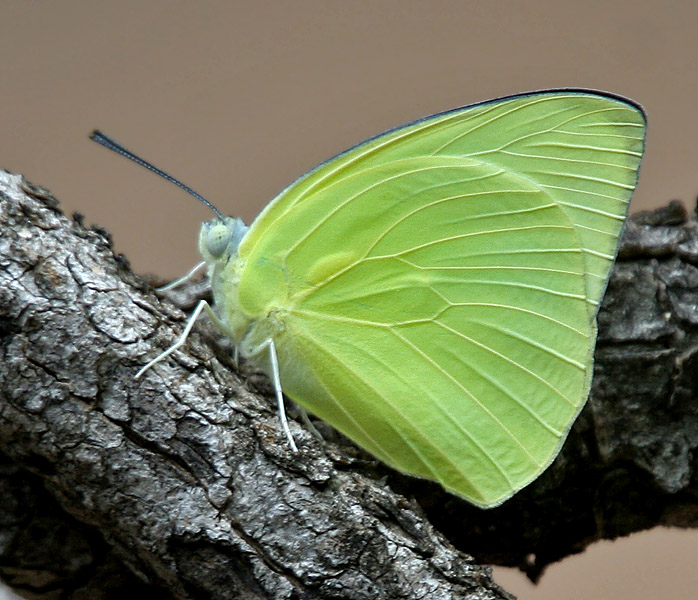
Common Emigrant Catopsilia pomona
55-80mm Wingspan
A common butterfly is seen during most months of a year, found flying in an erratic but distinctive pattern. They are also seen mudpuddling in large numbers in wet patches during dry weather. The wing color is dull yellow to greenish-white without markings. Larvae are fond of feeding on Cassias.
(14)
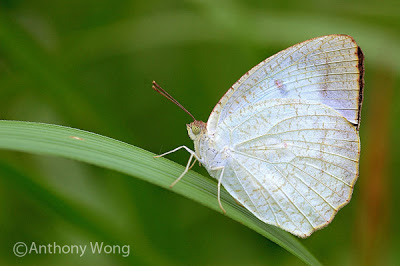
Mottled Emigrant Catopisilia pyranthe
50-70mm Wingspan
This butterfly gets its name from the flecked or mottled appearance of the underside of the wings. The color varies from chalky white to green with distinguishing silver spots in the center. They can be found migrating in large swarms. Cassias are the flavored food plant of the caterpillars.
(15)
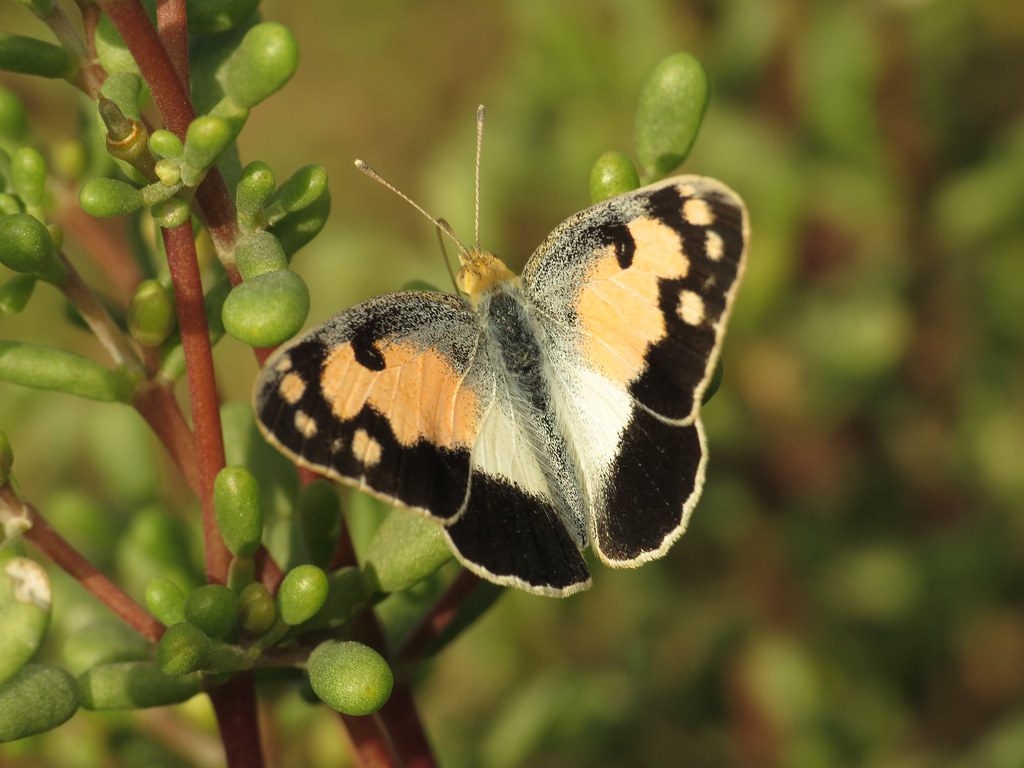
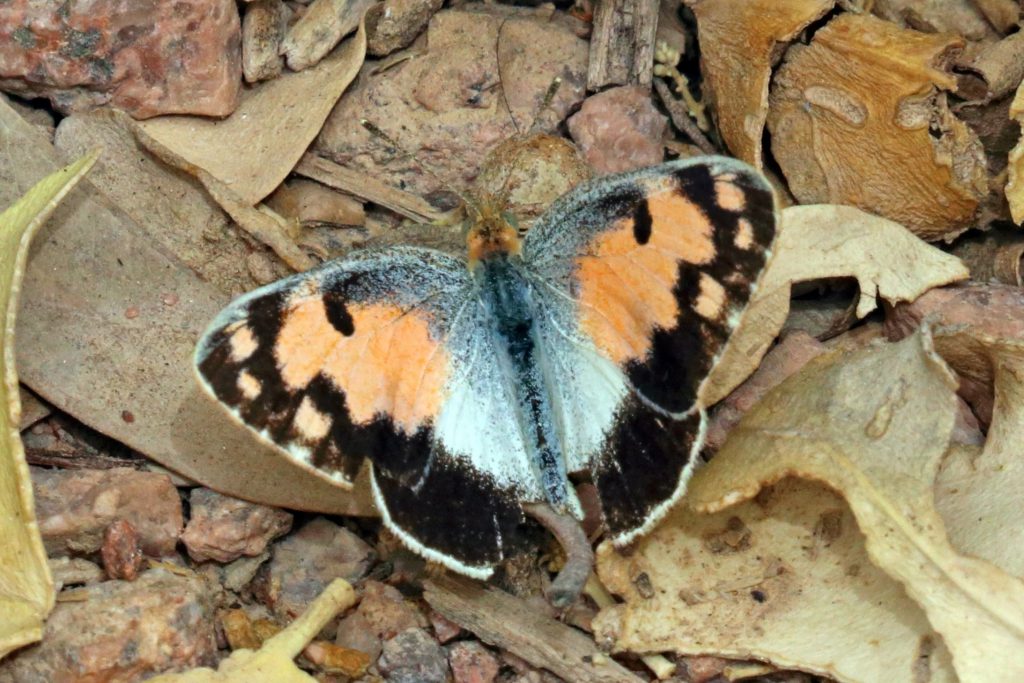
Small Salmon Arab Colotis amata
35-50mm Wingspan
As a butterfly of the coastal region, its common presence in Delhi makes it unique. The species is identified by the salmon-pink upper wing with a black margin and greenish-yellow underside. The sub-species found in Delhi might be an invader from some other region. Larval food in Delhi needs to be researched upon.
(16)
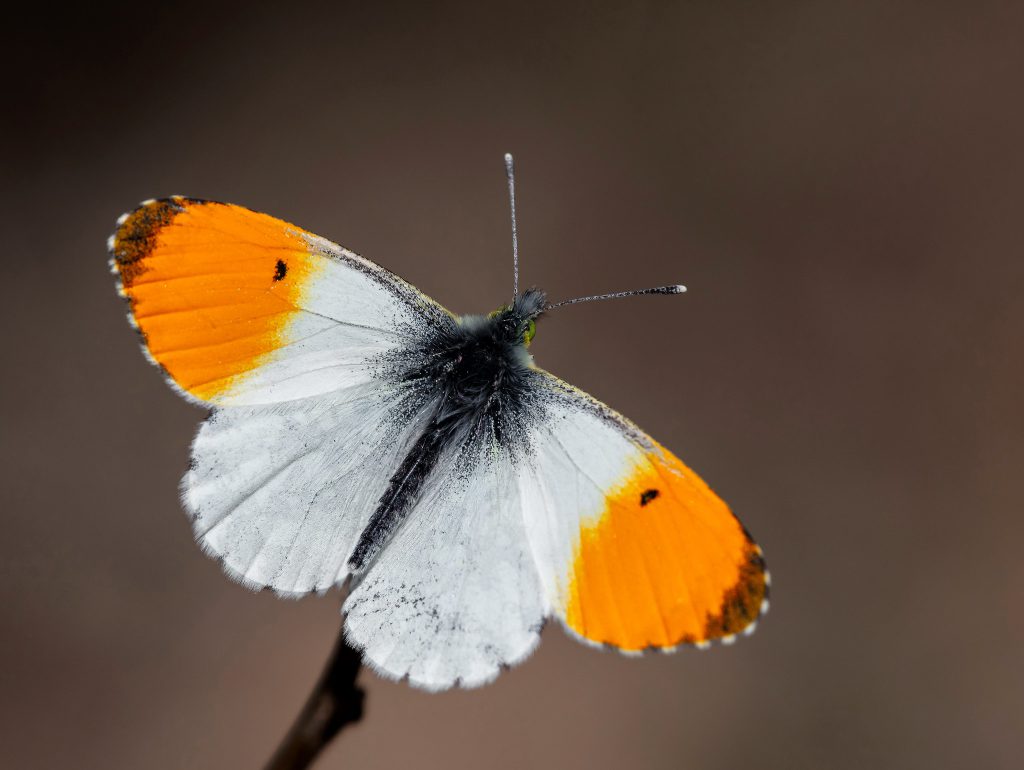
Small Orange Tip Colotis etrida
24-45mm Wingspan
This is one of the most common butterflies of Delhi and is usually found in open places with lots of flowers. The orange tips with a black border on the upper side of the white forewings are distinct features. It does not visit damp areas and can be seen throughout the year. The best food suited for the caterpillars is Capparis spp.
(17)
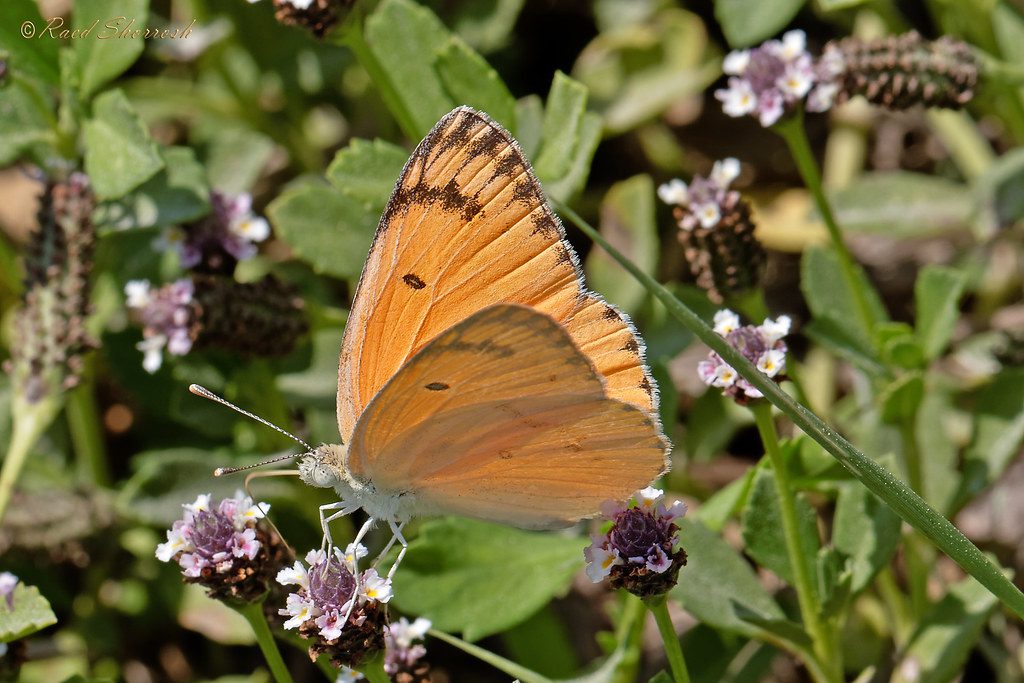
Large Salmon Arab Colotis fausta
40-50mm Wingspan
True to the name, the male of this species has salmon pink upper wings with dark margins and distinctive spots of the forewings. The male is dimorphic and varies from salmon pink to white color. Usually seen in rapid flights in open areas visiting flowers. Larvae feed primarily on Maerua spp.
(18)
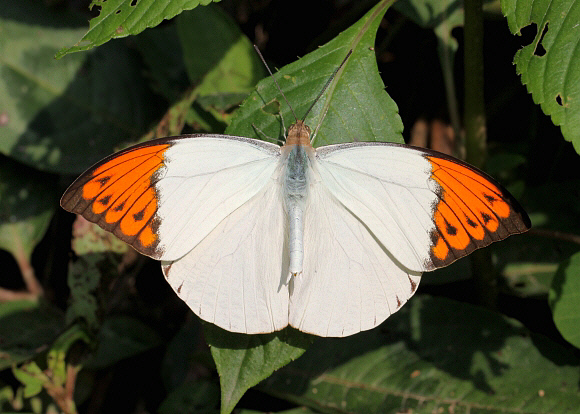
White Orange Tip Ixias marianne
50-55mm Wingspan
This is one of the most attractive butterflies seen in Delhi. Due to the bright orange marking on the edge of the upper forewings and rapid dancing flight. Often seen basking in sunny portions of deciduous and thorn forests. This species has marked dry and wet season forms with different spot patterns. Caterpillars feed on Capparis spp.
(19)
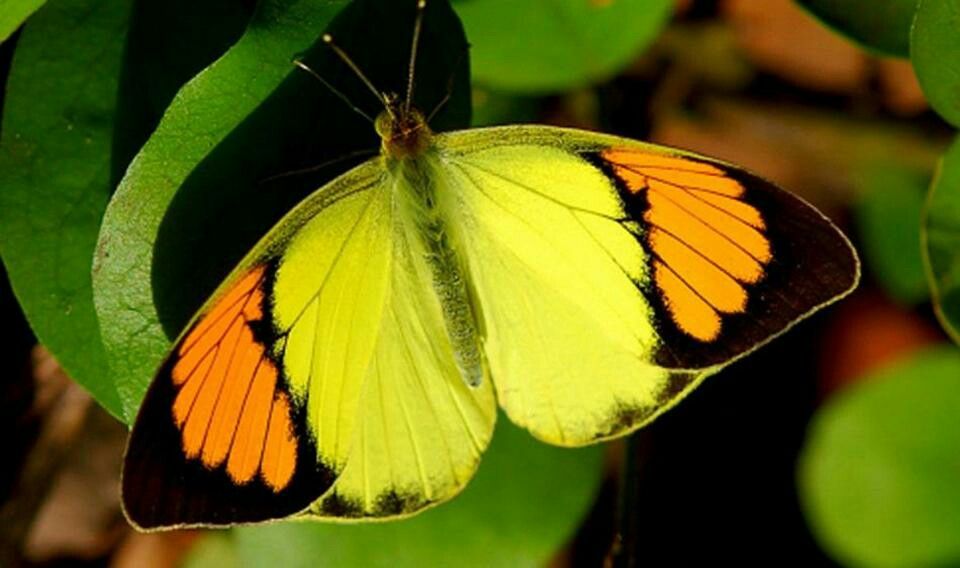
Yellow Orange Tip Ixias pyrene
50-70mm Wingspan
Another commonly seen butterfly, especially in the deciduous and thorn forests of the ridge, the male has yellow wings with distinctive orange tip within black margins on the upper side. The female is dull yellow with paler markings. Visits flowers and damp patches regularly. Larval food is comprised of different species of Capparis.
(20)
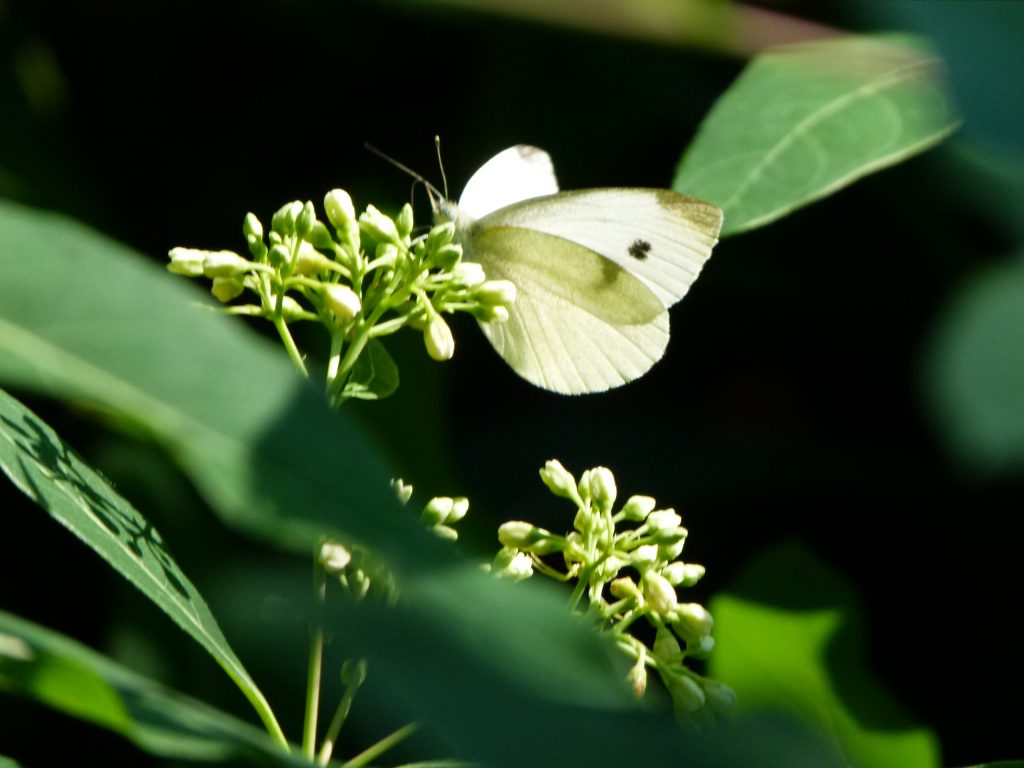
Indian Cabbage White Pieris canidia
45-60mm Wingspan
A hill butterfly, which visits Delhi mostly during winters. Seen flying haggardly in open spaces around shrubs. The upper side of the wing is white with distinctive black spots and margins while the underside has a dash of yellow. Caterpillars feed in cabbage and related plants and this has given the species its name.
(21)
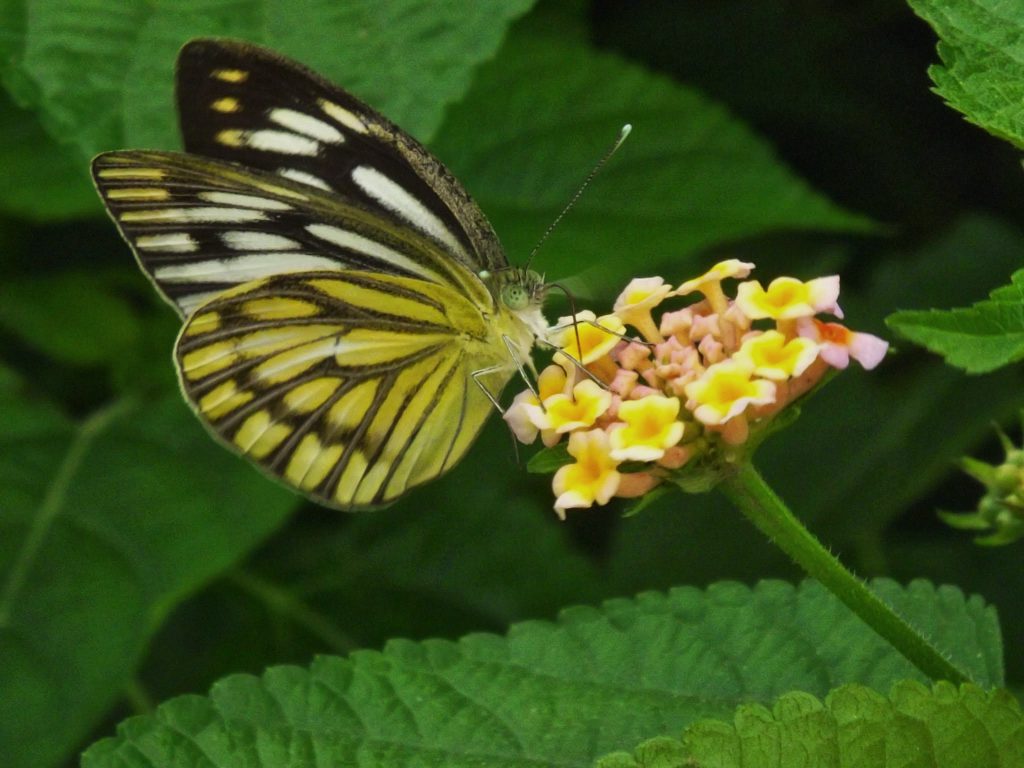
Common Gull Cepora nerissa
40-65mm Wingspan
One of the most common butterflies of Delhi known for its vibrant flight and color. It is seen throughout the year in all types of habitats frequenting flowers and damp patches. The yellow wings have distinctive dark veins and white patches. Capparis spp. are the preferred food plants for the caterpillars.
(22)
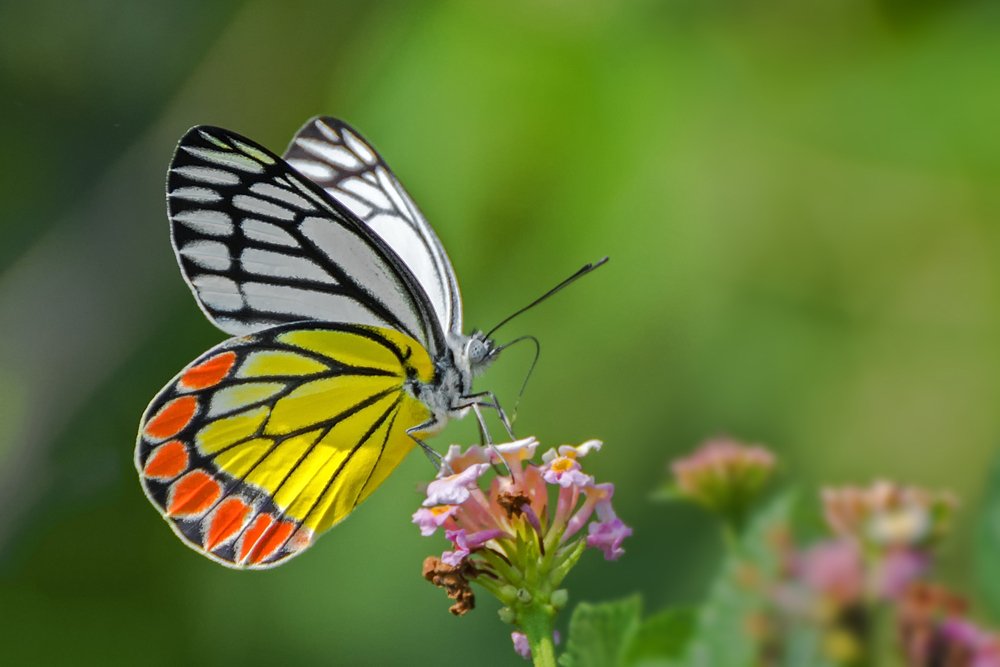
Common Jezebel Delias eucharius
66-83mm Wingspan
A brightly charismatic butterfly seen flying slowly amidst a wooded region. It is seen frequenting flowers and damp areas. The underside of the hind wing has a splash of yellow and very distinctive red spots circumscribed by white rings. Larvae feed on parasitic plants found on different trees.
(23)
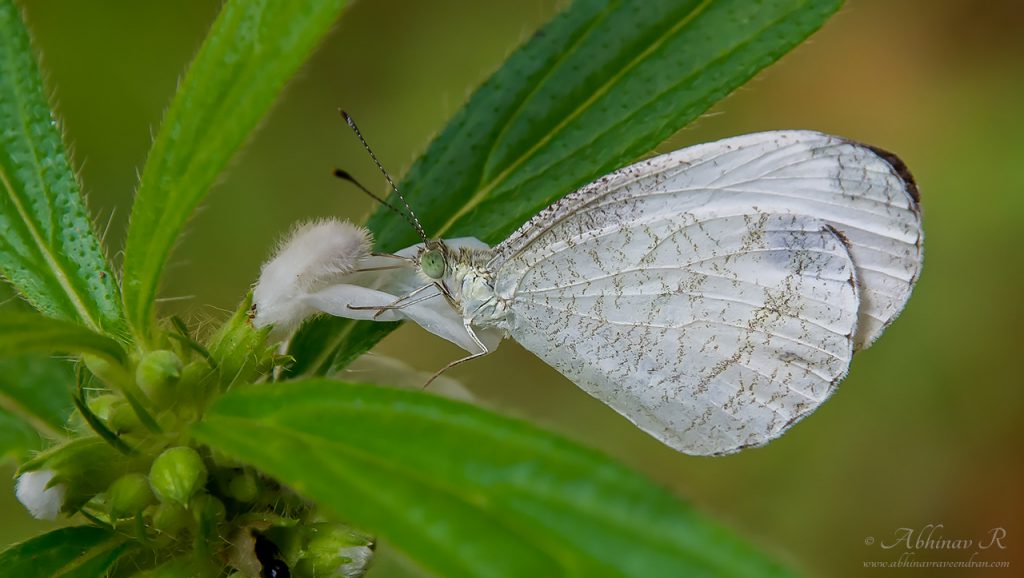
Psyche Leptosia nina
35-50mm Wingspan
A pale white butterfly, which is known for its very weak flight below knee level of observers. It has a black margin and conspicuous black spot on the upper side, which is rarely seen as it rests almost always with the wings folded. The underside of the wings is spotless white. Caterpillars found feeding on different species of Capparis.
(24)
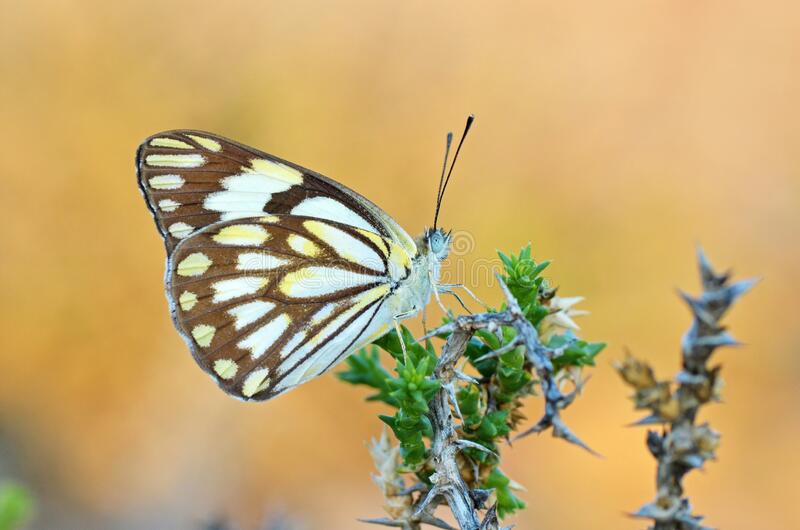
Pioneer Belenois aurota
40-55mm Wingspan
This species is also called Caper White and is distinguished by the hockey stick-shaped marking on the forewings. It is a well-known migrant and has dry and wet season forms, which are white and yellow respectively. Capparis spp. are the main food plants for the larvae.
(25)
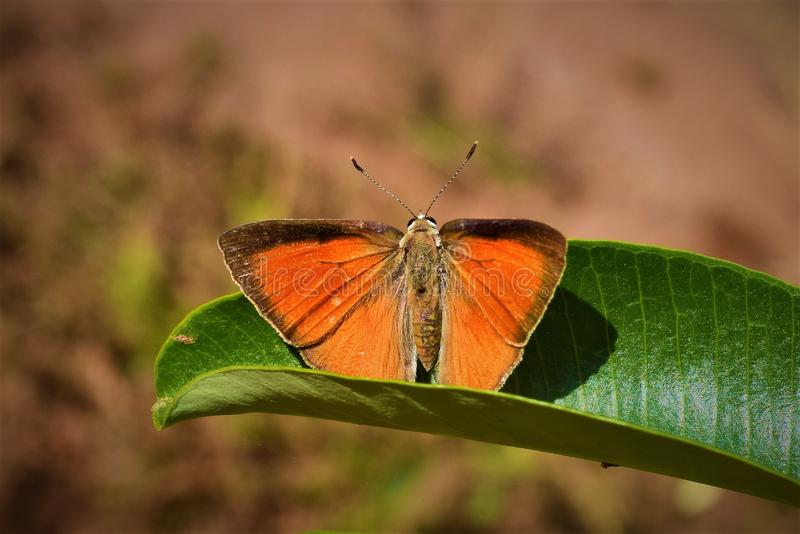
Indian Red Flash Rapala iarbus
33-41mm Wingspan
This butterfly is aptly named for its habit of flashing the bright red upper side of the wings while resting. The upper side also has black marking while the undersides are earthy brown. It is more commonly seen flying rapidly over plain areas. The caterpillar’s forage on a wide variety of plants.
(26)
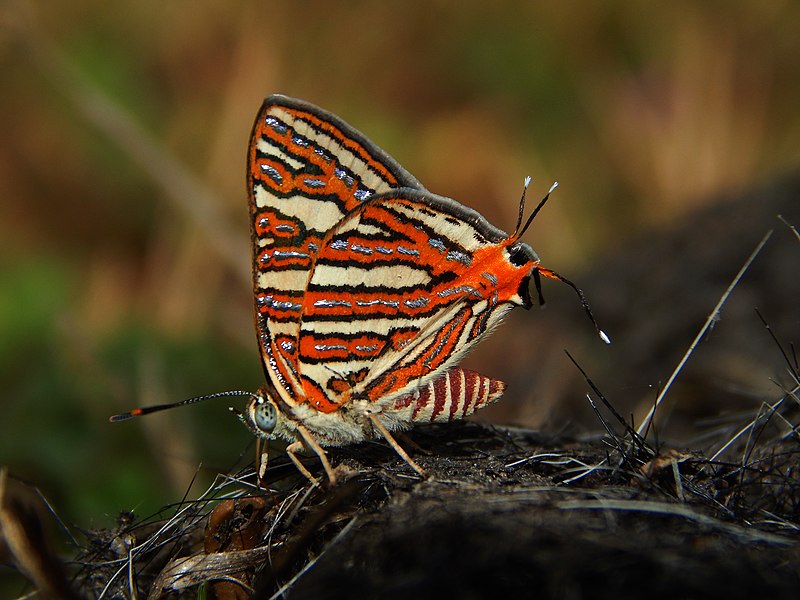
Common Silverline Spindasis vulcanus
26-34mm Wingspan
This species is easily identified by the underside of the wings with bright orange bands, which have a central lining that gives it the name. The hind wings have tails and a lobe. Prefers wooded areas and gardens and frequents flowers and bird droppings. The caterpillars are helped by certain ants for clearing their honey glands.
(27)
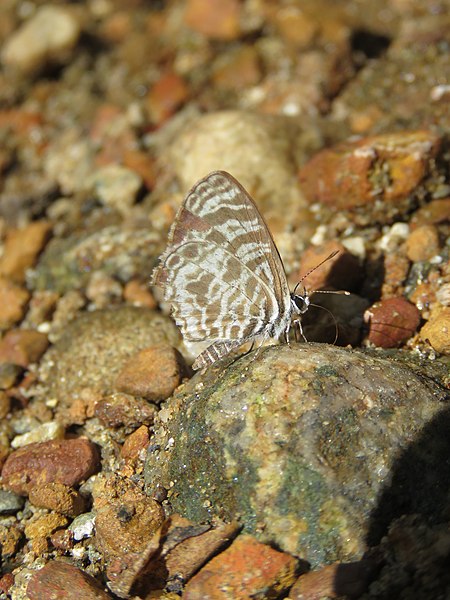
Zebra Blue Leptotes plinius
22-30mm Wingspan
Leptotes Plinius, the zebra blue or plumbago blue, is a species of blue butterfly (Lycaenidae) found in Sri Lanka, India to Australia. This butterfly is easily distinguished by the zebra-like pattern on the underside of the wings. Males have a violet-blue upper part while females are brownish with a blue base. Found flying rapidly in drier areas and also seen mudpuddling with other blues. Larval food is mainly comprised of leguminous shrubs and trees.
(28)
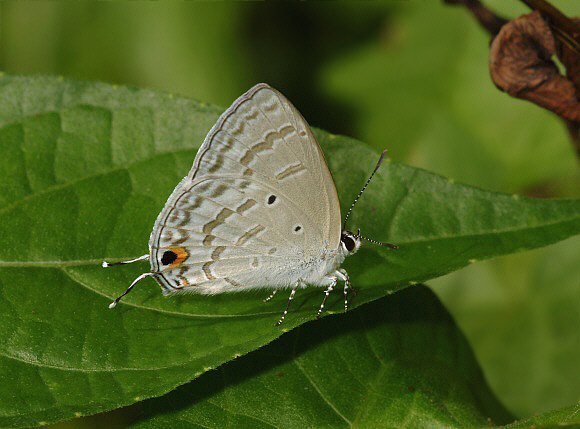
Forget-Me-Not Catochrysops strabo
25-35mm Wingspan
Catochrysops Strabo, the forget-me-not, is a small butterfly found in Asia that belongs to the lycaenids or blues family. It is found in Sri Lanka, India, from Sikkim to Indochina, and in Sundaland, Sulawesi, and the Philippines. Males have bright sky blue upper side while females are paler. The underside has pale markings and the hind wings have elegant tails with a circular black and yellow spot. The larvae feed on legumes and are attended by ants.
(29)
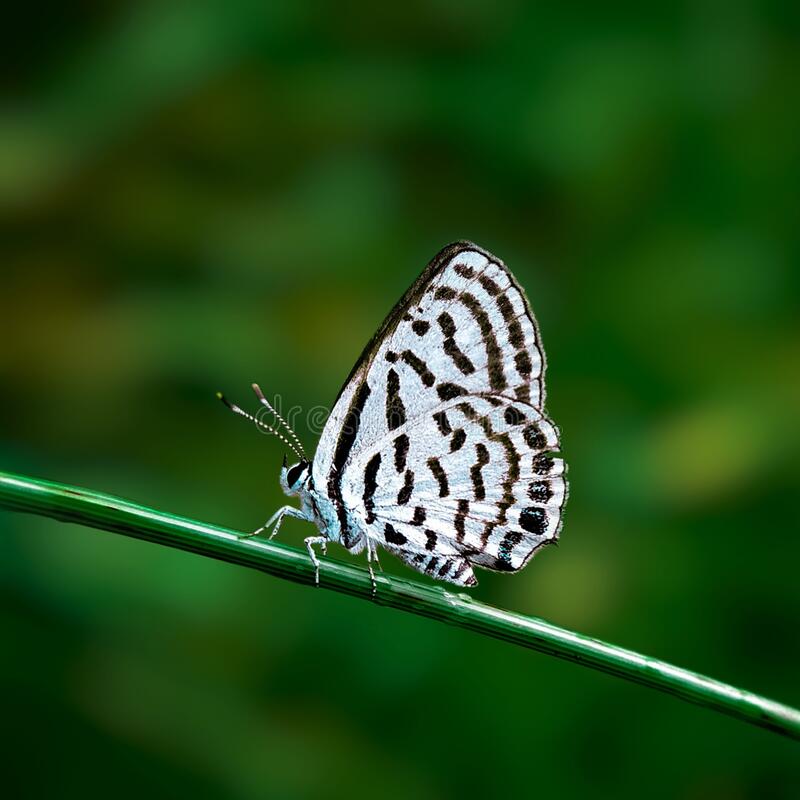
Rounded Pierrot Tarucus nara
23-28mm Wingspan
It is commonly seen in dry wooded regions. The underside is white with broad streaks of black color. Upperparts of wings are pale violet to blue in the male and brown in female. Wings are rounded and slender tails are present in the hind wing. Caterpillars feed almost exclusively on Zizyphus spp.
(30)
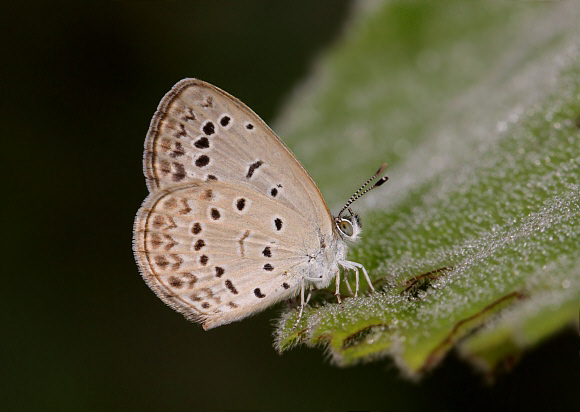
Dark Grass Blue Zizeeria karsandra
18-24mm Wingspan
Zizeeria karsandra, the dark grass blue, is a small butterfly. It belongs to the lycaenids or blues family, and the tribe Polyommatini. It is usually seen flying low in grassy areas. The hind wing is tailless and the underside has round black spots. The upper side of the male is purplish with a black margin while the female is brown. Found throughout the year, especially during and after the rains. Larvae feed on many different species.
(31)
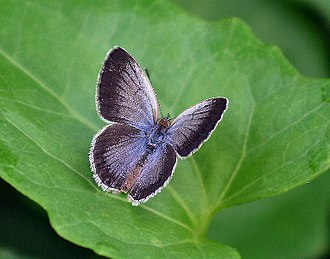
Pale Grass Yellow Pseudozizeeria maha
26-30mm Wingspan
Pseudozizeeria maha, the pale grass blue, is a small butterfly found in South Asia that belongs to the lycaenids or blues family. The species was first described by Vincenz Kollar in 1844. The underside of this species has very faint rounded black spots. The upper side of the wing is pale pink in the male with a brown margin and the female is dark brown.
(32)
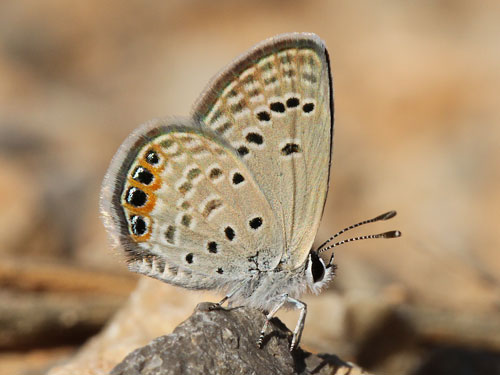
Grass Jewel Freyeria trochylus
15-22mm Wingspan
The grass jewel is a small butterfly found in Africa, Arabia, southern Europe, India, and southern Asia that belongs to the lycaenids or blues family. This is one of the tiniest butterflies of India. The hind wing is tailless and both the sexes are brownish above. The underside of the hind wing has a distinguishing pattern of four black spots, border by orange. Larvae feed on a wide range of leguminous plants.
(33)
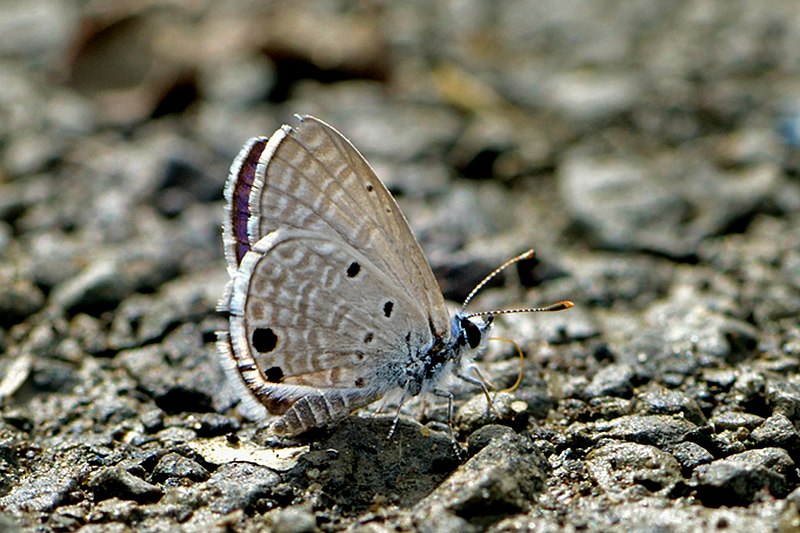
Dull Babul Blue Azanus uranus
20-25mm Wingspan
Azanus uranus, the dull babul blue or Indian babul blue, is a small butterfly found in India that belongs to the lycaenids or blues family. It is often spotted in dryer parts of the wooded areas. The male is dull blue above with distinct black borders, while the female has bluish scales and broad borders on the edges of the wings. Four spots on the underside are unmistakable. The caterpillars show mark preference to Acacias, which give it the name Babul Blue.
(34)
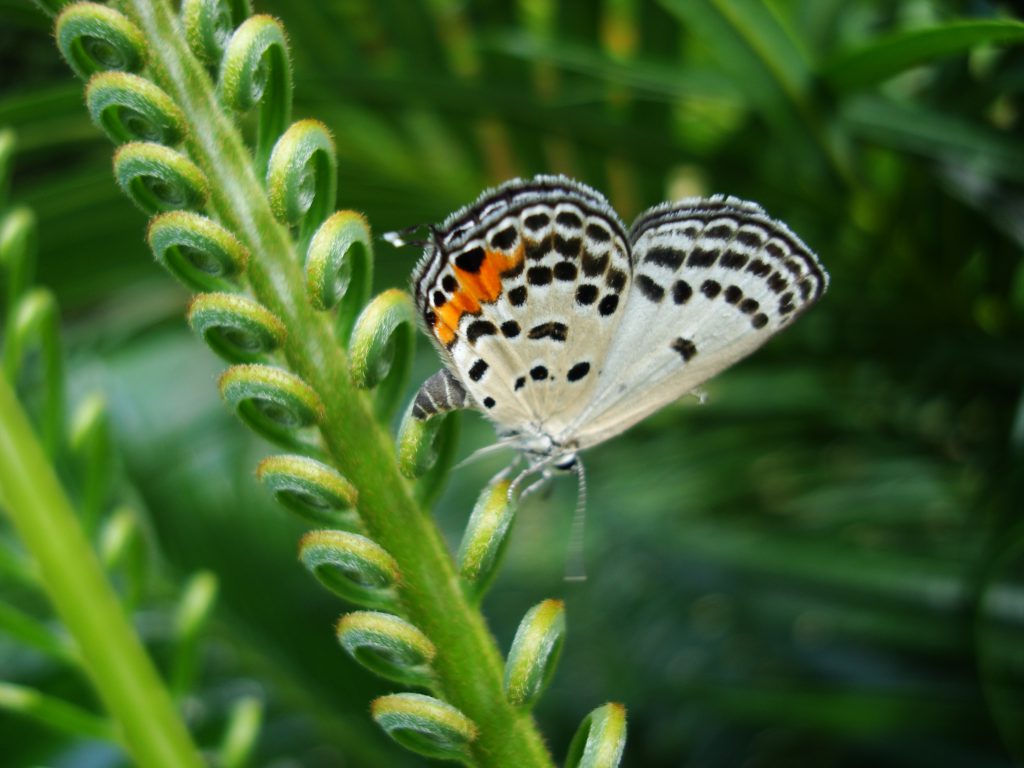
Red Pierrot Talicada nyseus
30-36mm Wingspan
The red Pierrot, is a small but striking butterfly found in the Indian subcontinent and South-East Asia belonging to the lycaenids, or blues family. The red Pierrots often found perching on its larva host plant, Kalanchoe, are usually noticed due to their striking patterns and colours. The hind wing is tailed and has a bright orange area on the upper side, which is otherwise black. The underside is white with black spots. The orange-red marginal band is also distinctive. Larvae feed on ornamental Kalanchoe spp.
(35)
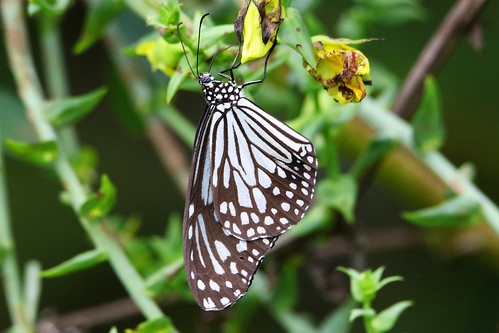
Blue Tiger Tirumala limniace
90-100mm Wingspan
The blue tiger is a butterfly found in South Asia and Southeast Asia that belongs to the crows and tigers, that is, the danaid group of the brush-footed butterfly family. This butterfly shows gregarious migratory behavior in southern India. The pale blue streaks and spots on the brownish wings are distinctive. The adults alight on many flower species for nectar and the larvae also feed on different species.
(36)
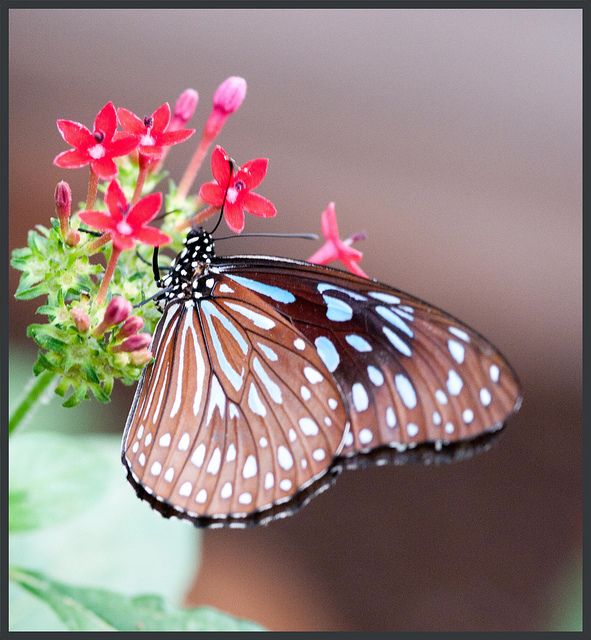
Striped Tiger Danaus genutia
72-100mm Wingspan
This yellowish-brown butterfly with clear black veins and white spots is seen in almost all habitat types of Delhi. Often seen roosting or migrating with other species. It is seen in large numbers during and after the rains. The caterpillars feed mostly on milkweed plants, while the adults prefer a variety of flowers.
(37)
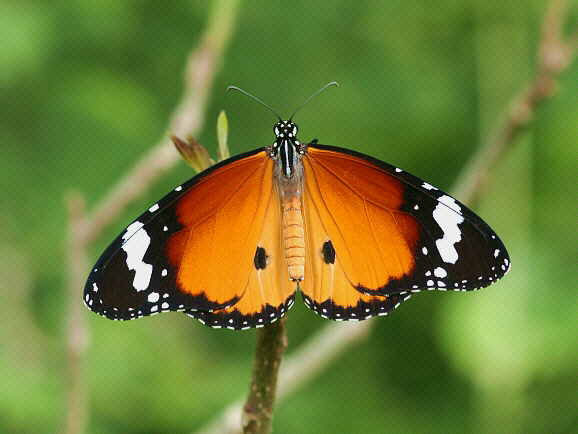
Plain Tiger Danaus chrysippus
70-80mm Wingspan
The Plain Tiger or African queen, is a medium-sized butterfly widespread in Asia, Australia, and Africa. It belongs to the Danainae subfamily of the brush-footed butterfly family Nymphalidae. It is the most common and hence the most easily, recognized of the Delhi butterflies. The patterns on the yellow-orange wings with black margins are the same as the Striped Tiger but without the veins. The butterfly is also mimicked by other species. Caterpillars feed on milkweeds while adults prefer flowers of many families
(38)
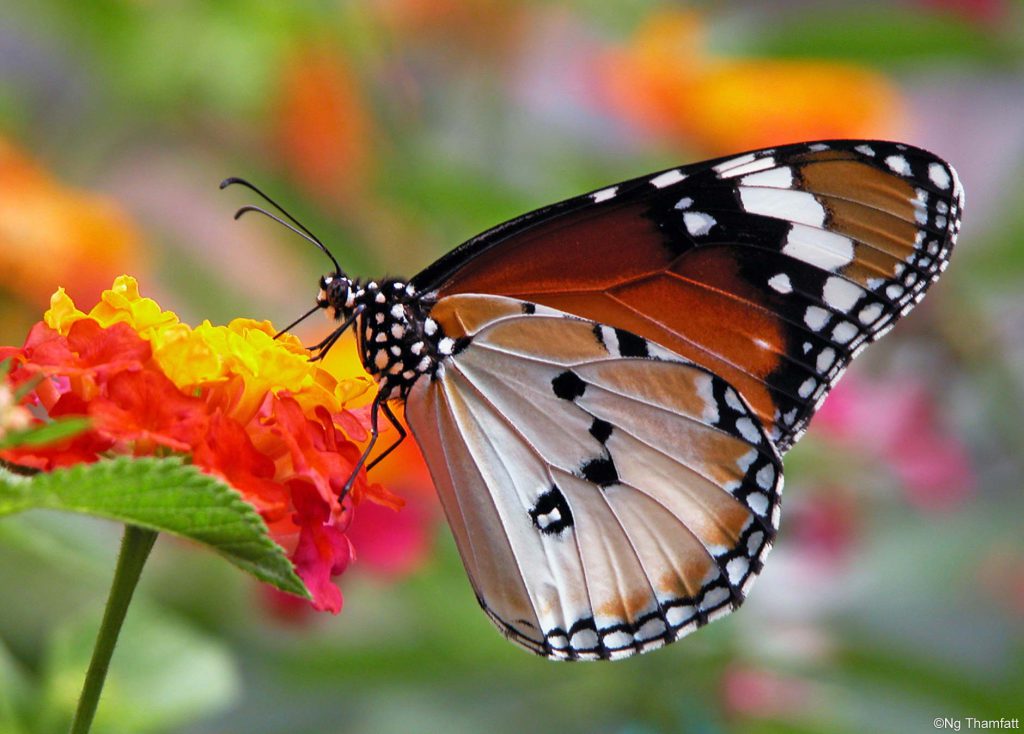
Common Crow Euploea core
85-95mm Wingspan
Euploea core, the common crow, is a common butterfly found in South Asia to Australia. It belongs to the crows and tigers subfamily Danainae (tribe Danaini). The adult has a black body with white spots. The wings are brown with two distinctive rows of white spots. The larvae prefer Nerium spp. While the adults are known to feed on flowers, roots, damaged leaves, and stems of many plants.
(39)
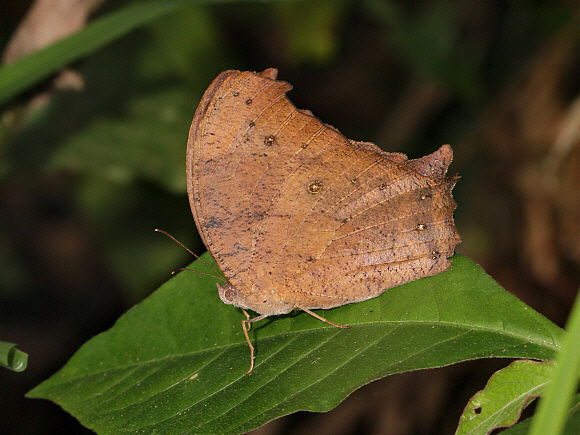
Common Evening Brown Melanitis leda
60-80mm Wingspan
Melanitis leda, the common evening brown, is a common species of butterfly found flying at dusk. The flight of this species is erratic. They are found in Africa, South Asia, and Southeast Asia extending to parts of Australia. The adult is dark-brown with distinctive eye-like spots encircled by orange rings. Larvae feed exclusively on grasses while adults prefer plant sap and fruits.
(40)
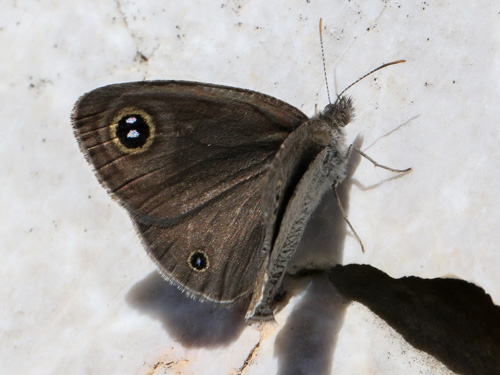
Common Threering Ypthima asterope
30-37mm Wingspan
Ypthima Asterope, the African ringlet or common three-ring, is a species of Satyrinae butterfly found in most dry areas of Africa and Asia. This butterfly has become slightly uncommon in Delhi as it prefers low land areas and agriculture fields. It can be easily distinguished by the one large epical eyespot and two or three small eyespots in the fore and hind wings on the underside, respectively. The caterpillars feed mainly on grasses.
(41)
Tawny Coster Acraea violae
50-65mm Wingspan
As the name suggests, this is a brilliant orange-yellow butterfly found very commonly in many habitats of Delhi. The upperside is bright in comparison to the underside with distinctive black and white spots. It is unpalatable to predators and plays that and exudes a yellow fluid when caught. The main larval host is Passiflora spp.

(42)
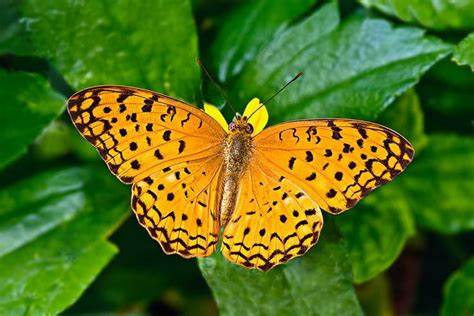
Common Leopard Phalanta phalantha
50-60mm Wingspan
Phalanta phalanthais a beautiful orangish-yellow butterfly. The color of the upper wings bright orange, with a yellow appearance. The wings are featured with a fair number of black spots and streaks. It is known for its territorial and quarrelsome nature. The chief diet of caterpillars is Flacorita spp.
(43)
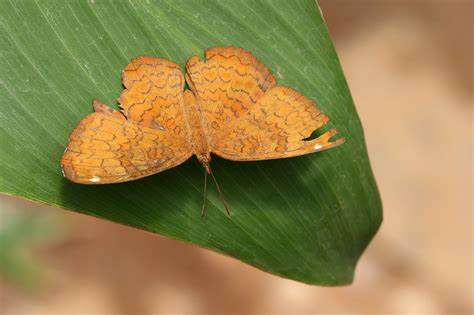
Common Castor Ariadne merione
45-60mm Wingspan
Ariadne merione, the common castor, is an orange butterfly with brown lines whose larvae feed almost exclusively on the castor (Ricinus communis). This species is found in south and southeast Asia. Like others in the family Nymphalidae, their front two legs are small and unused, effectively making them four-legged. This common species can be easily distinguished by its captivating gliding flight during which it flashes its dark brownish-black underside. The upper portion of the wing is rusty brown with pale wavy markings. Adults feed primarily on plant sap and ripe fruit.
(44)
Painted Lady Vanessa cardui
55-70mm Wingspan
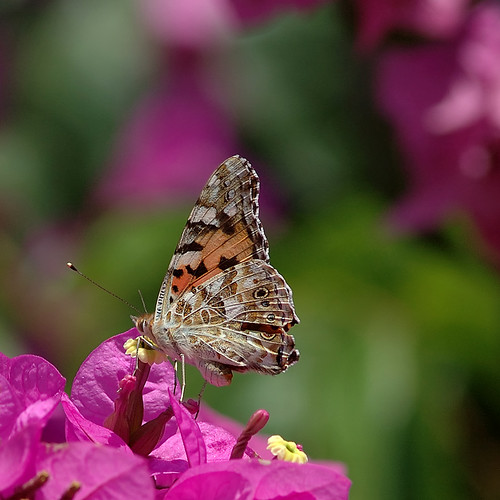
This golden brown species could well be the most widely distributed butterfly in the world and is common in our city. It can be distinguished by the white and brown markings on the upper side and a variegated underside. It is a known seasonal migrant and the adults feed on ripe fruits. Caterpillars grow on many different host plants.
(45)
Blue Pansy Junoniya orithiya
45-60mm Wingspan
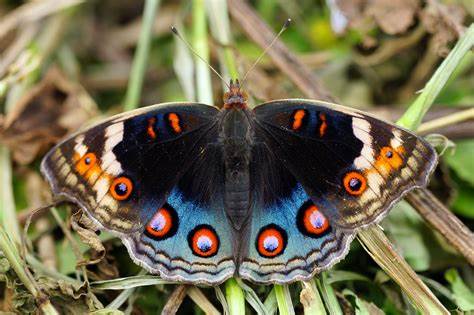
Junonia orithiya is a nymphalid butterfly. In India, it is a very common butterfly found mainly in dryer areas, adjoining forests, mostly during sunny spells. It is found frequenting flowers and damp areas. The upper portion, which is iridescent, blue-black with circular orange spots and white bands, is very distinctive. Caterpillars feed on a wide variety of plants of different families.
(46)
Yellow Pansy Junonia hierta
45-60mm Wingspan
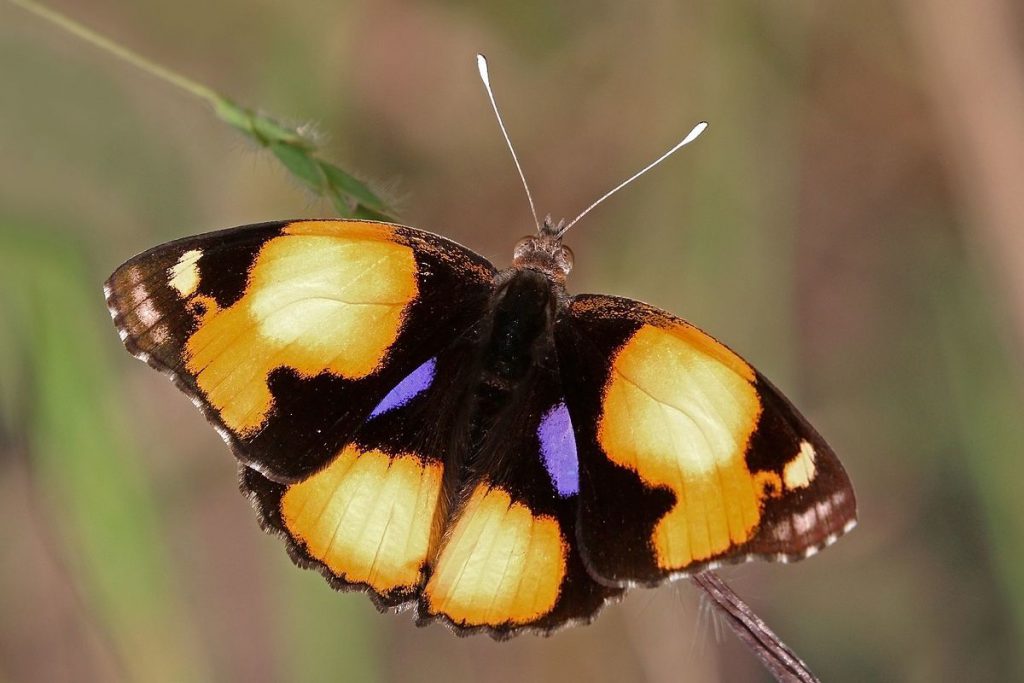
Junonia hierta is a species of butterfly found in the largest butterfly family, Nymphalidae. These are also known as the Brush-footed Butterflies. The Yellow Pansy Butterfly is attracted to rotting fruit and damp ground. Commonly seen basking on flowers in gardens and parks, they’re frequently sighted in grassland and savanna habitats too. The bright yellow upper wing with the brown margins and glossy oval blue spots are the distinguishing features for the female while the latter is absent in the males. Food for the larvae is mainly from the species of the family Acanthaceae.
(47)
Peacock Pansy Junonia almana
60-65mm Wingspan
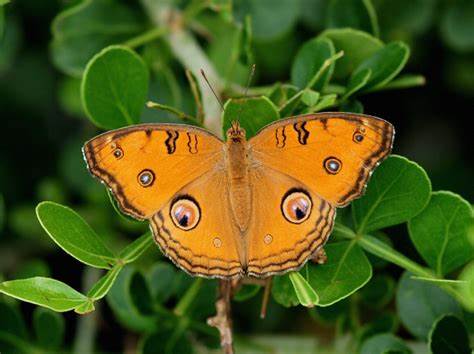
The peacock pansy is a species of nymphalid butterfly. It exists in two distinct adult forms, which differ chiefly in the patterns on the underside of the wings; the dry-season form has few markings, while the wet-season form has additional eyespots and lines. It is seen commonly in Delhi and is known for its two highly variant appearances in the wet and dry seasons. The adults prefer flowers while caterpillars feed mainly on plants of the Acanthaceae family.
(48)
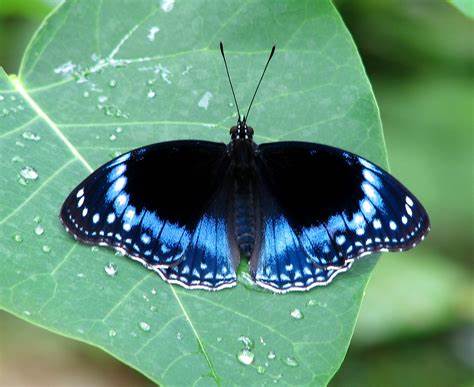
Danaid Eggfly Hypolimnas missippus
70-85mm Wingspan
The Danaid Eggfly is a widespread species of nymphalid butterfly. It is well known for polymorphism and mimicry. Males are blackish with distinctive white spots that are fringed in blue. Females are in multiple forms that include male-like forms while others closely resemble the toxic butterflies Danaus Chrysippus and Danaus plexippus. This common butterfly of Delhi is predominantly found in open rocky areas and edges of forests. Larvae feed mainly on Portulaca spp. and Hibiscus spp.
(49)
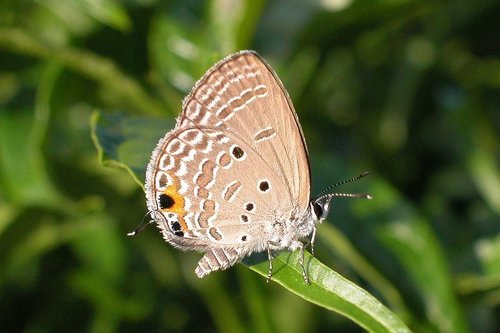
Plains Cupid Luthrodes pandava
15-20mm Wingspan
Luthrodes pandava (formerly Chilades pandava), the plains Cupid or cycad blue, is a species of lycaenid butterfly found in India, Sri Lanka, Myanmar, United Arab Emirates, Indochina, Peninsular Malaysia, Singapore, Taiwan, Java, Sumatra and the Philippines. They are among the few butterflies that breed on plants of the cycad class.
(50)
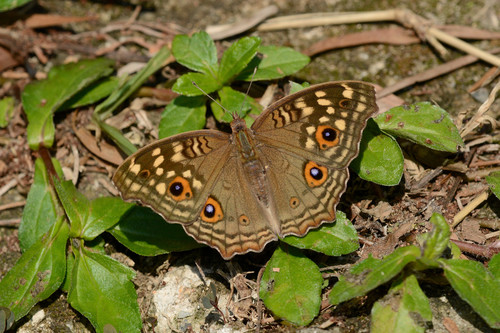
Lemon Pansy Junonia lemonias
45-60mm Wingspan
It is brown with numerous eyespots as well as black and lemon-yellow spots and lines on the upper side of the wings. The underside is a dull brown, with a number of wavy lines and spots in varying shades of brown and black. There is also an eyespot on the lower side of the forewing. In the wet-season form, the markings are distinct and vivid and the wing shape is a little more rounded. In the dry-season form, the markings are obscure and pale especially on the underside and the wing margin is more angular and jagged. This helps it camouflage in the dried leaf litter.
(51)
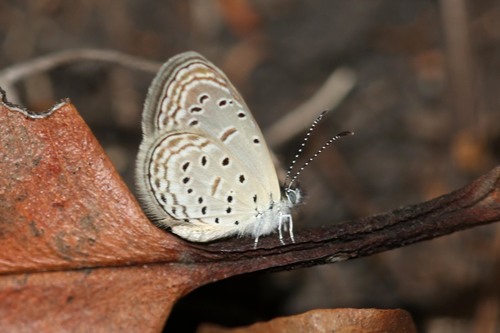
Tiny Grass Blue Zizula hylax
15-16mm Wingspan
A very small butterfly, often seen feeding on low wildflowers. It looks like other small blue butterflies, but is slightly duller blue or occasionally violet from certain angles. The patterns of black dots and gray bars are used to identify this species. Its host plants are a variety of common wildflowers. Likely it has limited dispersal range, but it can move through open areas and road verges
(52)
Common Pierrot Castalius rosimon
Around 30mm Wingspan
It is a common butterfly in the open areas and a thinly wooded country. It has a weak flight. It always flies close to the ground frequently settling on leaves. It is fond of sunshine and basks more after the rains. The cilia of both wings are marked in black and white. Its outer margins are marked in black on the upper side with a row of white lines on the hind wing. The inward area is white with intrusions of black. The black patches on its underside are evenly distributed throughout the wings, without leaving any distinct patch-less areas. It visits flowers, damp patches, dead insects, and bird droppings.
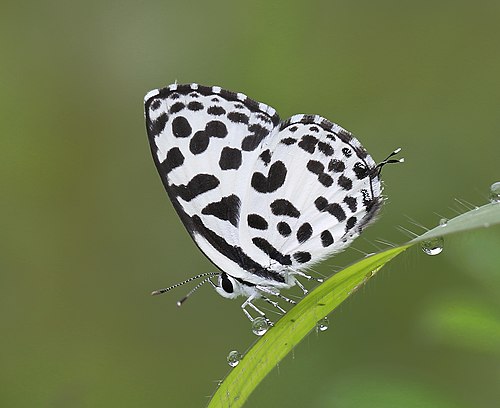
(53)
Gram Blue Euchrysops cnejus
20-26mm Wingspan
The Gram Blue is a small butterfly found in India. It a strong and rapid flyer, which can be seen in the open areas. The male of Gram Blue is light purple whilst the female is rather heavily black-dusted with the wing bases pale shining blue. The underside is pale buff, with the usual lycaenine markings as spots and striae. The spots in the costal and basal areas of the hindwing are black and very distinct. The black submarginal spots near the tails are edged with metallic green scaling and inwardly crowned with orange. The species also possesses a pair of string-like tails.
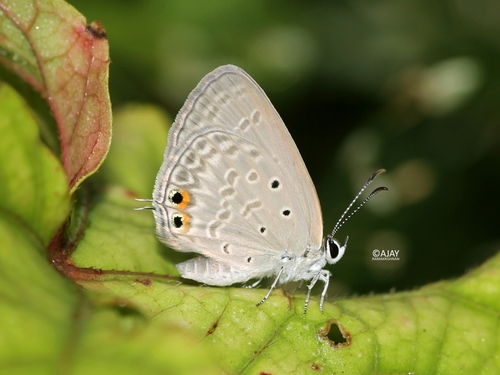
(54)
Formosan Swift Borbo cinnara
30-34mm Wingspan
This species occurs across Southeast Asia, from India to the Solomons, including Japan, Taiwan, and Australia. The wings of the adult butterflies are brown, fading to yellow at the base, and have white spots on the forewings. This butterfly favours a large variety of habitats including open woodlands, grasslands, and abandoned agricultural fields. Like most skippers, it holds up its forewings and flattens its hindwings when at rest.
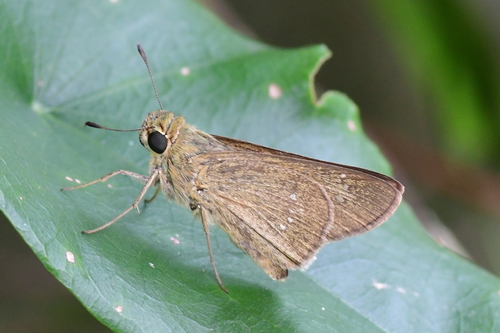
(55)
Common Jay Graphium doson
70-80mm Wingspan
The common jay is a black, tropical papilionid (swallowtail) butterfly with pale blue semi-transparent central wing bands that are formed by large spots. There is a marginal series of smaller spots. The underside of the wings is brown with markings similar to the upperside but whitish in color. The species was first described by father and son entomologists Cajetan and Rudolf Felder.
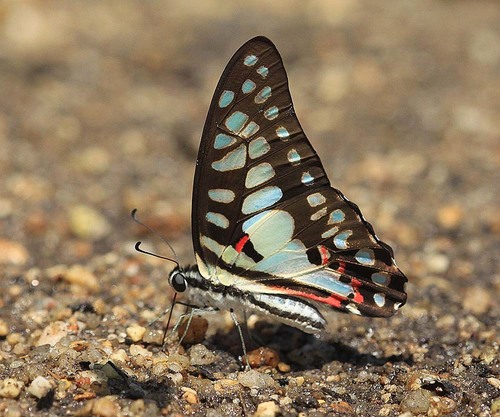
(56)
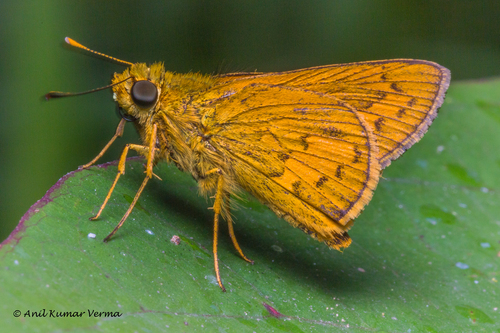
Dark Palm-Dart Telicota bambusae
33-36mm Wingspan
The dark palm dart is a grass skipper butterfly of the Hesperiidae family. The adults are brown with orange patches. The males have a prominent grey line across part of each forewing. The undersides of the female are greenish-yellow with orange and brown patches. The caterpillar hatches from a white hemispherical egg laid singly on a foodplant leaf.
(57)
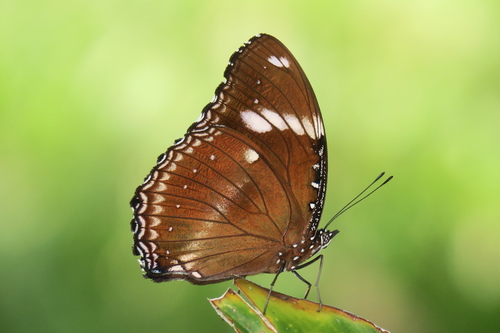
Great Eggfly Hypolimnas bolina
70-85mm Wingspan
It is a fairly common butterfly found in lightly wooded countries, deciduous forests, thick and moist scrub, and the greener part of human habitats. The male is dark brown to black with a large purple-washed white discal patch on each wing, and a similar but smaller sub-apical patch on the forewing. The female is brown with a series of moderately large postdiscal white dots on each wing. Adults are known to feed on a variety of nectar plants. Larvae are known to feed on species of plants in the family Acanthaceae and the genus Portulaca.
(58)
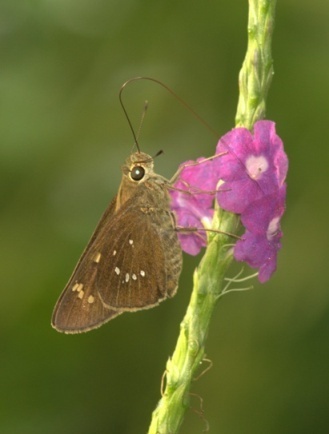
Conjoined Swift Pelopidas conjuncta
42-45mm Wingspan
The conjoined swift is a butterfly belonging to the family Hesperiidae. This butterfly has been sighted at grassy wastelands and fringes of nature reserves. They fly with a swift, strong, and darting flight. On the upperside, the wings are dark brown. There are pale yellowish-white hyaline spots in spaces 2-4, 6-8, and two cell spots in the forewing. On the underside, the wings are paler ochreous brown. The larvae are known to breed on “Rottboellia, cochinchinensis”.
(59)
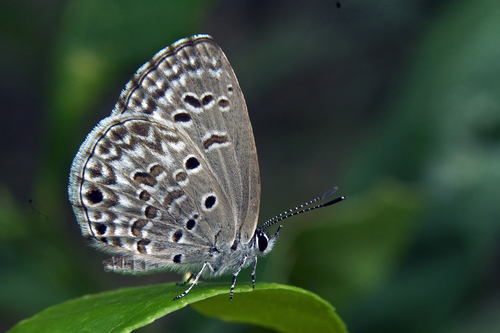
Lime Blue Chilades lajus
80-100mm Wingspan
The lime blue butterfly is a small butterfly, found in India, belongs to Lycaenidaes or the blue family. It inhabits thin vegetation such as scrublands and gardens and avoids dense forests. It has no tails. The male is shiny blue up to the margins without any borders and patches on the upper side. In the female, the blue areas are only limited to the basal parts and are absent in some individuals. The hindwing has a sub-marginal row of white rings. The ring at the tornus is enlarged and surrounds a black spot. The underside is whitish brown and looks similar in both sexes.
(60)
Blue-Spotted Arab Colotis phisadia
20mm Wingspan
The blue-spotted Arab is a small butterfly of the family Pieridae. This butterfly is usually seen in desert regions with very little and open vegetation, including rocky areas. The upper side of the male forewing has a pale salmon-pink ground color. Base arrogated with bluish-grey scales that extend outwards. Black spot on the underside of the forewing. Back wings much paler, and light or no spot. In females, the markings on the outer margin of the fore and hindwings are shiny brown in color, instead of black. Also, the females have a much paler yellow color on the wings’ underside. Larva feeds on Salvadora persica.
Counting Butterflies
Counting butterflies is extremely important not just because we love them and they are beautiful creatures but due to the intricate role they play in the ecosystem as components of the food chain as well as being pollinators.
Butterflies are under severe threat, like all wildlife around us there numbers have also sharply declined and these signs can no longer be ignored.
Butterflies are key biodiversity indicators for scientists as they are very sensitive to changes in the environment.
Now it all depends on citizen scientists who are willing to record the butterflies. They see around them and upload them on Butterflies of India, Indian Biodiversity Portal, and iNaturalist. The data from this and other counts will also help to identify important trends in species that will assist in planning how to protect butterflies from extinction, as well as understanding the effect of climate change on wildlife.
How to contribute
Simply count butterflies in your area during bright days during the Big Butterfly Count Week. Records are welcome from anywhere: from parks, school grounds, and gardens, to fields and forests. Please follow the government guidelines on large gatherings and travel restrictions imposed in your region due to COVID 19 pandemic.
Download one of the three Apps iNaturalist found butterflies and India Biodiversity Portal, and create an account, and simply start clicking and uploading. You could even use web versions of the same to upload the records once you are back home.


Published: Jan 20, 2021
Latest Revision: Jan 20, 2021
Ourboox Unique Identifier: OB-1011665
Copyright © 2021

 Skip to content