






by or hameiri
Copyright © 2021
The story about the yellow rubber ducks

Copyright © 2021
On January 1992, a big Cargo ship sailed from Hong kong to USA. On the way it got into a storm and the ship was at an angle of forty degrees and 12 containers fell from it. One of the containers opened and the container 28,800 rubber creatures fell into the ocean. The rubber creatures were yellow ducks, blue turtles, green frogs, and red beavers. The wind and the ocean currents carried the creatures away.
On November 16, 1992, six rubber creatures landed on an island beach near Alaska. A few days later another 20 land in Alaska, a little south from there.
About 400 creatures landed between November 1992 and August 1993 on an 850-kilometer coastline in the southeastern part of the Gulf of Alaska.
They attract the attention of the scientist Curtis Ebbesmeyer
Curtis Ebbesmeyer is An oceanograph that studies the buoyancy of objects on the surface of the water. What ignited his imagination was a bottle with a letter found on a Canadian beach. The bottle was discovered in 1990 was launched in May 1980 near China. Curtis developed a computer model called OSCURS.
The model is used to study winds, waves and the ocean currents in the North Pacific.
Curtis decided to develop a model of ocean currents and looked for a good patterns of ocean movement.
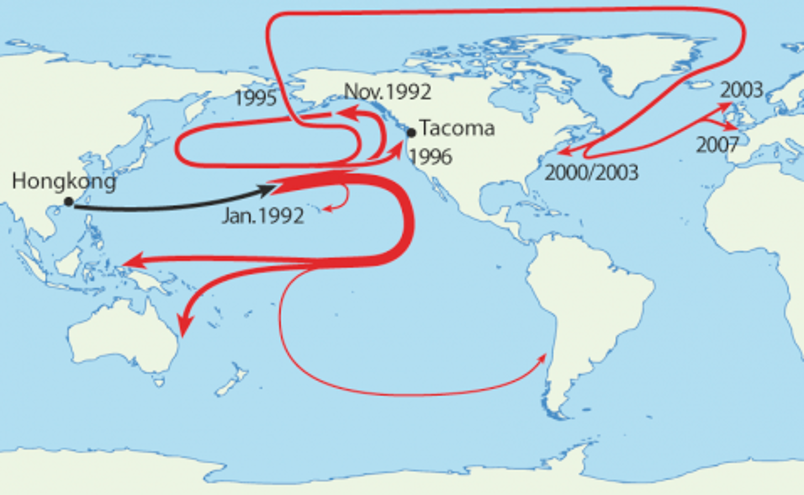
image of the travel that the duck past
At the end of May 1990, the ship Hansa Carrier ran into a difficult storm on a voyage from Korea to the United States.
5 containers fell from the ship, each container containing about 20,000 shoes made by the Nike company.
4 containers were opened in the stormy sea and about 60,000 shoes embarked on a voyage.
Curtis found the opportunity he was looking for – he started looking for reports of finding shoes on the beach and he wrote an article in the local newspaper that rolls out and spreads to a news agency.
Over the course of a year Curtis receives a report of the finding of 1,300 shoes, out of the 60,000 original shoes.
With the information, Curtis build for the first time a model.
The fall of the ducks into the water in 1992 gave Curtis the first chance to test the model he developed.
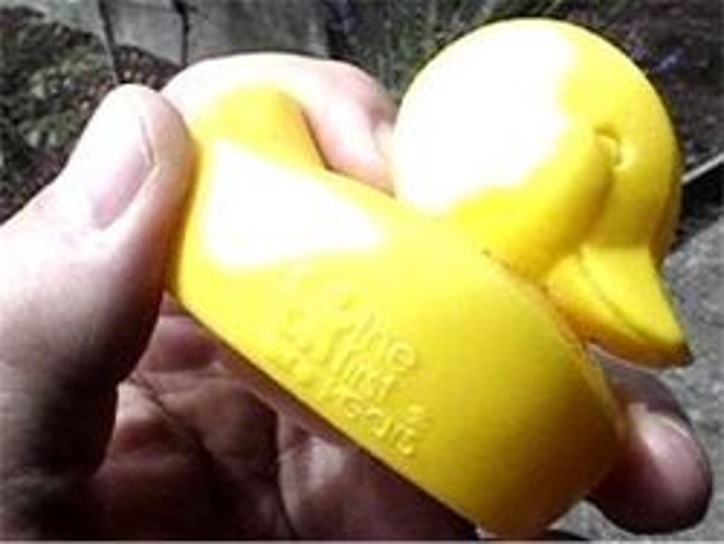
Curtis and another researcher named Ingram predict a number of movement routes for ducks and refine the model according to the actual finding of the ducks.
About 19,000 ducks head south and reached the shores of Indonesia and Australia. A minority came to South America.
About 10,000 moved north and traveled between Japan and all of Alaska. Some crossed the Bering Strait, revolved around the North Pole and crossed the Atlantic Ocean. They moved south and reached the western United States and from there crossed the Atlantic Ocean towards Europe.
Curtis Continue to follow:
34,000 hockey gloves.
5,000,000 Lego bricks.
Pegs from Japan, fishing boats, aircraft parts, bowling balls, sculptures and more and more …
Mapping “junk circles” in the oceans.
In 2009 he published a book called “flotsametrics and the floating world: how one man’s obsession with runaway sneakers and rubber ducks revolutionized ocean science”
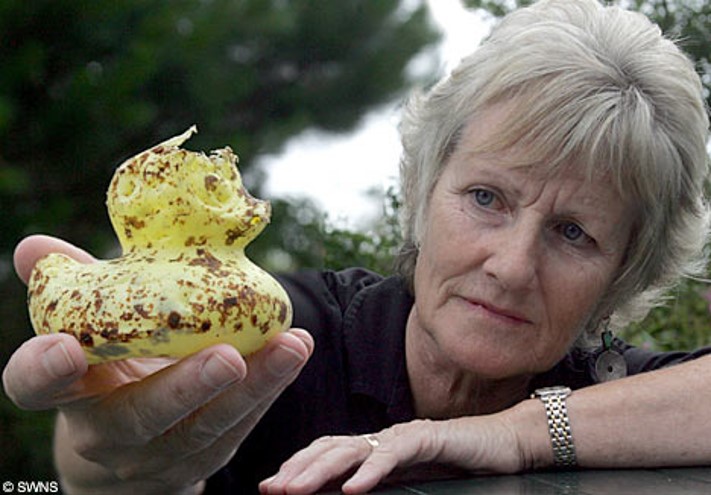
image of duck after 15 years in the sea
video about the story https://www.youtube.com/watch?v=_uuMpVf2R8E
Published: Apr 4, 2021
Latest Revision: Apr 5, 2021
Ourboox Unique Identifier: OB-1098034
Copyright © 2021

 Skip to content