






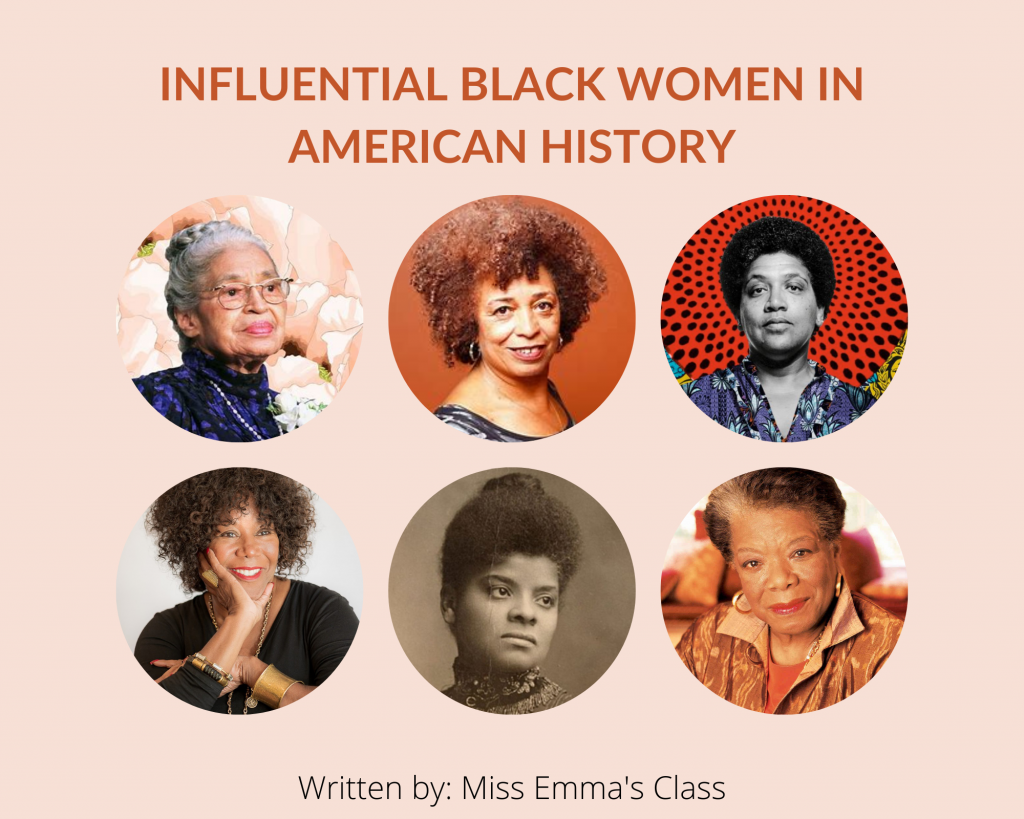
Influential Black Women in American History

Copyright © 2022
To Educators:
This book is for students to learn about influential black women in American history, the forgotten bunch. History textbooks consistently leave out influential black women when discussing topics such as abolition and the civil rights movement, so we made our own! Students will read and watch interactive videos about black women who influenced the world with their social justice activism. Students are encouraged to use this book as a template to make their own books to supplement their own classrooms. This book is intended to be a project for a 5th grade class.
To Students:
This book is meant to accompany your social studies textbook, which most likely overlooks the important accomplishments black women have made throughout history and in present times. I have filled out the first few pages and left a few pages blank on purpose! Take a look at how I have created the first few entries to get inspiration for your own entries. Your job is to research an influential Black woman in our nation’s past or today and give a brief summary of her influence on our nation. You may use one of the women I have listed at the end of this book and add information about her through your own research, or you may start a blank page and research another influential Black woman of your choosing. You must conduct your own research and include information from at least 2 credible sources in your summary. Get creative with this! If you would rather imbed an audio clip or video of your summary instead of typing a paragraph, please feel free to do so! You must also include either a picture of the woman you are researching, or a relevant short video (no more than 3 minutes). Once everyone has added to the book, we will have an excellent resource to add to our classroom library! I am eager to see what kind of information all of you historians find!
Student Learning Outcomes:
Students will learn how black women have influenced the world throughout history and today.
5th Grade Social Studies Standard:
5.6c Across time and place, different groups of people in the Western Hemisphere have struggled and fought for
equality and civil rights or sovereignty
Ida B. Wells was an African American journalist, civil rights activist, and womainist. Born enslaved, Wells later attended college and, though underqualified, began teaching at segregated schools at age 16 when she lost her parents and brother to yellow fever. On a train ride from Memphis to Nashville on May 4, 1884, she was asked to move from her first-class seat to ride on the car for black people. She refused and was forcibly removed by the train crew. She sued the train company a year later and won, although the case was inevitably overturned by the Tennessee Supreme Court. After this incident, Wells began writing about issues of race and politics in the south under the alias “lola”. She spoke out against lynchings and the poor conditions of segregated schools, among other social justice issues. She formed several civil rights organizations, namely the National Association of Colored Women, the Alpha Suffrage Club in Chicago, and the NAACP. She was active in the fight for women’s suffrage, especially for black women. She was invited to walk at the 1913 Suffrage Parade in Washington D.C. where she refused to walk at the back of the parade and rather marched at the front with the white feminists.
Rosa Parks (February 4, 1913 – October 24, 2005)

Rosa Parks was a civil rights activist who’s courageous acts sparked major change. On December 1, 1995 Parks was on a Montgomery bus and refused to give her seat up to a white man. She was arrested and jailed for this act of resistance. Her decision sparked the Montgomery Bus Boycott that lasted 381 days. Over the course of the boycott, Black people stopped riding the city bus until they were treated better. She was an activist for black people as well as children, as she served as a youth leader at her local branch of the NAACP during the time of her arrest and worked later in her life advocating for underrepresented youth.
Audre Lorde (February 18, 1934 – November 17, 1992)
Audre Lorde was an accomplished writer and poet. She studied at The National University of Mexico in Cuernavaca, earned a bachelor’s degree from Hunter College and a master’s degree from Columbia University. In the 1960’s, she became active in the anti-war, civil rights, and women’s rights movements. She became the writer-in-residence at Tugaloo College in Mississippi in 1968. Her poetry began to take on political themes such as racism, sexism, and violence. She also portrayed her experience as a lesbian woman in many of her works. She continued writing during the following decades, addressing the intersectionality of race, class, and gender. She was a prominent speaker at the 1979 March on Washington for Lesbian and Gay Rights, co-founded “Kitchen Table: Women of Color Press” in 1981, where she promoted the literary work of women of color, and was a founding member of “Sisterhood in Support of Sisters in South Africa”, an organization that advocated for women living under apartheid. She received many awards for her social justice literature throughout her career. Lorde died in 1992 from breast cancer.
Angela Davis (January 26, 1944 –
Angela Davis is an educator and social justice and civil rights activist. She studied philosophy at Brandelis University and went on to acquire her master’s degree from the University of California, San Diego in the late 1960’s. While studing at the University of California, Davis joined may groups, namely the Black Panthers and Che-Lumumba Club, an all-Black branch of the Communist Party. Due to her association with communism, she was fired from her position at UCLA. She took them to court, won the case, and eventually left UCLA in 1970 when her contact expired. Davis spent 18 months in jail due to her alleged involvement in the attempted escape of George Lester Jackson, a man accused of killing a prison guard after the murder of several Black inmates. She was eventually acquitted in June 1972. Today, Davis is a Distinguished Professor Emerita at the University of California, Santa Cruz. She has written many books related to social justice issues such as race, gender, and the prison-industrial complex.
Ruby Bridges
Dorothy Height
Maya Angelou
Alicia Garza

Patrisse Cullors
Opal Tometi
Understanding Check:
-
What are 3 things you learned from this book?
-
Name at least one new person you learned about in this book and what information you learned.
-
How has one of these women influenced change in American history?
Homework:
Write a letter to a person in this book. Think about what you would ask them about themselves, their accomplishments, or the time period they lived in. What would you tell them about yourselves or any important things currently going on that relate to their accomplishments? You are encouraged to do further research on this person to make your letter accurate and specific. Have fun!
References:
Biography – Rosa Parks. (n.d.). Retrieved February 27, 2022, from https://www.rosaparks.org/biography/
Brandman, M. (2021, June). Audre Lorde. National Women’s History Museum. Retrieved February 27, 2022, from https://www.womenshistory.org/education-resources/biographies/audre-lorde
History.com Editors. (2009, November 9). Angela Davis. History.com. Retrieved February 27, 2022, from https://www.history.com/topics/black-history/angela-davis
Norwood, A. R. (2017). Ida B. Wells-Barnett. National Women’s History Museum. Retrieved February 27, 2022, from https://www.womenshistory.org/education-resources/biographies/ida-b-wells-barnett
U.S. Department of the Interior. (2020, December 30). Ida B. Wells (U.S. National Park Service). National Parks Service. Retrieved February 27, 2022, from https://www.nps.gov/people/idabwells.htm
Published: Feb 24, 2022
Latest Revision: Feb 28, 2022
Ourboox Unique Identifier: OB-1286172
Copyright © 2022

 Skip to content