






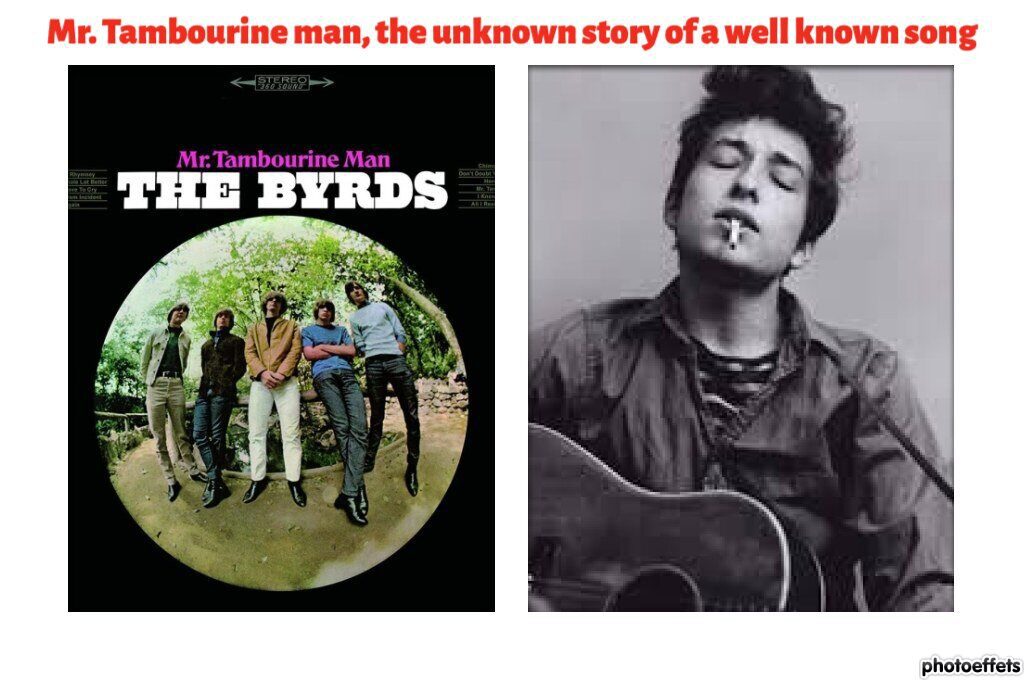
Mr. Tambourine Man

Copyright © 2022
This e-book will focus on the song Mr. Tambourine Man as it holds a special place in my heart as my grandfather made me discover it when I was a child.
2
I hope you will enjoy it as much as I did making it.
Let’s start !
3
The famous “Mr. Tambourine Man” song was written by Bob Dylan and released in March 1965 as the first track of his album Bringing It All Back Home. But the song wasn’t made in one take and has not always been as we know it now.
Let’s retrace the history of the song !
4
Dylan began writing and composing “Mr. Tambourine Man” in February 1964, after attending Mardi Gras in New Orleans during a cross-country road trip with several friends, and completed it in late April of that year after he had returned to New York.
5
Dylan recorded “Mr. Tambourine Man” with Ramblin’ Jack Elliott singing harmony. As Elliott was slightly off key, that recording wasn’t used. You can hear here the first recording of the song, at folksinger Eric von Schmidt’s home in Sarasota, in early May.
6
There have been some speculations about the song’s meaning: some say it is about drugs, particularly with lines such as “take me on a trip upon your magic swirling ship” and “the smoke rings of my mind” but Dylan has denied the song is about drugs. Though he was smoking marijuana at the time the song was written, Dylan was not introduced to LSD until a few months later. The song has also been interpreted as a call to the singer’s spirit or muse, or as a search for transcendence. But it seems, like Dylan claimed it, that the song was inspired by Bruce Langhorne, Dylan’s guitarist.
7
Dylan was supposedly inspired to write “Mr. Tambourine Man,” on which Langhorne also plays, after seeing him arrive for a recording session holding a giant Turkish frame drum with jingle-jangling bells attached to its edges. It looked like a tambourine the size of an extra-large pizza.
Dylan said, “‘Mr. Tambourine Man was inspired by Bruce Langhorne. Bruce was playing guitar with me on a bunch of the early records. He had this gigantic tambourine. It was like, really big. It was as big as a wagon wheel. He was playing, and this vision of him playing this tambourine just stuck in my mind. I don’t know if I’ve ever told him that.”
8
Here’s another song from the same album, in which Langhorne played with Dylan, Maggie’s farm:
9
Since it was written, the song has been sung live many times.
Here’s an early live version of the song at the Newport Folk Festival in 1964:
10
Here’s another one taken on Dylan’s 1965 UK tour, in Liverpool:
11
Even though Bob Dylan’s song is very famous, maybe it is not his version you have heard…
Indeed, the group The Byrds recorded the song as their debut single on April 12th, 1965.
To make it sound more like the Beatles, the band decided to give the song a full, electric rock band treatment, creating the musical sub-genre of folk rock.
Dylan was invited to a band rehearsal to hear their rendition. He was impressed, enthusiastically commenting, “Wow, you can dance to that!”
12
Certainly, what made The Byrds’ recording of the song so memorable was its opening with a distinctive, Bach-inspired guitar introduction and that then, like Dylan’s version, goes into the song’s chorus.
Although Dylan’s version contains four verses, the Byrds perform only the song’s second verse and two repeats of the chorus, followed by a variation on the song’s introduction, which then fades out.
13
The Byrds’ arrangement of the song had been shortened during the band’s rehearsals, at the suggestion of Jim Dickson, the band’s manager in order to accommodate commercial radio stations, which were reluctant to play songs that were over two-and-a-half minutes long.
As a result, the single reached number 1 on the Billboard Hot 100, and number 1 on the UK Singles Chart, making it the first recording of a Dylan song to reach number 1 on any pop music chart.
14
Here’s a live version of the song on the ed Sullivan show on December 12th, 1965:
15
Although the Byrd’s version is the first that come to mind, other artists have recorded their own version of the song.
Here’s Judy collins’ version:
16
And here’s a version of the song by Stevie Wonder from his 1966 album:
17
It’s almost the end…
Do you wanna hear one last fun fact about the song ?
18
There you go !
Both Bob Dylan’s and The Byrds’ versions were listed on Rolling Stones’ list of the 500 Greatest Songs of All Time, (respectively 106 and 79).
Making it one of three songs to place twice, along with “Walk This Way” by both Aerosmith and Run-DMC with Perry and Tyler, and “Blue Suede Shoes” by both Carl Perkins and Elvis Presley.
19
Now and sadly, it really is the end…
But I hope you enjoyed, and maybe see you soon in another e-book !
20
Published: Apr 20, 2022
Latest Revision: Apr 20, 2022
Ourboox Unique Identifier: OB-1315468
Copyright © 2022