






by Ameer
Copyright © 2022
Bethlehem

Copyright © 2022
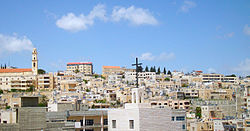
Bethlehem about 10 km (6.2 miles) south of Jerusalem. Its population is approximately 25,000,[4][5] and it is the capital of the Bethlehem Governorate. The economy is primarily tourist-driven, peaking during the Christmas season, when Christians make pilgrimage to the Church of the Nativity.[6][7] The important holy site of Rachel’s Tomb is at the northern entrance of Bethlehem, though not freely accessible to the city’s own inhabitants and in general Palestinians living in the occupied West Bank due to the Israeli West Bank barrier.
The earliest known mention of Bethlehem was in the Amarna correspondence of 1350–1330 BCE when the town was inhabited by the Canaanites. The Hebrew Bible, which says that the city of Bethlehem was built up as a fortified city by Rehoboam,[8] identifies it as the city David was from and where he was anointed as the king of Israel. The Gospels of Matthew and Luke identify Bethlehem as the birthplace of Jesus. Bethlehem was destroyed by the Emperor Hadrian during the second-century Bar Kokhba revolt; its rebuilding was promoted by Empress Helena, mother of Constantine the Great, who commissioned the building of its great Church of the Nativity in 327 CE. The church was badly damaged by the Samaritans, who sacked it during a revolt in 529, but was rebuilt a century later by Emperor Justinian I.
Bethlehem became part of Jund Filastin following the Muslim conquest in 637. Muslim rule continued in Bethlehem until its conquest in 1099 by a crusading army, who replaced the town’s Greek Orthodox clergy with a Latin one. In the mid-13th century, the Mamluks demolished the city’s walls, which were subsequently rebuilt under the Ottomans in the early 16th century.[9] Control of Bethlehem passed from the Ottomans to the British at the end of World War I. Bethlehem came under Jordanian rule during the 1948 Arab-Israeli War and was later captured by Israel in the 1967 Six-Day War. Since the 1995 Oslo Accords, Bethlehem has been administered by the Palestinian Authority.[
Proclaimed a crusade in 1123, the struggle between the Christians and Muslims in the Iberian Peninsula was called the Reconquista by Christians, and only ended in 1492 with the fall of the Muslim Emirate of Granada. From 1147, campaigns in Northern Europe against pagan tribes were considered crusades. In 1199, Pope Innocent III began the practice of proclaiming political crusades against Christian heretics. In the 13th century, crusading was used against the Cathars in Languedoc and against Bosnia; this practice continued against the Waldensians in Savoy and the Hussites in Bohemia in the 15th century and against Protestants in the 16th. From the mid-14th century, crusading rhetoric was used in response to the rise of the Ottoman Empire, only ending in 1699 with the War of the Holy League.
Published: May 6, 2022
Latest Revision: May 6, 2022
Ourboox Unique Identifier: OB-1325953
Copyright © 2022