






by hassan
Copyright © 2016
Capacitors

Copyright © 2016
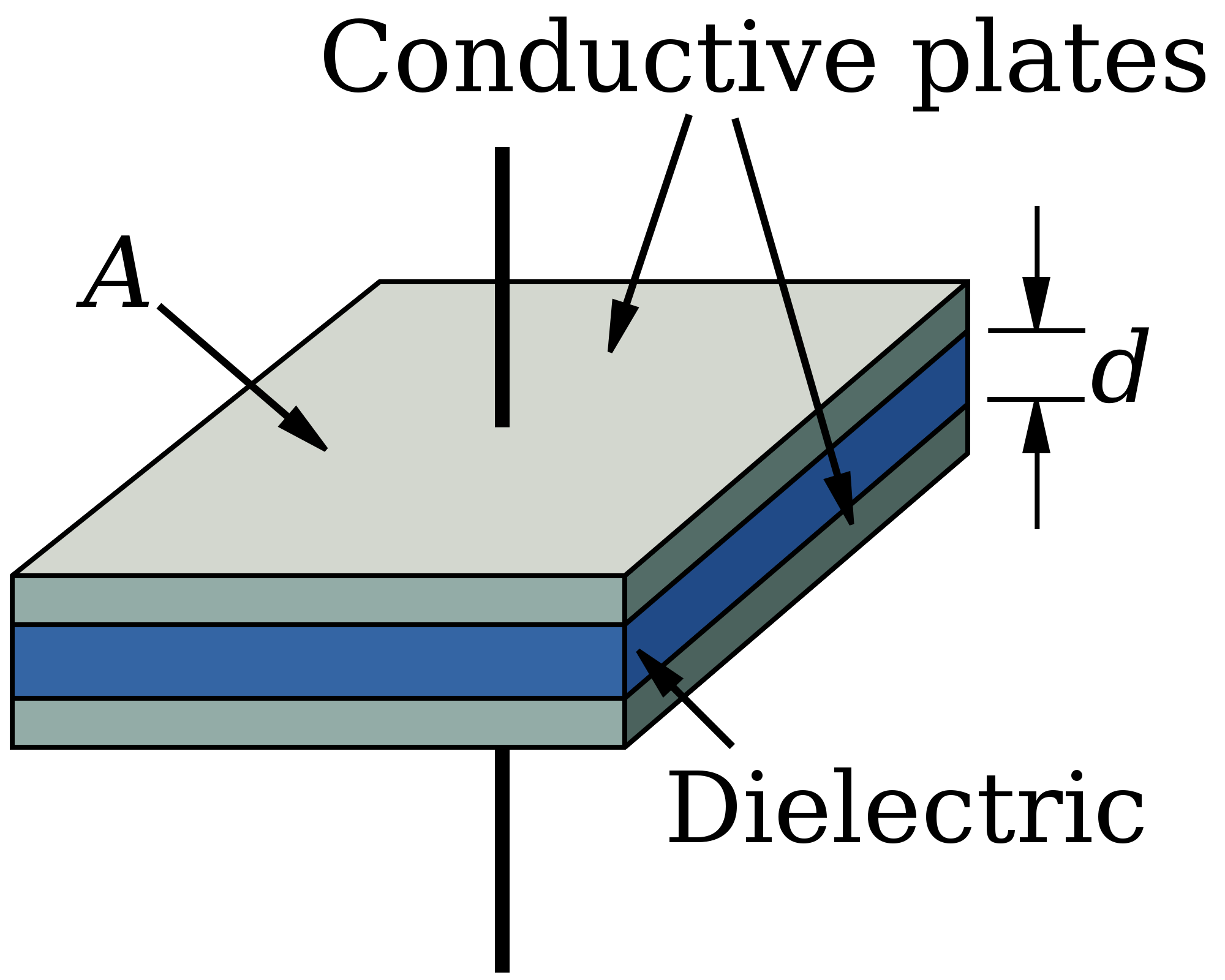
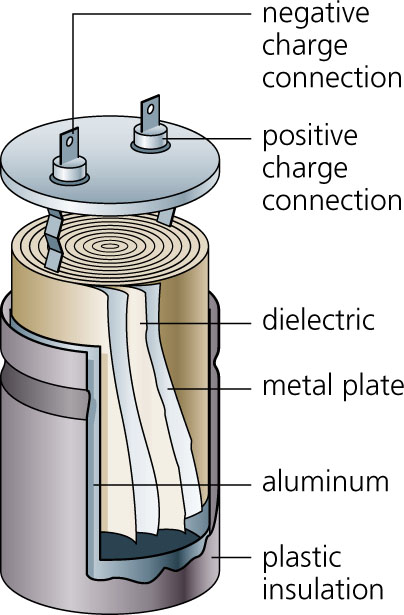
A capacitor (originally known as a condenser) is a passive two-terminalelectrical component used to store electrical energy temporarily in an electric field. The forms of practical capacitors vary widely, but all contain at least twoelectrical conductors (plates) separated by a dielectric (i.e. an insulator that can store energy by becoming polarized). The conductors can be thin films, foils or sintered beads of metal or conductive electrolyte, etc. The nonconducting dielectric acts to increase the capacitor’s charge capacity. Materials commonly used as dielectrics include glass, ceramic, plastic film, air,vacuum, paper, mica, and oxide layers. Capacitors are widely used as parts ofelectrical circuits in many common electrical devices. Unlike a resistor, an ideal capacitor does not dissipate energy. Instead, a capacitor stores energy in the form of an electrostatic field between its plates.
When there is a potential difference across the conductors (e.g., when a capacitor is attached across a battery), an electric field develops across the dielectric, causing positive charge +Q to collect on one plate and negative charge −Q to collect on the other plate. If a battery has been attached to a capacitor for a sufficient amount of time, no current can flow through the capacitor. However, if a time-varying voltage is applied across the leads of the capacitor, a displacement current can flow.
An ideal capacitor is characterized by a single constant value, its capacitance. Capacitance is defined as the ratio of the electric charge Q on each conductor to the potential difference V between them. The SI unit of capacitance is the farad (F), which is equal to one coulomb per volt (1 C/V). Typical capacitance values range from about 1 pF (10−12 F) to about 1 mF (10−3 F).
The larger the surface area of the “plates” (conductors) and the narrower the gap between them, the greater the capacitance is. In practice, the dielectric between the plates passes a small amount of leakage current and also has an electric field strength limit, known as the breakdown voltage. The conductors and leads introduce an undesired inductanceand resistance.
Capacitors are widely used in electronic circuits for blocking direct current while allowing alternating current to pass. Inanalog filter networks, they smooth the output of power supplies. In resonant circuits they tune radios to particularfrequencies. In electric power transmission systems, they stabilize voltage and power flow.[1]
Theory of operation
A capacitor consists of two conductorsseparated by a non-conductive region.[13]The non-conductive region is called thedielectric. In simpler terms, the dielectric is just an electrical insulator. Examples of dielectric media are glass, air, paper,vacuum, and even a semiconductordepletion region chemically identical to the conductors. A capacitor is assumed to be self-contained and isolated, with no netelectric charge and no influence from any external electric field. The conductors thus hold equal and opposite charges on their facing surfaces,[14] and the dielectric develops an electric field. In SI units, a capacitance of one farad means that onecoulomb of charge on each conductor causes a voltage of one volt across the device.[15]
An ideal capacitor is wholly characterized by a constant capacitance C, defined as the ratio of charge ±Q on each conductor to the voltage V between them:[13]

Because the conductors (or plates) are close together, the opposite charges on the conductors attract one another due to their electric fields, allowing the capacitor to store more charge for a given voltage than if the conductors were separated, giving the capacitor a large capacitance.
Sometimes charge build-up affects the capacitor mechanically, causing its capacitance to vary. In this case, capacitance is defined in terms of incremental changes:


Published: May 25, 2016
Latest Revision: May 25, 2016
Ourboox Unique Identifier: OB-139315
Copyright © 2016