







Christmas traditions

Copyright © 2022
Christmas traditions include a variety of customs, religious practices, rituals, and folklore associated with the celebration of Christmas. Many of these traditions vary by country or region, while others are practiced in a virtually identical manner across the world.
Traditions associated with the Christmas holiday are diverse in their origins and nature, with some having an exclusively Christian character with origins from within the religion, while others have been described as more cultural or secular in nature and have originated from outside the realm of Christian influence. Christmas traditions have also changed and evolved significantly in the centuries since Christmas was first instituted as a holiday, with celebrations often taking on an entirely different quality or atmosphere depending on the time period and geographical region.
Christmas Day (inclusive of its vigil, Christmas Eve), is a Festival in the Lutheran Church, a Solemnity in the Roman Catholic Church, and a Principal Feast of the Anglican Communion. Other Christian denominations do not rank their feast days but nevertheless place importance on Christmas Eve/Christmas Day, as with other Christian feasts like Easter, Ascension Day, and Pentecost.[1] As such, for Christians, attending a Christmas Eve or Christmas Day church service plays an important part in the recognition of the Christmas season. Christmas, along with Easter, is the period of highest annual church attendance. A 2010 survey by Lifeway Christian Resources found that six in ten Americans attend church services during this time.[2] In the United Kingdom, the Church of England reported an estimated attendance of 2.5 million people at Christmas services in 2015.[3]
he practice of putting up special decorations at Christmas has a long history. In the 15th century, it was recorded that in London it was the custom at Christmas for every house and all the parish churches to be “decked with holm, ivy, bays, and whatsoever the season of the year afforded to be green”.[4] The heart-shaped leaves of ivy were said to symbolize the coming to earth of Jesus, while holly was seen as protection against pagans and witches, its thorns and red berries held to represent the Crown of Thorns worn by Jesus at the crucifixion and the blood he shed.[5][6]Nativity scenes are known from 10th-century Rome. They were popularised by Saint Francis of Assisi from 1223, quickly spreading across Europe.[7] Different types of decorations developed across the Christian world, dependent on local tradition and available resources, and can vary from simple representations of the crib to far more elaborate sets
– renowned manger scene traditions include the colourful Kraków szopka in Poland,[8] which imitate Kraków‘s historical buildings as settings, the elaborate Italian presepi (Neapolitan, Genoese and Bolognese),[9][10][11][12] or the Provençal crèches in southern France, using hand-painted terracotta figurines called santons.[13] In certain parts of the world, notably Sicily, living nativity scenes following the tradition of Saint Francis are a popular alternative to static crèches.[14][15][16] The first commercially produced decorations appeared in Germany in the 1860s, inspired by paper chains made by children.[17] In countries where a representation of the Nativity scene is very popular, people are encouraged to compete and create the most original or realistic ones. Within some families, the pieces used to make the representation are considered a valuable family heirloom.
he traditional colors of Christmas decorations are red, green, and gold. Red symbolizes the blood of Jesus, which was shed in his crucifixion, while green symbolizes eternal life, and in particular the evergreen tree, which does not lose its leaves in the winter, and gold is the first color associated with Christmas, as one of the three gifts of the Magi, symbolizing royalty.[6]
The Christmas tree was first used by German Lutherans in the 16th century, with records indicating that a Christmas tree was placed in the Cathedral of Strassburg in 1539, under the leadership of the Protestant Reformer, Martin Bucer.[18][19] In the United States, these “German Lutherans brought the decorated Christmas tree with them; the Moravians put lighted candles on those trees.
[22][23] Professor David Albert Jones of Oxford University writes that in the 19th century, it became popular for people to also use an angel to top the Christmas tree in order to symbolize the angels mentioned in the accounts of the Nativity of Jesus.[24] The Christmas tree is considered by some as Christianisation of pagan tradition and ritual surrounding the Winter Solstice, which included the use of evergreen boughs, and an adaptation of pagan tree worship;[25] according to eighth-century biographer Æddi Stephanus, Saint Boniface (634–709), who was a missionary in Germany, took an axe to an oak tree dedicated to Thor and pointed out a fir tree, which he stated was a more fitting object of reverence because it pointed to heaven and it had a triangular shape, which he said was symbolic of the Trinity.[26]
The English language phrase “Christmas tree” is first recorded in 1835[27] and represents an importation from the German language.[25][28][29]
From Germany the custom was introduced to Britain, first via Queen Charlotte, wife of George III, and then more successfully by Prince Albert during the reign of Queen Victoria. By 1841 the Christmas tree had become even more widespread throughout Britain.[30] By the 1870s, people in the United States had adopted the custom of putting up a Christmas tree.[31] Christmas trees may be decorated with lights and ornaments.
Along with a Christmas tree, the interior of a home may be decorated with these plants, along with garlands and evergreen foliage. The display of Christmas villages has also become a tradition in many homes during this season. The outside of houses may be decorated with lights and sometimes with illuminated sleighs, snowmen, and other Christmas figures. Mistletoe features prominently in European myth and folklore (for example the legend of Baldr), it is an evergreen parasitic plant which grows on trees, especially apple and poplar, and turns golden when it is dried. It is customary to hang a sprig of mistletoe in the house at Christmas, and anyone standing underneath it may be kissed. Mistletoe has sticky white berries, one of which was traditionally removed whenever someone was kissed under it. This is probably a fertility ritual. The mistletoe berry juice resembles semen.[34]
ther traditional decorations include bells, candles, candy canes, stockings, wreaths, and angels. Both the displaying of wreaths and candles in each window are a more traditional Christmas display. The concentric assortment of leaves, usually from an evergreen, make up Christmas wreaths and are designed to prepare Christians for the Advent season. Candles in each window are meant to demonstrate the fact that Christians believe that Jesus Christ is the ultimate light of the world.[35]
Christmas lights and banners may be hung along streets, music played from speakers, and Christmas trees placed in prominent places.[36] It is common in many parts of the world for town squares and consumer shopping areas to sponsor and display decorations. Rolls of brightly colored paper with secular or religious Christmas motifs are manufactured for the purpose of wrapping gifts.
For the Christian celebration of Christmas, the viewing of the Nativity play is one of the oldest Christmastime traditions, with the first reenactment of the Nativity of Jesus taking place in A.D. 1223.[37] In that year, Francis of Assisi assembled a Nativity scene outside of his church in Italy and children sang Christmas carols celebrating the birth of Jesus.[37] Each year, this grew larger and people travelled from afar to see Francis’ depiction of the Nativity of Jesus that came to feature drama and music.[37] Nativity plays eventually spread throughout all of Europe, where they remain popular. Christmas Eve and Christmas Day church services often came to feature Nativity plays, as did schools and theatres.[37] In France, Germany, Mexico and Spain, Nativity plays are often reenacted outdoors in the streets.[37]
he earliest extant specifically Christmas hymns appear in fourth-century Rome. Latin hymns such as “Veni redemptor gentium“, written by Ambrose, Archbishop of Milan, were austere statements of the theological doctrine of the Incarnation in opposition to Arianism. “Corde natus ex Parentis” (“Of the Father’s love begotten”) by the Spanish poet Prudentius (d. 413) is still sung in some churches today.[38] In the 9th and 10th centuries, the Christmas “Sequence” or “Prose” was introduced in North European monasteries, developing under Bernard of Clairvaux into a sequence of rhymed stanzas. In the 12th century the Parisian monk Adam of St. Victor began to derive music from popular songs, introducing something closer to the traditional Christmas carol.By the 13th century, in France, Germany, and particularly, Italy, under the influence of Francis of Assisi, a strong tradition of popular Christmas songs in the native language developed.
Christmas carols in English first appear in a 1426 work of John Awdlay, a Shropshire chaplain, who lists twenty-five “caroles of Cristemas”, probably sung by groups of wassailers, who went from house to house.[40]

Child singers in Bucharest, 1841
The songs now known specifically as carols were originally communal folk songs sung during celebrations such as “harvest tide” as well as Christmas. It was only later that carols began to be sung in church.
Traditionally, carols have often been based on medieval chord patterns, and it is this that gives them their uniquely characteristic musical sound. Some carols like “Personent hodie“, “Good King Wenceslas“, and “The Holly and the Ivy” can be traced directly back to the Middle Ages.
They are among the oldest musical compositions still regularly sung. “Adeste Fideles” (O Come all ye faithful) appears in its current form in the mid-18th century, although the words may have originated in the 13th century.Singing of carols initially suffered a decline in popularity after the Protestant Reformation in northern Europe, although some Reformers, like Martin Luther, wrote carols and encouraged their use in worship.
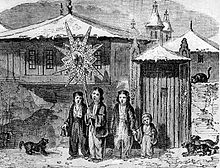 Child singers in Bucharest, 1841 The songs now known specifically as carols were originally communal folk songs sung during celebrations such as “harvest tide” as well as Christmas. It was only later that carols began to be sung in church. Traditionally, carols have often been based on medieval chord patterns,
Published: Dec 20, 2022
Latest Revision: Dec 20, 2022
Ourboox Unique Identifier: OB-1398256
Copyright © 2022

 Skip to content