






New World

Copyright © 2023
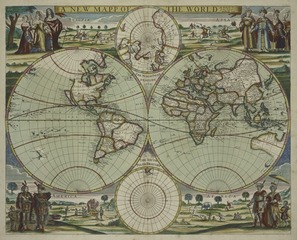
The term “New World” is used to describe the majority of lands of Earth‘s Western Hemisphere, particularly the Americas.[1] The term gained prominence in the early 16th century during Europe‘s Age of Discovery, after Italian explorer Amerigo Vespucci published the Latin-language pamphlet Mundus Novus, presenting his conclusion that these lands (soon called Americas based on Amerigo’s name) constitute a new continent.[2] This realization expanded the geographical horizon of earlier European geographers, who had thought that the world only included Afro-Eurasian lands. Africa, Asia and Europe thus became collectively called the “Old World” of the Eastern Hemisphere, while the Americas were then referred to as “the fourth part of the world”, or the “New World”.[3]
Australia and Antarctica are considered neither Old World nor New World lands, since they were only discovered by Europeans much later. They were associated instead with the Terra Australis that had been posited as a hypothetical southern continent.
Origin of term
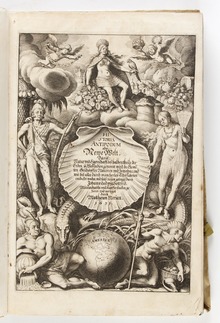
The Florentine explorer Amerigo Vespucci is usually credited for coming up with the term “New World” (Mundus Novus) for the Americas in his 1503 letter, giving it its popular cachet, although similar terms had nonetheless been used and applied before him.
Prior usage
The Venetian explorer Alvise Cadamosto used the term “un altro mondo” (“another world”) to refer to sub-Saharan Africa, which he explored in 1455 and 1456 on behalf of the Portuguese.[4] This was merely a literary flourish, not a suggestion of a new “fourth” part of the world; Cadamosto was aware that sub-Saharan Africa was part of the African continent.
Peter Martyr d’Anghiera, an Italian chronicler at the service of Spain, doubted Christopher Columbus‘s claims to have reached East Asia (“the Indies“),[citation needed] and consequently came up with alternative names to refer to them.[5] Only a few weeks after Columbus’s return from his first voyage, Martyr wrote letters referring to Columbus’s discovered lands as the “western antipodes” (“antipodibus occiduis”, letter of 14 May 1493),[6] the “new hemisphere of the earth” (“novo terrarum hemisphaerio”, 13 September 1493),[7] and in a letter dated 1 November 1493, refers to Columbus as the “discoverer of the new globe” (“Colonus ille novi orbis repertor”).[8] A year later (20 October 1494), Peter Martyr again refers to the marvels of the New Globe (“Novo Orbe”) and the “Western Hemisphere” (“ab occidente hemisphero”).[9]
In Columbus’s 1499 letter to the Catholic Monarchs of Spain, reporting the results of his third voyage, he relates how the massive waters of South America’s Orinoco delta rushing into the Gulf of Paria implied that a previously unknown continent must lie behind it.[10] Columbus proposes that the South American landmass is not a “fourth” continent, but rather the terrestrial paradise of Biblical tradition, a land allegedly known (but undiscovered) by Christendom.[11] In another letter (to the nurse of Prince John, written 1500), Columbus refers to having reached a “new heavens and world” (“nuevo cielo é mundo”)[12] and that he had placed “another world” (“otro mundo”) under the dominion of the Kings of Spain
Mundus Novus[edit]

The term “New World” (Mundus Novus) was coined in Spring 1503 by Amerigo Vespucci in a letter written to his friend and former patron Lorenzo di Pier Francesco de’ Medici, which was published in Latin) in 1503–04 under the title Mundus Novus. Vespucci’s letter contains the first explicit articulation in print of the hypothesis that the lands discovered by European navigators to the west were not the edges of Asia, as asserted by Christopher Columbus, but rather an entirely different continent that represented a “New World”.[3]
According to Mundus Novus, Vespucci realized that he was in a “New World” on 17 August 1501[14] as he arrived in Brazil and compared the nature and people of the place with what Portuguese sailors told him about Asia. A chance meeting between two different expeditions occurred at the watering stop at Bezeguiche in present-day Dakar, Senegal, as Vespucci was on his expedition to chart the coast of newly discovered Brazil and the ships of the Second Portuguese India armada, commanded by Pedro Álvares Cabral, were returning from India.
Having already visited the Americas in prior years, Vespucci likely found it difficult to reconcile what he had already seen in the West Indies with what returning sailors told him of the East Indies. Vespucci wrote a preliminary letter to Lorenzo, while anchored at Bezeguiche, which he sent back with the Portuguese fleet, which expressed a certain puzzlement about his conversations.[15] Vespucci ultimately was convinced while on his mapping expedition of eastern Brazil from 1501 to 1502. After returning from Brazil in the spring of 1503, Vespucci authored the Mundus Novus letter in Lisbon and sent it to Lorenzo in Florence, with the famous opening paragraph:[16]
In passed days I wrote very fully to you of my return from new countries, which have been found and explored with the ships, at the cost and by the command of this Most Serene King of Portugal; and it is lawful to call it a new world, because none of these countries were known to our ancestors and to all who hear about them they will be entirely new. For the opinion of the ancients was, that the greater part of the world beyond the equinoctial line to the south was not land, but only sea, which they have called the Atlantic; and even if they have affirmed that any continent is there, they have given many reasons for denying it is inhabited. But this opinion is false, and entirely opposed to the truth. My last voyage has proved it, for I have found a continent in that southern part; full of animals and more populous than our Europe, or Asia, or Africa, and even more temperate and pleasant than any other region known to us.
Published: Dec 1, 2023
Latest Revision: Dec 1, 2023
Ourboox Unique Identifier: OB-1521880
Copyright © 2023

 Skip to content