






by rin ben yshay
Copyright © 2024
Sukiyaki – Sakamoto Kyu (1963

Copyright © 2024
Sakamoto Kyu (坂本九), Originally born as Oshima Hisashi (大島九)was the 9th child of the Sakamoto family, born in Japan, December 10, 1941.
His name has a quit a pun in it.
Japanese use chinese characters as part of their writing system, and so since he was born as the 9th of his family – his parents used the chinese charater of ‘9’ to name him.
There are 2 ways to pronouce this chinese charater,
one is a specific and special and used as a person’s name, in this case – Hisashi
another is by the original way of pronounciation – kyuu.
And so, Oshima Hisashi, whos parents divorced later in his life, he took his mother’s last name and became Japan’s and the world most famous singer of the 60’s – Sakamoto Kyuu.
The 1940’s were a rough time for the world, and for Japan. Kyu had to run with 2 siblings and his mother from the ongoing war.
With such events shaping his childhood, he soon foun himself leaning towards music, and started learning guitar in high school. Soon he changed his coars to vocals.
at 16 he already joined a band – but as bandmates do, they kept fighting with eachother. eventually Sakamoto got his big breakthrough with his band in a music festival, but after another quarrel with his band – he left.
His solo career start with the iconic song – Ue wo Muite Arukou (上を向いて歩こう) which is so famouse, it takes only 2 keyboard typing on a japanese keyboard untill the dictionary automatically suggest you the name of this classic.
The song’s title translates to: Let’s keep walking while looking up – which is also the first line of the song:
Let’s continue walking/ while facing up/ so that the tears won’t drop.
The song holds very emotional lyrics, in a somewhat happy-poppy melody. But the voice of Sakamoto Kyu makes it all more moving.
Lyrics of the song in English:
I look up as I walk
so the tears won’t fall
remembering that spring day
on a night spent all alone
I look up as I walk
counting the stars with teary eyes
remembering that summer day
on a night spent all alone
Happiness lies above the clouds
Happiness lies up in the sky
I look up as I walk
so the tears won’t fall
I cry as I walk
on a night spent all alone
remembering that autnum day
on a night spent all alone
Sadness lies in the shadow of the stars
Sadness lies in the shadow of the moon
I look up as I walk
so the tears won’t fall
I cry as I walk
on a night spent all alone
The song can be interprated in sevral way:
it can feel like a long song – of someone who has gone through a break-up and is trying to hold on.
The official reasoning, or emotions, behind the lyrics, are of the composer – Ei Rokosuke, who was simply sad and frustrated in the time of the writing.
The reason for that is the Japanese struggle and large-scale demonstrations at that time, againts the U.S army occupational forces and presence, which were signing a security treaty with Japan at the time.
The anguish and sadness of those days, of Rokosuke returning home alone on that spring day, are the motive behind writing the lyrics.
Despite the ‘original’ ‘meaning’ of the song, which is much less known, the ability of Sakamoto Kyu to make this a heartfelt song is incredbile.
In his visit to Japan in 1963, Louise Benjamin of Pye Records, could not shake off from the immense popularity of the song, and decided to bring it back to England.
The song gained popularity in the UK, but as one might wonder – why and how did people in the UK enjoyed a song with such a long title in a foreign language?
They didn’t.
Louis Benjamin published the song under a more catchy Japanese title called ‘sukiyaki’ – after a favorite popular local dish, which is also familiar for the anglophone world.
At first, Pye records recorded an instrumental version of the song with Kenny Ball and His Jazzmen, but then the song became such a hit, and was released in its original version by HMV, and topped the charts of HMV’s no.6 most sold record at the time!
In 1963, Capitol Records of the US released Sakamoto’s song under the similar UK title, and it was a massive hit.
It sold over 1,000,000 copies and remained on top of the Billboard Hot 100 chart as no.1 for 3 weeks in June 1963.
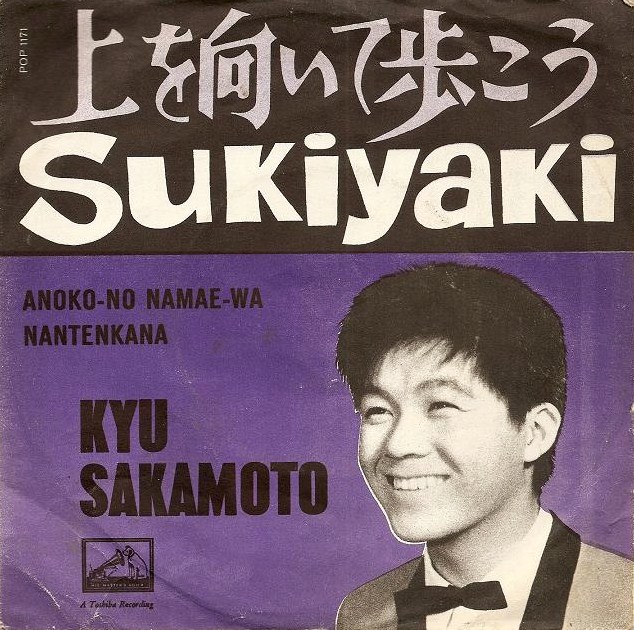
The song is an all-time classic now across the world and across languages
and was covered by:
KISS
John Denver & Sheena Easton
Sukiyaki as Performed by the World Famous Glenn Miller Orchestra
Bobby Vee
Japanese Artists Project (during covid)
It even had 2 Hebrew versions
one by IDF band in 1967
one by Meir Goldenberg in 1991
To conclude, the song ‘sukiyaki’ has and have a huge power all across the world, to bring solace, to squeeze up some optimism, and is always feeling relevant in times of crisis or despair.
This only shows what’s being referred to Japan’s ‘soft power’ – the ability to ‘conquer’ populations, other countries, not by the force of arms or weapons, but by the power of wonderful music, no matter the language.
Published: Mar 5, 2024
Latest Revision: Mar 5, 2024
Ourboox Unique Identifier: OB-1560720
Copyright © 2024

 Skip to content