






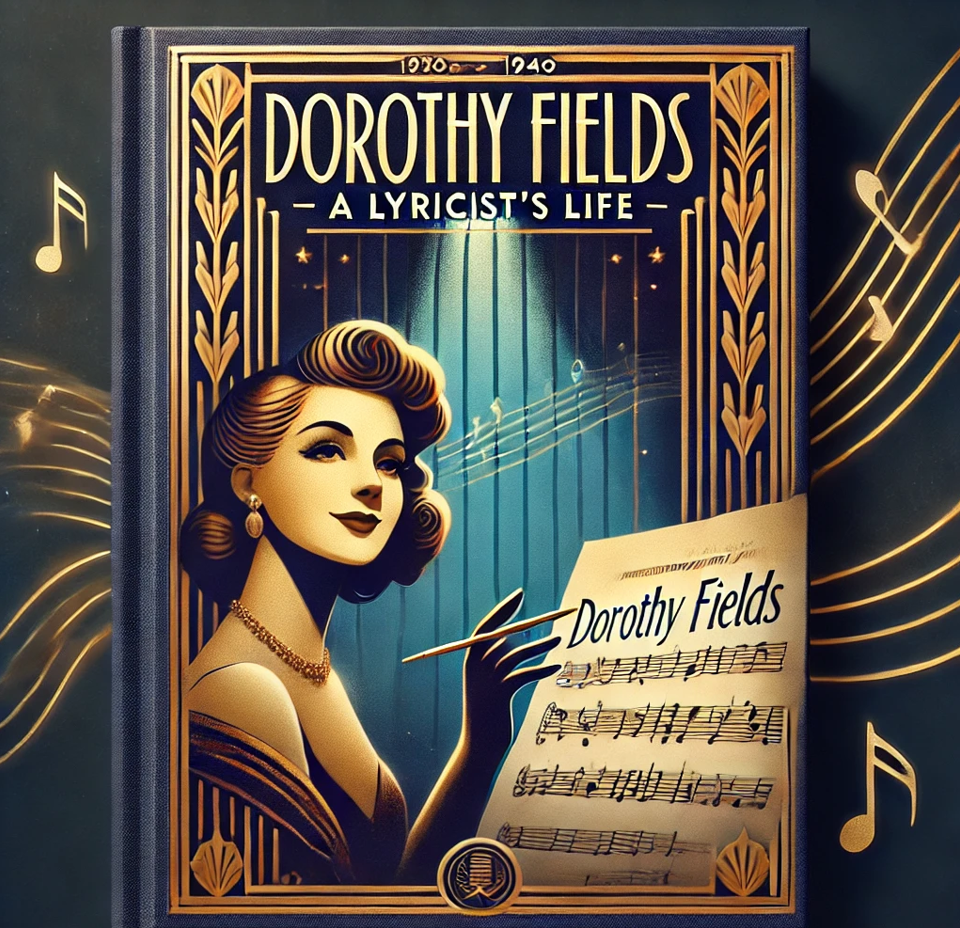
Who was Dorothy Fields?

Copyright © 2025
Dorothy Fields was an American librettist and lyricist. She wrote more than 400 songs for Broadway musicals and films.
Dorothy was born on July 15th 1904. She was the daughter of the hugely successful vaudevillian Lew Fields, and his wife Rose.
She had an elder sister Frances, and two older brothers Joseph and Herbert, who were both to become playwrights and provide the books for several successful musicals.
Lew Fields had become a theatrical producer and despite frequent financial crises, he and his family enjoyed a prosperous lifestyle with numerous servants in their large house on West 90th Street, Manhattan, and a summer home at Far Rockaway.
On leaving school, Dorothy was employed as a drama teacher, and contributed light verse to the column “The Conning Tower” in the New York World. In 1924 she married a doctor called Jack Wiener, but the marriage was a clear mistake from the start. At about the same time Dorothy met songwriter J. Fred Coots, and they wrote a few songs together.
Nothing was published, and according to Dorothy, her lyrics were poor, but the experience convinced her that she should try to develop a career in songwriting. This led to a fortuitous meeting with Jimmy McHugh who worked at Jack Mills Music.
The breakthrough came with the next revue, Delmar’s Revels, when Dorothy found her style in penning the easy, colloquial words for I Can’t Give You Anything But Love, Baby .
Although the song failed in that show, it was picked up in Blackbirds of 1928 and became a huge hit for Cliff “Ukulele Ike” Edwards.
Following Blackbirds, McHugh and Fields tried their hand at a book musical, Hello Daddy! . It starred Dorothy’s own daddy Lew, making his last appearance on Broadway. It was successful commercially but produced no lasting hit songs.
In the early 1930s, Hollywood was an irresistible magnet for top songwriters. Cinema was booming and bursting with confidence following the advent of the talkies, while popular theatrical entertainment was facing the dual threat of competition with movies, and the Depression.
During the decade McHugh and Fields wrote songs for over a dozen films. Despite being based in Hollywood, they also undertook several projects for Broadway revues. An amusing article from Popular Songs in 1935 interviews the pair at this time.
Significantly Dorothy branched out to begin working with other composers and most importantly, several collaborations with Jerome Kern.
Some of the Kern collaborations were for film operettas, a style which never suited Dorothy’s talents. However one film with Kern represents the summit of her Hollywood achievements – the glorious Swing Time, starring Fred and Ginger.
Back in New York, Dorothy was also back on Broadway with a new book musical, working with composer Arthur Schwartz. The show was Stars in Your Eyes and it had an impressive pair of stars in Ethel Merman and Jimmy Durante.
Her best-known pieces
“On the Sunny Side of the Street” (1930)
“The way you look tonight” (1936)
Lyrics to “The way you look tonight”
This classic was originally sung by Fred Astaire to Ginger Rogers in a comic situation in the film Swing Time; Ginger has been washing her hair in the shower and emerges to listen to Fred wrapped in a towel and with her hair full of suds. It’s still romantic however, as Ginger listens entranced, and it won Dorothy and Jerome Kern the Best Song Oscar in 1936.
Since then it’s become one of the most beloved romantic songs of all time with numerous performers naming it as their personal favorite love song.
Kern’s contribution is of course a major part of this. Dorothy Fields said “The first time Jerry played that melody for me I had to leave the room because I started to cry. The release absolutely killed me. I couldn’t stop, it was so beautiful.”
“A fine romance” (1936)
“Dont blame me” (1948)
“Big spender” (1966)
Lyrics to Big spender
The minute you walked in the joint,
I could see you were a man of distinction,
A real Big Spender,
Good looking, so refined.
Say, wouldn’t you like to know what’s going on in my mind?
So let me get right to the point,
I don’t pop my cork for every man I see.
Hey Big Spender,
Spend a little time with me.
Wouldn’t you like to have fun? Fun? Fun?
How’s about a few laughs? Laughs?
I can show you a good time,
Let me show you a good time.
The minute you walked in the joint,
I could see you were a man of distinction,
A real Big Spender,
Good looking, so refined.
Say, wouldn’t you like to know what’s going on in my mind?
So let me get right to the point,
I don’t pop my cork for every man I see.
Hey Big Spender,
Hey Big spender!
Hey Big spender!
Spend a little time with me.
This is a unique song. I can think of no other that even distantly resembles it.
It comes of course from the great 1964 stage musical Sweet Charity with music by Cy Coleman. It occurs early in the show, when we’ve met Charity but haven’t seen her colleagues, the Fan-Dango Ballroom dance hostesses, at work. Of course in the 1960s there was no such creature as a dance hostess; the girls should be prostitutes for the story to make sense. Anyway, Big Spender shows us these jaded ladies go through the motions of pretending to be turned on by and interested in the sorry losers who show up as their prospective clients. Ethan Mordden describes the number as “.. an exhibition piece for the Fan-Dango girls, posing and beckoning at a bar they hold, sit on, straddle, pet and all but make love to, while the music gets so merrily filthy that it does in sound what Fosse does in movement.”
The reference to Fosse reminds us what a huge impact he made with his staging of all the numbers in Sweet Charity, but Big Spender is also a great triumph for Coleman and Fields. From the six notes in the unforgettable vamp, and the first line of the lyric The minute you walked in the joint, the song grabs the listener’s attention. Unusually, Coleman and Fields worked at the piano together on this song, melody and lyric developing alongside one another.
Dorothy Fields’ celebrated skill in the use of colloquialisms is well on display in this lyric; her sure ear for contemporary speech is astounding for a woman in her sixties.
Published: Jan 19, 2025
Latest Revision: Jan 19, 2025
Ourboox Unique Identifier: OB-1641877
Copyright © 2025

 Skip to content