






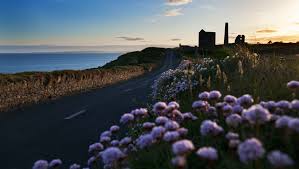
Ireland

Copyright © 2017
Tourism
There are three World Heritage Sites on the island: the Brú na Bóinne, Skellig Michael and the Giant’s Causeway. A number of other places are on the tentative list, for example the Burren, the Ceide Fields and Mount Stewart.
Some of the most visited sites in Ireland include Bunratty Castle, the Rock of Cashel, the Cliffs of Moher, Holy Cross Abbey and Blarney Castle. Historically important monastic sites include Glendalough and Clonmacnoise, which are maintained as national monuments in the Republic of Ireland.
Flora and Fauna
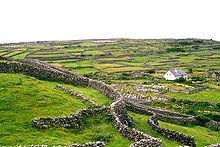
Because Ireland became isolated from mainland Europe by rising sea levels before the last ice age had completely finished, it has fewer land animal and plant species than Great Britain, which separated later, or mainland Europe. There are 55 mammal species in Ireland and of them only 26 land mammal species are considered native to Ireland.Some species, such as, the red fox, hedgehog and badger, are very common, whereas others, like the Irish hare, red deer and pine marten are less so. Aquatic wildlife, such as species of sea turtle, shark, seal, whale, and dolphin, are common off the coast. About 400 species of birds have been recorded in Ireland. Many of these are migratory, including the barn swallow.
Demographics
People have lived in Ireland for over 9,000 years. The different eras are termed mesolithic, neolithic, Bronze Age, and Iron Age.
Early historical and genealogical records note the existence of major groups such as the Cruthin, Corcu Loígde, Dál Riata, Dáirine, Deirgtine, Delbhna, Érainn, Laigin, Ulaid. Slightly later major groups included the Connachta, Ciannachta, Eóganachta.
Culture
Ireland’s culture comprises elements of the culture of ancient peoples, later immigrant and broadcast cultural influences (chiefly Gaelic culture, Anglicisation, Americanisation and aspects of broader European culture). In broad terms, Ireland is regarded as one of the Celtic nations of Europe, alongside Scotland, Wales, Cornwall, Isle of Man and Brittany. This combination of cultural influences is visible in the intricate designs termed Irish interlace or Celtic knotwork. These can be seen in the ornamentation of medieval religious and secular works. The style is still popular today in jewellery and graphic art, as is the distinctive style of traditional Irish music and dance, and has become indicative of modern “Celtic” culture in general.
Sports
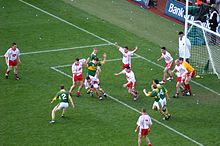
The island of Ireland fields a single international team in most sports. One notable exception to this is association football, although both associations continued to field international teams under the name “Ireland” until the 1950s. An all-Ireland club competition for soccer, the Setanta Cup, was created in 2005.
Many other sports are also played and followed, including basketball, boxing, cricket, fishing, greyhound racing, handball, hockey, horse racing, motor sport, netball, show jumping and tennis.
Other Sports
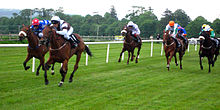
Horse racing and greyhound racing are both popular in Ireland. There are frequent horse race meetings and greyhound stadiums are well-attended. The island is noted for the breeding and training of race horses and is also a large exporter of racing dogs. The horse racing sector is largely concentrated in the County Kildare.
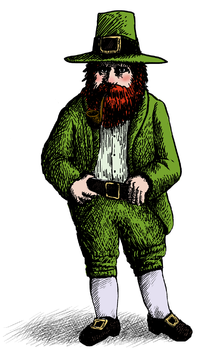
Leprechaun
A leprechaun is a type of fairy in Irish folklore. They are usually depicted as little bearded men, wearing a coat and hat, who partake in mischief. They are solitary creatures who spend their time making and mending shoes and have a hidden pot of gold at the end of the rainbow. If captured by a human, they often grant three wishes in exchange for their freedom. Like other Irish fairies, leprechauns may be derived from the Tuatha Dé Danann.[1] Leprechaun-like creatures rarely appear in Irish mythology and only became prominent in later folklore.
Published: Jan 16, 2017
Latest Revision: Jan 16, 2017
Ourboox Unique Identifier: OB-226467
Copyright © 2017

 Skip to content