






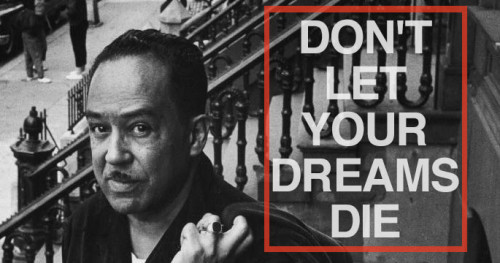
As I grew older

Copyright © 2017
As I grew older
It was a long time ago.
I have almost forgotten my dream.
But it was there then,
In front of me,
Bright like a sun—
My dream.
And then the wall rose,
Rose slowly,
Slowly,
Between me and my dream.
Rose until it touched the sky—
The wall.
Shadow.
I am black.
I lie down in the shadow.
No longer the light of my dream before me,
Above me.
Only the thick wall.
Only the shadow.
My hands!
My dark hands!
Break through the wall!
Find my dream!
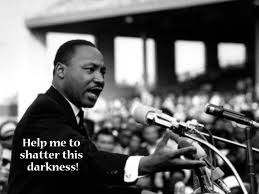
Help me to shatter this darkness,
To smash this night,
To break this shadow
Into a thousand lights of sun,
Into a thousand whirling dreams
Of sun!
The analysis
“As I Grew Older” contains a narrative about struggle and empowerment that shares thematic similarities with “Dreams” and “Harlem.”
In the beginning of the poem, the speaker recalls a dream he had long ago and had nearly forgotten, but now he can see it ahead of him once more. This is fairly straightforward symbolism – the speaker represents all African Americans who had to relinquish their dreams due to the pervasive discrimination and persecution in early 20th century American society. African American children may have experienced a few brief years of blissful ignorance (like the speaker), but they all eventually became aware of their status as second-class citizens – a wall of injustice that rises up to gradually block the sunlight. Just because the wall has risen up, though, it does not mean that the dream ceases to exist – the speaker simply cannot not see it anymore.
Hughes deliberately uses the symbol of a shadow as a way to actualize his character’s blackness, because the speaker’s race is the barrier that is keeping him from achieving his dream. When the narrator describes lying hidden in the shadows, Hughes invokes Ralph Ellison’s depiction of his African American narrator in Invisible Man (1952): “I am an invisible man. No, I am not a spook like those who haunted Edgar Allan Poe; nor am I one of your Hollywood-movie ectoplasms. I am a man of substance, of flesh and bone, fiber and liquids — and I might even be said to possess a mind. I am invisible, understand, simply because people refuse to see me.”
As the poem progresses, though, the speaker’s listlessness and apathy turns into determination and vigor, creating a shift of energy. The speaker forcefully commands his “dark hands” to break through the wall so he can access his dream. He is no longer willing to let it languish beyond his grasp. He wants to “shatter this darkness” and “smash this night.” Hughes uses this violent language to show that the speaker is suddenly empowered and feels no equivocation or anxiety about what he must do.
Langston Hughes life
Langston Hughes was born on February 1, 1902, in Joplin, Missouri. He published his first poem in 1921. He attended Columbia University, but left after one year to travel. His poetry was later promoted by Vachel Lindsay, and Hughes published his first book in 1926. He went on to write countless works of poetry, prose and plays, as well as a popular column for the Chicago Defender. He died on May 22, 1967.
James Mercer Langston Hughes was born on February 1, 1902, in Joplin, Missouri. His parents, James Hughes and Carrie Langston, separated soon after his birth, and his father moved to Mexico. While Hughes’s mother moved around during his youth, Hughes was raised primarily by his maternal grandmother, Mary, until she died in his early teens. From that point, he went to live with his mother, and they moved to several cities before eventually settling in Cleveland, Ohio. It was during this time that Hughes first began to write poetry, and that one of his teachers first introduced him to the poetry of Carl Sandburg and Walt Whitman, both whom Hughes would later cite as primary influences. Hughes was also a regular contributor to his school’s literary magazine, and frequently submitted to other poetry magazines, although they would ultimately reject him.
Hughes graduated from high school in 1920 and spent the following year in Mexico with his father. Around this time, Hughes’s poem “The Negro Speaks of Rivers” was published in The Crisis magazine and was highly praised. In 1921 Hughes returned to the United States and enrolled at Columbia University where he studied briefly, and during which time he quickly became a part of Harlem’s burgeoning cultural movement, what is commonly known as the Harlem Renaissance. But Hughes dropped out of Columbia in 1922 and worked various odd jobs around New York for the following year, before signing on as a steward on a freighter that took him to Africa and Spain. He left the ship in 1924 and lived for a brief time in Paris, where he continued to develop and publish his poetry.
My letter to Langston Hughes
Hi langston Hughes Iknow that you black peson and the wite– people behave bad with you like discrimination and recism prejudice Iadvice you to stay fight the the recism with the art ,the music , the poems and I believe that with the art you can do it ,I want to say to you never give up and achieve your dream .
My dream
I want to tell you about my dream.
my dream is so big and I can’t tell you about all fo it , because it’s so long , big and I want to keep deportment
from my dream secret .
first,I want to be big engineer and I want to have a company to me amd to my partners , I want to face any obstacle and destroy all the walls that face me too , I wish that i can do it , and I wish to any one have a dream to can do it .
thats what I can tell.
Published: Jan 23, 2017
Latest Revision: Feb 6, 2017
Ourboox Unique Identifier: OB-229608
Copyright © 2017

 Skip to content