






by Jason Arbour
Copyright © 2017
Samson v. Gideon

Copyright © 2017
A bit about Gideon –
Gideon was from the tribe of Manasseh, in the Abiezrite clan.
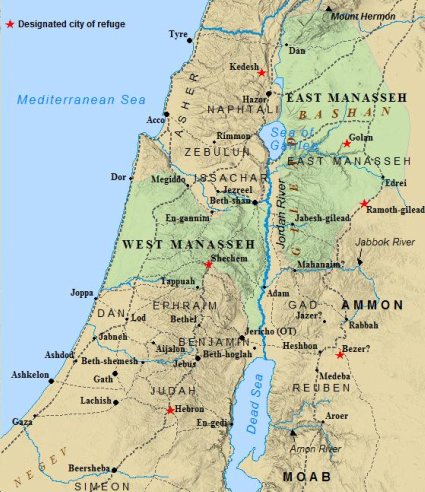
He was appointed after seven years of Midianite oppression by “An angel of the LORD” (Judges 6:11). He was trying to keep Midianites away from his father’s winepress when the angel appeared to him and told him that the LORD is with him. After Gideon questioned the LORD’s commitment to the nation of Israel, the LORD Himself appears and tells Gideon that he will be the instrument through which the LORD delivers Israel. Gideon questions Him, but is assured that G-D will be with him. Gideon asks for a sign of the LORD, and then goes to prepare an offering. When he brings it back, the angel instructs him to put it out on a rock, then touches the offering with his staff, and the offering is consumed in fire. The angel then disappears, which makes Gideon cry out, and G-D reassures him. Gideon then builds an altar and names it “Adonai-Shalom”.
The text does not list exactly the sins that the Israelites committed at the start but merely says that they did what was “offensive” to the LORD. Later on, the LORD says that He had commanded then not to worship the gods of the Amorites, but the Israelites had disobeyed Him. Likely they were worshipping Idols and forgetting the tenets of Judaism. Rashi makes an interesting note on the first verse of the chapter; saying that before this point it was always said that the Israelites “continued to do what was offensive to the LORD”. However, at this point, the Israelites are only said to have done what was offensive, not that they continued. Rashi explains this by saying that the song of Deborah and Barak ben Abinoam sang in chapter five redeemed the people of Israel, and they had just begun to sin again at the start of their Midianite oppression.
Gideon faced the enemy of the Midianites. They were not a very nice people.
The Midianites generally harassed the Israelites. After the Israelites planted a crop, the Midianites came after them and tore up the field. The Midianites also tore up crops that had already been planted, and they destroyed the ‘produce of the land all the way to Gaza”. They stole all the livestock of the land of Israel so that they left “no means of sustenance in Israel, not a sheep or an ox or an ass”. The “invaded” the land and “ravaged” it. “Israel was reduced to utter misery by the Midianites”.

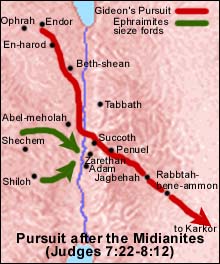
In Judges chapter 8, verse 5, Gideon announces that he is pursuing two kings of Midian, Zebah and Zalmunah.
We know that they had an army of about 15,000 in Gideon’s time, down 120,000 men that had been killed throughout the conflict. We know that they made camp east of Nobah and Jogbehah and that they took flight upon Gideon’s attack. We know that they worshipped the false god Baal-Peor (encyclopaedia Judaica volume 14), and that they made their living as shepherds or as traders. They also survived by periodically raiding the permanent settlements around them.
Gideon is for the most part a military leader, albeit a diplomatic one. He also is a leader who puts a lot of faith in G-D. For example, in Judges chapter 7 verse 2, G-D tells Gideon that there are too many Israelite soldiers so that it will not look like a miracle when they capture a city, and that Gideon should get rid of some of the soldiers. Gideon follows G-D and shrinks his fighting force from roughly 32,000 fighting men to an even 300 soldiers. Here, he is both making tactical military decisions as to how many soldiers to bring along, and also putting faith in G-D that He will provide the miracles enough to take the enemies they encounter. Gideon is making a great decision here, as not only is he following G-D, but he is also decreasing drastically the size of his army. This will make it much easier for them to move through the desert and support themselves when they are in pursuit of their enemies later on.
We also see Gideon as a military leader later on in chapter 7, in verses 15-25, when he leads his small fighting force to take the Midianite camp, eventually also capturing and beheading the Midianite princes Oreb and Zeeb. In this case, we also see his diplomatic ability, as Gideon sends out messages amongst the hill-country of Ephraim, gathering men to help his small forces.
We are then immediately treated to another example of Gideon’s diplomacy in the beginning of chapter 8, when the men of Ephraim become cross with Gideon. Gideon manages to calm their anger with surprisingly few words.
An Assyrian depiction of beheadings, like what was done to Oreb and Zeeb

Gideon is appointed by an angel, though he does not realise it until the angel makes a miracle happen and then disappears.
After Gideon speaks with G-D, he decides to prepare an offering the LORD. The man who told him that he was a judge instructs him to place the offering on a rock. The man then touches the rock with his staff and the offering is consumed by fire. The man proceeds to vanish, and Gideon discovers that he is an Angel.
Later on, Gideon wants a sign that G-D is truly with him, and asks G-D to perform a miracle. Gideon tells the LORD that he will place a wool fleece on the threshing floor and wait for the dew to collect. He asks G-D to make it so that the wool fleece is wet, but the floor is not. G-D does so.
Gideon then asks G-D to do the opposite, to make the floor wet but not the fleece, and G-D does so.
scroll sideways and downwards to see the whole image:
/about/GettyImages-91727817-5716e05a3df78c3fa2e6a333.jpg)
A picture of Samson and Delilah.
The role of women is much more prominent in Samson’s story

The only women mentioned in the story are Gideon’s wives and his concubine in Shechem.
The themes of attraction never really come up in Gideon’s story, though it is mentioned that he has many wives, who bore him seventy sons at least, plus a few from women who were not his wives. When the Israelites try and make Gideon their overlord, he relinquishes the power, saying that “the LORD alone shall rule over you” (Judges 8:23). Gideon is never shown to have much power, but mostly being a gentle, constant force. He never has great power over people, but always has great success. Those who do hold a large amount of power over others, the kings of Midian, are put to death.
Intermarriage is not dealt with at all. Assimilation is dealt with at the beginning and end of the story when the Israelites turn to the Ba’alites. Both times assimilation is spoken of poorly. At the beginning, they are punished with oppression from the Midianites and at the end, they forego G-D, “who saved them from all the enemies around them”.
Women do not play a role in this story.
Samson does very little explicit leadership in his story. He usually acts as a loner. The only Israelites mentioned in his story are his mother, his father, and his father’s household. He is certainly not a typical judge. This is in stark contrast to Gideon, who interacts often with other Israelites, and usually a large number of them at any one time. Samson avoids leadership pretty effectively, while Gideon actively takes on the role. Though Gideon does drop a number of his followers, it is for the tactical advantage of having G-D perform a miracle instead of leaving the conquering to the Israelites, and Gideon still wants to lead his people. As well, Gideon acts as a diplomat, cooling tensions with other groups. The only diplomacy Samson does is done in order to anger the Philistines. Gideon also pretty well completes the deliverance of the Israelites from his enemies (the Midianites), while Samson only starts the rebellion against the Philistines, leaving the rest of the job to others (not that his contribution was insubstantial).
Samson is very particular in his individuality, he acts as a lone soldier through his entire story and does not enlist the aid of others, even abandoning his parents for a short time while they are travelling together. Gideon however, spends his entire story dealing with other people. Whether it be an Angel, a Midianite city, a too-large Israelite army, or a tribe annoyed that they weren’t brought along for the fight, Gideon spends his time very much in the company of others. Another difference between the two is how they deal with G-D. Gideon seems to have very little faith, asking G-D for miracle after miracle to prove G-D’s commitment to the cause. Samson meanwhile, has a terrific relationship with G-D, being given back his inhuman strength, despite having cut his hair.
Gideon achieves relatively more, actually conquering his enemy. Samson does kill a very large number of his enemy, including any of the important people that were going to be present for his execution, including “all the lords of the Philistines” and at least three thousand commoners. Gideon also manages to kill two kings of the Midianites, as well as their entire poulation.
Commentaries say that Gideon was lame in both feet, but when imbued with the spirit of G-D, “he could step with one stride from Zoreah to Eshtaol”. Commentaries also say that he took his Nazirite vows extremely seriously, absolutely never taking the LORD’s name in vain. He took his vows so seriously that his identity as a Nazirite was so clear that Delilah knew he was a Nazir immediately upon seeing him.
An interesting commentary says the following:
The angel who told Samson’s mother that he would be a Nazir knew that Delilah would have him break his vows, but his mother did not. This is why when she repeats the blessing that “the boy is to be a Nazirite to God from the womb,” she added her own, “to the day of his death”. This shows that the heavenly bodies already knew that Samson would fall weakness to something, perhaps why he was only instructed to begin the deliverance, and never to finish it.
In his death, Samson shows his unconventionality as a Judge, praying for revenge on those who hold him and not for fortune for the nation of Israel, like most other judges. Perhaps another reason he would not complete the divine mission, but only begin the fight against the Philistines, while conventional Judges like Gideon would complete their missions.
Gideon is also a very pious man. While Samson is so observant that commentaries constantly mention how he never mentioned the LORD’s name in vain, Gideon constantly turns down the Israelite monarchy, telling the Israelites that G-D alone will rule them.
An artist’s depiction of Samson – scroll around to see the whole picture:

Published: Mar 31, 2017
Latest Revision: Mar 31, 2017
Ourboox Unique Identifier: OB-282097
Copyright © 2017

 Skip to content