






by noor neta yael orin
Copyright © 2017
Women received the right to vote in the United States

Copyright © 2017
“Men, their rights, and nothing more. Women,their rights, and nothing less.”
By Susan B.Anthony

During America’s early history as a nation, women were denied some of the key rights enjoyed by male citizens. For example, a married women couldn’t own property and had no legal claim to any money they might earn, and no female had the right to vote.
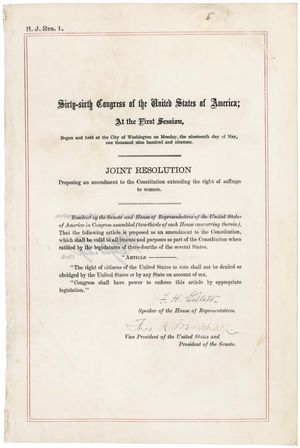
On August 18, 1920, the 19th Amendment to the U.S. Constitution granted American women the right to vote.
” The right of citizens of the United States to vote shall not be denied or abridged by the United States or by any State on account of sex.
Congress shall have power to enforce this article by appropriate legislation.” (Direct quote)
Who led to the revolution?
In America at the time when women started to fight for their rights a lot of organizations were established.
Most of this organizations were managed by women.
All of those organizations contributed to the adding of the 19th Amendment to the U.S. Constitution.
These organizations Organized and carried out a large number of protests.
they Produced and hung posters around the cities with slogans that carried there direct messages to the goverment about the unjustice and inequality between the sexes.
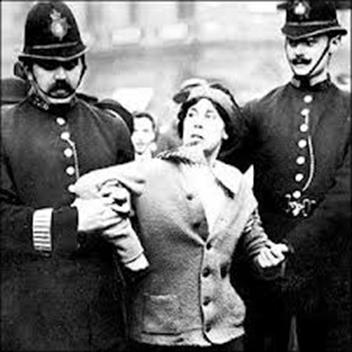
The majority of the public Imagined the drive of women to vote as a a small, poor ambition lead by group of women who persisted against the odds until men finally “gave” them the right vote. Nothing could be further from the truth.
The mass movement encompassed and included thousands of women and there “small and poor” ambition changrs the the lives of several generations of American women.
On Election Day in 1920, millions of American women exercised their right to vote for the first time. It took activists and reformers nearly 100 years to win that right, and the campaign was not easy: Disagreements over strategy threatened to cripple the movement more than once. But on August 26, 1920, the 19th Amendment to the Constitution was finally ratified, enfranchising all American women and declaring for the first time that they, like men, deserve all the rights and responsibilities of citizenship.
- The campaign for women’s suffrage began in earnest in the decades before the Civil War. many American women were beginning to chafe against what historians have called the “Cult of True Womanhood”: that is, the idea that the only “true” woman was a pious, submissive wife and mother concerned exclusively with home and family. Put together, all of these contributed to a new way of thinking about what it meant to be a woman and a citizen in the United States. In 1923, the National Women’s Party proposed an amendment to the Constitution that prohibited all discrimination on the basis of sex. The so-called Equal Rights Amendment has never been ratified
In 1848, a group of abolitionist activists–mostly women, but some men–gathered in Seneca Falls, new york to discuss the problem of women’s rights. (They were invited there by the reformers Elizabeth cady stanton and lucretia mott.) Most of the delegates agreed: American women were autonomous individuals who deserved their own political identities. “We hold these truths to be self-evident,” proclaimed the Declaration of Sentiments that the delegates produced, “that all men and women are created equal, that they are endowed by their creator with certain inalienable rights, that among these are life, liberty, and the pursuit of happiness.” What this meant, among other things, was that they believed women should have the right to vote.
This animosity eventually faded, and in 1890 the two groups merged to form the National American Woman Suffrage Association. (Elizabeth Cady Stanton was the organization’s first president.) By then, the suffragists’ approach had changed. Instead of arguing that women deserved the same rights and responsibilities as men because women and men were “created equal,” the new generation of activists argued that women deserved the vote because they were different from men. They could make their domesticity into a political virtue, using the franchise to create a purer, more moral “maternal commonwealth.”
Starting in 1910, some states in the West began to extend the vote to women for the first time in almost 20 years. ( Idaho and Utah had given women the right to vote at the end of the 19th century.) Still, the more established Southern and Eastern states resisted. In 1916, NAWSA president Carrie Chapman Catt unveiled what she called a “Winning Plan” to get the vote at last: a blitz campaign that mobilized state and local suffrage organizations all over the country, with special focus on those recalcitrant regions. (Meanwhile, a splinter group called the National Women’s Party focused on more radical, militant tactics–hunger strikes and White House pickets, for instance–aimed at winning dramatic publicity for their cause.)
World War I slowed the suffragists’ campaign but helped them advance their argument nonetheless: Women’s work on behalf of the war effort, activists pointed out, proved that they were just as patriotic and deserving of citizenship as men, and on August 26, 1920, the 19th Amendment to the Constitution was finally ratified.
answear the following questions :
-
Who was the Suffrage organization’s first president?
-
when did woman got the right to vote?
-
when did the Amendment to the Constitution was finally ratified?
-
when did the states in the West began to extend the vote to women for the first time?
-
what did the American women declared?
Published: Dec 7, 2017
Latest Revision: Dec 7, 2017
Ourboox Unique Identifier: OB-392270
Copyright © 2017

 Skip to content