






by Jeffrey Jones
Copyright © 2018
Strategic Change

Copyright © 2018
Overview:
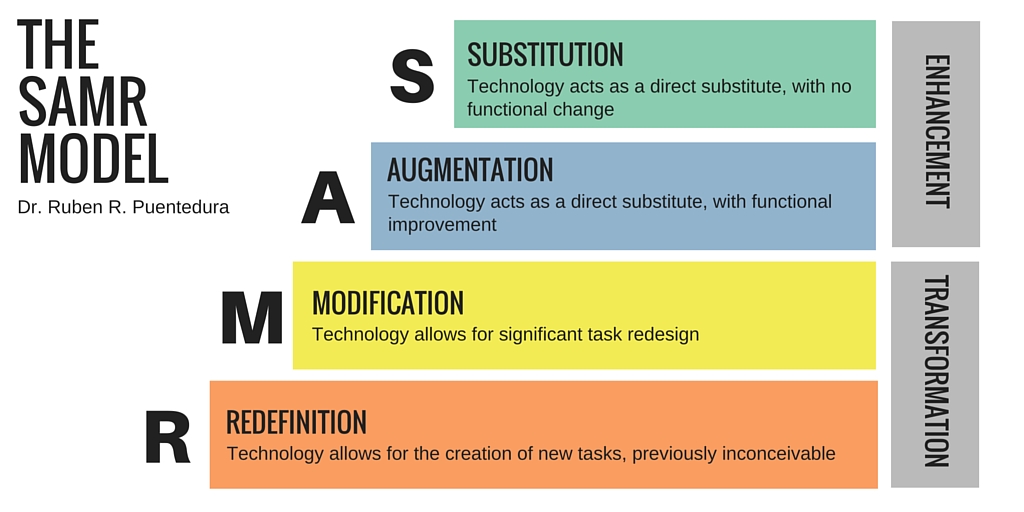
Monte Vista Christian School (MVCS) was the first in the world to implement a 1:1 iPad program. However many teachers at the school are using the available technology as a mere substitute for old ways of doing things. For example, instead of having students take notes on paper, they use Notability. Instead of reading from a hard copy, students read from digital books. Instead of turning assignment in at the teacher’s desk, students submit work digitally. While the school markets itself as a place of innovation, this has done little to help students develop and hone 21st century skills. In the current environment, students are largely passive consumers of content while teachers are the primary information source (“the sage on the stage”). Students listen to lessons and take notes, while teachers orally dispense data.
Guideline 1: Identify a new mission or a need for reform within the school.
Following the SAMR model, MVCS teachers will use technology tools to modify and redefine classroom activities in order to (1) move the classroom learning experience from a teacher-centered model to student-centered one, and (2) help learners develop 21st century skills and become active creators of content.
Guideline 2: Seek support for educational change.
The middle school and high school principals will lead an effort to help teachers use technology tools to support a shift toward a student-centered classroom. First, they will research technologies that promote the 4Cs and identify model schools (such as Bulldog Tech) that implement student-centered pedagogies (such as PBL) with technology. Second, they will identify innovative teachers who can lead workshops on specific technologies, learning spaces, and pedagogical strategies. Third, they will offer professional development training to interested teachers by sending them to edtech conferences (e.g., Silicon Valley CUE) and/or to visit model schools.
Guideline 3: Create and communicate a model of the change effort.
June 2018 – End of year inservice week
- The principals will present research supporting (1) the need to move away from a passive learning model (tradition lectures, note-taking, and multiple-choice tests) to active learning models (problem-based, project-based, inquiry-based learning, etc.), (2) the necessity of developing 21st century skills for the future workplace, and (3) the movement of universities away from the traditional lecture.
- Some of the identified innovative teachers will offer workshops on a variety of technology tools that can used to demonstrate the redefinition (R in the SAMR model) of classroom activities that also promote the 4Cs (creativity, communication, collaboration, and critical thinking).
- Faculty will be encouraged to pick at least one tool to explore over the summer break.
August 2018 – Beginning of year inservice week
- A representative from an outside organization (such as BIE) will lead a 3 day professional development seminar on technology-supported constructivist learning models.
- Each instructor will develop one unit that (1) utilizes technology tools to redefine classroom activities, (2) allows learners to generate shareable content, and (3) promotes 21st century skills to be implement in the 1st semester.
August-December 2018
- The principal will schedule a visit to the classroom during the selected unit and a follow-up debrief with each faculty member.
- Grade-level teams (for middle school) and subject-area teams (for high school) will meet once a month on Friday afternoons to share ideas, stories, and struggles, and identify areas needed for additional support and training.
- The principals will collect feedback from team representatives to learn how to best serve the instructors.
October 2018 – Quarter 1 inservice
- The principals will lead a faculty-wide debrief on the progress of change, providing motivation, support, and encouragement.
- Both success and failure stories will be shared by individual teachers.
December 2018 – Quarter 2 inservice
- The principals will report on the progress made in the first semester.
- Each instructor will develop a second unit that (1) utilizes technology tools to redefine classroom activities, (2) allows learners to generate shareable content, and (3) promotes 21st century skills to be implement in the 1st semester.
- Ambitious instructors will be challenged to create a technology-supported interdisciplinary project to be completed during the second semester.
January 2019-June 2019
- The principal will schedule a visit to the classroom during the selected unit and a follow-up debrief with each faculty member.
- Grade-level teams (for middle school) and subject-area teams (for high school) will meet once a month on Friday afternoons to share ideas, stories, and struggles, and identify areas needed for additional support and training.
- The principals will collect feedback from team representatives to learn how to best serve the instructors.
June 2019 – End of year inservice week
- The principals will recap the progress made during the year, identifying areas of success as well as places where learning occurred through failure and struggle.
Guideline 4: Secure needed resources.
MVCS has an abundance of technology resources. Each student has an iPad. The school has two computer labs (one Mac and one PC), a green room for video-creation, a makerspace room, Minecraft Education Edition on the computers in the PC lab, Apple TVs in every room, and 6 VR headsets. The primary resource needed is funding to (1) bring in outside PD training, (2) compensate innovative teacher for putting in extra time, and (3) send interested teacher to conferences and model schools.
Guideline 5: Acknowledge the emotional reaction to change.
Many teachers, especially those who have decades of experience, are reluctant to change and default to “the way they’ve always done it.” To press through this reluctance, the principals will provide (1) research-based motivation for a pedagogical shift, (2) ongoing training and support (from outside professional development to modeling and instruction from innovative teachers, etc.), and (3) space for sharing successes and struggles. It will be communicated regularly that “we are all in this together” and we are moving this direction not because it is easy but because it is best for our students.
Guideline 6: Anticipate restructuring problems and identify problem-solving skills.
Any time an organization pushes for change, problems are bound to arise.
Problem: Assessment – Teachers operating from a traditional model had the end-of-unit test as the way to assess learning. With a shift to a focus on 21st century skills, some may not know how to assess learners in this regard.
Solution: As part of the beginning of year professional development, teachers will receive training in formative assessment as well as the paradigm for assessment offered by Lee Crockett in his book Mindful Assessment. Assessment that only requires the recall of facts demonstrates a lower-order skill. Assessment that is linked with creation of content and analysis of data is a higher-order skill.
Problem: Classroom Management – Teachers operating from a traditional model could easily identify disruptive behavior, for instance, when a student speaks out of turn. With a student-centered model, the classroom may have a higher noise level. This may be difficult for some teachers to manage.
Solution: As part of the beginning or year professional development, teachers will receive training in productive group work. Innovate teachers can also provide workshops on classroom management technology tools.
Guideline 7: Share the leadership.
The principals will work closely with innovative teachers and meet regularly with team representatives to monitor and encourage progress.
Guideline 8: Anchor the innovation as quickly as possible to the classroom practice.
After the professional development seminar, instructors will be required to create one unit of instruction each semester that implements innovative technology and practices. Principals will schedule visits and follow up meetings to discuss how things went and offer support. At team meetings, instructors will be able to share stories, strategies, and struggles with one another whereby individual teachers can hear about what works well and what doesn’t.
Guideline 9: Embed the renewal effort and process into organizational practice.
The implementation of the renewal effort will be evaluated through classroom observations and teacher evaluations. The primary formal interaction between principal and instructor will revolve around the strides being taken to implement the strategic changes. At end of quarter inservices, model teachers will be put forth as exemplars in front of colleagues.
Published: Feb 20, 2018
Latest Revision: Feb 20, 2018
Ourboox Unique Identifier: OB-434373
Copyright © 2018

 Skip to content