






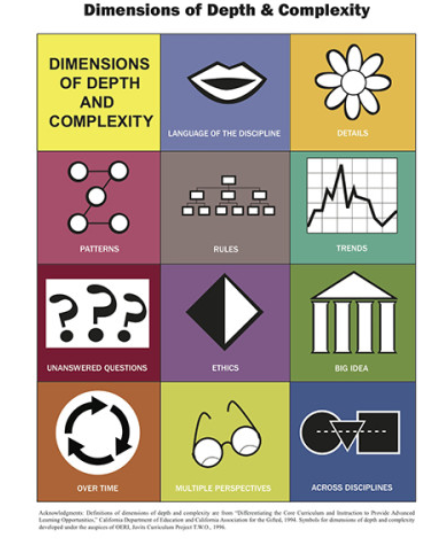
DEPTH AND COMPLEXITY

Copyright © 2018
LANGUAGE OF THE DISCIPLINE
Refers to terminology, nomenclature, jargon of the topic.
What tools are used by the experts in the discipline?
What are the origins of new terms in this discipline?
DETAILS
What details define?
What details are more important than others and what is your experience of this?
What distinguishes this from other things?
What are its attributes?
What features characterize this?
Examples: Features, Characteristics, Time, Atoms, Cells
ETHICS
Describe the ethical issues you find?
How did or does an ethical issue affect the information you are studying?
Why are their different ethical issues in different times and places?
What are some universal ethics and values?
Examples:
Experimental bias
Coincillence
Disagreements among experts
Good vs Bad Research
TRENDS
Describe the trends
Identify the causes and results of a trend
How do you evaluate a trends importance to what you are studying?
How are trends related to patterns?
Examples:
Research trends
Finanial support
Environmental Trends
Space Exploration
Health Trends
RULES
Describe the rules
Indentify the implicit and explicit rules
How do you evaluate rules efficiency and validity?
How are rules related to patterns and details?
Compare structural rules and procedural rules
Examples:
Scientific Method
Measurement
Data Collection
BIG IDEA
List the evidence needed to support a big idea
How do you evaluate a big ideas importance to what you are studying?
How does working with big ideas help you learn new knowledge?
Examples
Law, Theories, Principles
Engergy
Gravity
Waves
Light
MULTIPLE PERSPECTIVES
Describe the multiple perspectives on an issue or topic
Identify a different point of view and explain it
How does a point of view affect what we learn?
What perspectives do experts have?
When is you perspective different from others? Why?
Examples
Perspectives of different experts
Points of view on problems and issues
Ethical issues
OVER TIME
Describe the past, present, and possible future related to this issue or topic
Identify a time this issue or topic was different
How does knowing things over time affect what we learn?
How is history being made every day? How does this help us predict the future?
EXAMPLES
Time as related to scientific rules
Formulas
Scientific innovation
PATTERNS
Describe patterns you find
How do you evaluate a pattern’s importance to what you are studying?
How does one pattern compare to another?
Identify the primary patterns and the secondary patterns
How are patterns and details related?
EXAMPLES
DNA
Periodic table
Biological Solutions
Molecules
Crystals
UNANSWERED QUESTIONS
Describe the unknown details or stimuli for the event
Identify the origins of an unanswered question
How do you evaluate an unanswered question’s importance
How do you determine if, in fact, a question is unanswered?
Which areas of science or human behavior can you connect with unanswered questions?
EXAMPLES
Experimentation
Ethical Implications
The Future
Solution to current problems
Unintended consequences
ACROSS DISCIPLINES
Describe a topic’s place in more than one discipline or subject area
Sort information you are studying into several disciplines
How is “across disciplines” related to multiple perspectives?
What is concillience
EXAMPLES
Origins of laws, theories
Communicating research findings
Quantities, mearsuments and tools
Published: Nov 9, 2018
Latest Revision: Nov 9, 2018
Ourboox Unique Identifier: OB-527683
Copyright © 2018