






Why Scientists Get Things Wrong

Copyright © 2019
Scientists do science, but what is science?
From Wikipedia: Science (from the Latin word scientia, meaning “knowledge”)[1] is a systematic enterprise that builds and organizes knowledge in the form of testable explanations and predictions about the universe.[2][3][4]
2
I like this definition better: the intellectual and practical activity encompassing the systematic study of the structure and behaviour of the physical and natural world through observation and experiment.
3
Now we can talk about how we define a scientist:
From Wikipedia: A scientist is someone who conducts scientific research to advance knowledge in an area of interest.[1][2]
4
That’s a problematic definition, as someone who isn’t doing active research (like me) would cease to be a scientist. Secondly, what is knowledge and how do you advance it? Thirdly
5
Or perhaps this definition:
a person who is studying or has expert knowledge of one or more of the natural or physical sciences
According to this second definition, I am still a scientist. But againa, what is expert knowledge?
6
I was a scientist for over forty years. And although I am not a ‘practicing scientist’ any more, I still think like a scientist. What do scientists do?
Scientists observe things. They ask questions. Then they try to answer them. They form hypotheses. And then they look for ways to test them.
7
During my career I met two senior scientists who had students who fabricated results. Scientists who cheat and make up data are rare. But they do exist. In addition I personally knew a scientist who was exposed for falsely claiming to have received a Ph.D. degree.
8
He wrote many articles whose veracity has since been in doubt.
9
But there are many factors that prevent scientists from being objective.
Firstly we are all human beings. We can’t directly observe everything. We don’t hear very high or very low frequences, we can’t see infra red radiation, we can’t smell with the acuity of a dog, etc.)
Secondly, success comes with rewards – a salary, glory, fame and recognition, promotions, royalties on inventions. And it’s hard to be objective when what you do is putting bread on your table.
10
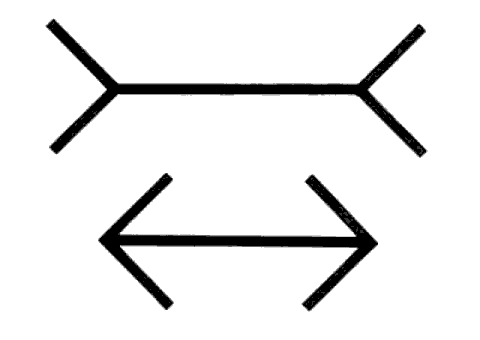
As human beings we make simple mistakes, even when we know. There are many riddles that confound us. We know that both lines are equivalent in the Muller-Lyer test, but one stills seems longer, not matter what we do. There are hundreds of visual illusions.
11
12
Scientists have opinions, dogmas and gut feelings. They are subject to the same foibles as everyone else. They think according to the same Sytem 1 and System 2 as everyone else. They jump to conclusions. They are humans.
14
Scientists tend not to repeat their own experiments and certainly not those of others. They make sweeping generalization based on limited foundings. They select the best data and call them ‘typical’. They ignore results that they do not understand. They are generally poor statisticians. And they tend to believe in the data that supports their hypotheses and dogmas.
15
Published: Jun 15, 2019
Latest Revision: Jun 15, 2019
Ourboox Unique Identifier: OB-652189
Copyright © 2019

 Skip to content