






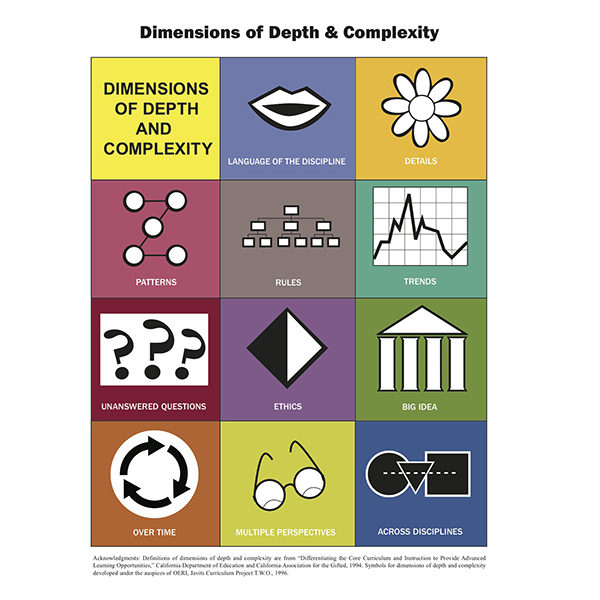
Depth and Complexity

Copyright © 2019
8 Elements of Depth and 3 Elements of Complexity
Trends
Patterns
Ethics
Rules
Details
Language of the Discipline
Unanswered Questions
Big Idea
Across Disciplines
Multiple Perspectives
Over Time
Trends
Describe the trends.
Identify the causes and results of a trend.
How do you evaluate a trend’s importance to what are you studying?
How are trends related to patterns?
How (and when) does a fad become a trend?
*describe
*compare and contrast
*identify relationships
*categorize/classify
*judge w/criteria & prove w/evidence
~general directions, tendencies, current styles, drifts, influences, changes over time
“One trend is _____”, “One effect is _____”, “The ongoing influence of ____ affected ____ by_____”
Patterns
Describe the patterns you find.
How do you evaluate a pattern’s importance to what you are studying?
How does one pattern compare to another?
Identify the primary patterns and the secondary patterns.
How are patterns and details related?
*describe
*define cause and effect
*prioritize
*category/classify
*determine relevance
~predictive, able to be replicated, cycles, motifs, repetitive, made up of details, person-made and natural designs, recurring elements
“One repeat is ____”, “One reoccurring ____ in ____ is ___.”, “One prediction is ____.”
Ethics
Describe the ethical issues you find.
How did/does an ethical issue affect the information you are studying?
Why are there different ethical issues in different times and places?
What are some universal ethics or values?
How do ethics get developed?
How does a culture teach/transmit its ethics?
*determine bias
*prioritize
*identify relationships
*determine relevance
*judge w/criteria
*distinguish fact from opinion/fantasy
*test assumptions
~controversies, dilemmas, biases, prejudices, decision-making, principles of “right” behavior, a set or theory of moral values, philosophies, metaphysics, professional rules or standards, value-laden ideas
“One controversy is ____”, “One example of prejudice is ____”, “One ethical consideration regarding _____ is _____.”
Rules
Describe the rules.
Identify the implicit and explicit rules.
How do you evaluate rules’ efficiency and validity?
How are rules related to patterns and details?
Compare structural rules and procedural rules.
*describe (the rules)
*identify relationships (among rules)
*categorize/classify
*prioritize
*differentiate fact from opinion and fact from fantasy & conjecture
*determine relevance
*judge w/criteria (the importance of a set of rules)
~standards, related to structure, authoritative directions for conduct or procedure, usual courses of action or behavior, statements of truth, methods, organizational elements
“The rule is ___”, “The order is ____.”, “The order used to ____ is _____.”, “_____ is made by _____.”
Details
What details define ____?
Which details are more important than others and what is your evidence of this?
What distinguishes this from other things?
What are its attributes?
What features characterize this?
*describe
*prioritize
*note ambiguity
*category/classify
*determine relevance
*sequence the details
*select details to determine bias or absence of bias
~clues, facts, features, data, ideas, traits, items, parts, particulars, specifics, elements, factors, attributes
“One ____ is _____.”, “The ____ of _____ are _____.”, “The evidence is _____.”, “The factors are _____.”
Language of the Discipline
What words are specific to the work in this discipline?
What tools are used by the experts in this discipline?
What are the origins of new terms in this discipline?
*identify/list/define the terms
*prioritize
*identify relationships
*categorize the terms or tools
*judge w/criteria
*distinguish appropriateness of usage of the terminology
*determine relevance
~terminology, nomenclature, lexicon, tools of the discipline, combinations and patterns of terms, jargon, idiom, signs & symbols, figures of speech, eponyms & neologisms of discipline
“The words is _____.”, “The specialized language used to describe _____ includes ______.”,”The skills/tools are ____.”
Unanswered Questions
Describe the unknown details or stimuli for the event.
Identify the origins of an unanswered question.
How do you evaluate an unanswered question’s importance?
How do you determine if, in fact, a question is unanswered?
Which areas of science or human behavior can you connect with unanswered questions?
*describe/state
*note ambiguity
*distinguish fact from fiction/opinion
*formulate questions
*problem solving
*identify missing information
*test assumptions
*prove w/evidence
~a puzzle, a conundrum, unsolved, an unknown, something unexplained, a dilemma, doubtful or uncertain
“The question I have is _____.”, “The things that do not match are ____.”, “The missing information is _______.”, “The unknown/unproven/unresolved ____ regarding ____ is _____”
Big Idea
List the evidence needed to support a big idea.
How do you evaluate a big idea’s importance to what you are studying?
How does working with big ideas help you learn new knowledge?
How are patterns, trends, and rules related to big ideas?
*describe (the big idea)
*infer a big idea from supporting evidence/information
*categorize/classify big ideas
*identify relationships (among big ideas)
*determine relevance
*judge w/criteria (the importance of a big idea)
~generalizations, related to many instances, developed from many facts, overarching, related to global or universal themes, principles, law, theories
“One main idea is ____.”, “One general statement is ____.”, “One theme is _____”, “The theory/theorem/formula _____ is _____.”
Across Disciplines
Describe a topic’s place in more than one discipline or subject area.
Sort information you are studying into several disciplines.
How is “across disciplines” related to “multiple perspectives”?
How do experts in a discipline learn from experts in other disciplines?
What is consilience (and who is E.O. Wilson)?
*describe the topic in terms of different disciplines
*prioritize various subject areas’ importance to the topic
*identify relationships (among information from different disciplines)
*judge with criteria (the various points of view)
*compare & contrast info (from various disciplines)
~multidisciplinary, interdisciplinary, connections among disciplines, touching on many subjects at once
“An example in (math, science, social studies, language arts) is _____.”, “_____ is important because _____”, “One common idea is ____”, “_____ is related to ____ in the field/area of ____ in that ____”
Multiple Perspectives
Describe the multiple perspectives on an issue or topic.
Identify a different point of view and explain it.
How does point of view affect what we learn?
What perspectives do experts have?
When is your perspective different from others? Why?
*describe (the perspectives)
*prioritize (the most important perspectives)
*identify relationships (among perspectives)
*determine relevance of various points of view
*judge with criteria (the various points of view)
~different points of view, ways of seeing and reporting things, often dependent on time & place, different slants, affected by roles & responsibilities
“Another idea is _____”, “One different perspective is ____”, “An opposite idea is _____”, “______ would view this situation differently from _____ in that ____.”
Over Time
Describe the past, present, and possible future related to this issue or topic.
Identify a time that this issue or topic was different.
How does knowing things over time affect what we learn?
How is history being made every day? How does this help us predict the future?
*describe the topic over time
*judge with criteria
*identify relationships of a topic and different time periods
*determine relevance of knowing this topic over time
*differentiate fact from opinion (over time)
~looking at past, present, & future, applying something historic to present knowledge, predicting something based on present knowledge, applying from the past to the present, noting change
“One change/modification is _____.”, “Now people think _____.”, “Elements/ideas that have not changed in _____ from ____ to ____ are ____.”, “Our prediction about the future is _____.”
Published: Jul 31, 2019
Latest Revision: Jul 31, 2019
Ourboox Unique Identifier: OB-667915
Copyright © 2019

 Skip to content